
Utility contract management is the day-to-day control of your electricity, gas and water contracts once they’re signed. It means keeping accurate contract records, checking every bill against the agreed rates, handling changes at your sites and making sure each contract delivers what you agreed until it ends.
Signing a good deal is only half the job. A lot of value is lost after signing, through billing errors, unrecorded site changes and contracts nobody is watching. This guide shows you how to build a simple utility contract strategy and run it week to week. Ready to act rather than read? Our team can check your contracts as part of a free business energy review.
Compare, switch and save today
Compare business energy, water and telecoms quotes from leading UK suppliers in minutes. It’s free, there’s no obligation, and it takes about a minute.
| Part of the job | What it involves | How often |
|---|---|---|
| Contract register | One record of every supply, rate and end date | Update with every change |
| Bill checking | Each invoice checked against the contract and meter reads | Every bill |
| Change control | New sites, closed sites, meter and capacity changes logged with the supplier | As they happen |
| Strategy review | Costs, usage and upcoming end dates reviewed | Twice a year |
What is utility contract management?
Utility contract management is the ongoing control of a utility contract between signing and the end of the term. It applies to every supply you pay for, from business electricity to gas and water. Ofgem’s guidance for business customers explains the contract types and protections that apply.
It sits in the middle of the contract journey: after you buy and negotiate the contract, and before you decide whether to renew. For how all the stages fit together, see utility contract lifecycle management.
Day to day, utility contract management covers four jobs:
- Keeping records: supplier, meter numbers, rates, start and end dates, notice period.
- Checking bills: comparing every invoice with the contract and your meter reads.
- Controlling changes: new sites, closed sites, meter changes and capacity changes.
- Reviewing the strategy: making sure your contracts still fit your budget and sites.
Why does utility contract management matter?
Because most avoidable utility costs come from contracts nobody is actively managing.
- Billing errors go unnoticed. Estimated reads, wrong rates and wrongly applied charges add up month after month if nobody checks.
- Site changes aren’t passed on. A closed unit or a reduced supply capacity keeps costing money until the supplier is told in writing.
- End dates are missed. Without a register, contracts can drift onto expensive rates. Our B2B contract renewal playbook explains what happens if you miss a renewal deadline.
- Records are scattered. If a supplier fails, you need your contract and meter details in one place to sort out the handover quickly.
How to build a utility contract strategy
A utility contract strategy is a short, written plan for how your business looks after its utility contracts. It can fit on one page. These five steps cover it.
- Build a contract register. Record every supply in one place (see the template below). If you’re missing meter numbers, your current bills or your supplier can give you them.
- Set your priorities. Decide whether price certainty or flexibility matters more to your budget. Our guide to business energy contract types explains how that choice affects your contract.
- Name an owner. One person, inside the business or a trusted partner, should own the register, the bill checks and the change log.
- Set a review rhythm. Check bills as they arrive, log changes as they happen, and review the whole strategy twice a year.
- Plan ahead for each end date. Put every end date and notice period in a shared calendar so the renewal decision starts early, not at the last minute.
What should a utility contract register include?
| Field | Example |
|---|---|
| Site and address | Unit 4, Riverside Park |
| Utility | Electricity |
| Supplier | Supplier name |
| Meter numbers | MPAN or MPRN, meter serial number |
| Contract type | Fixed or flexible |
| Rates | Unit rates and standing charge |
| Start and end date | Dates from the contract |
| Notice period | Days or months, and how notice must be given |
| Contract owner | Name of the person responsible |
How to check utility bills: an invoice validation checklist
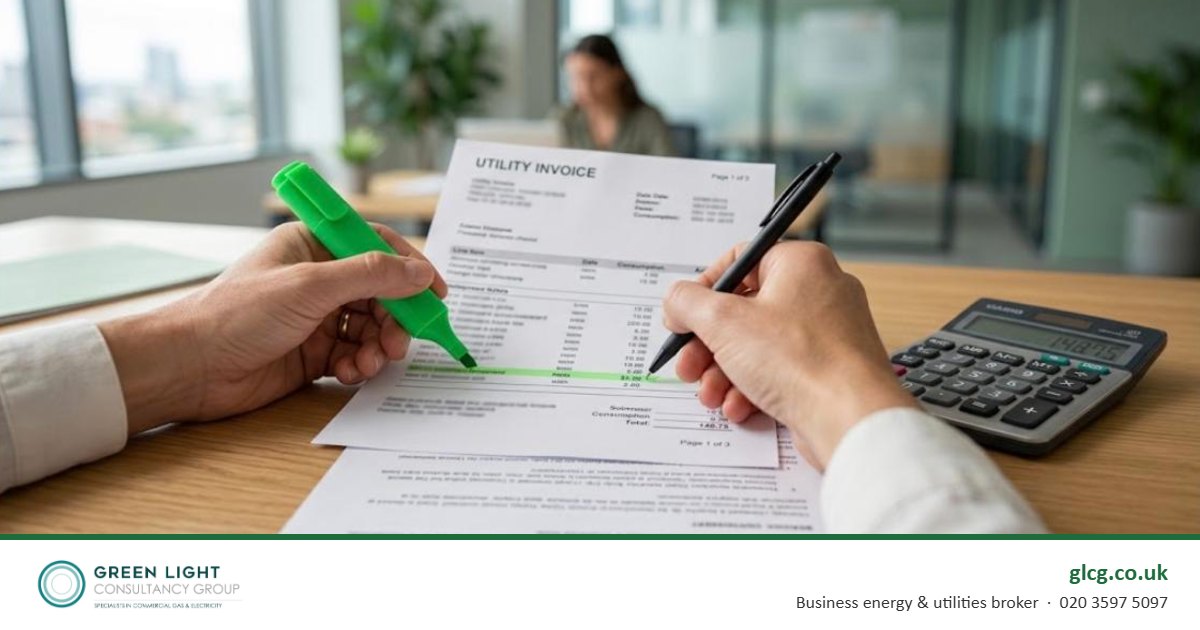
Checking the total isn’t enough. Check each line against your contract and your meter.
| Check | What to look for |
|---|---|
| Contract rates | Unit rates and standing charges match the signed agreement |
| Meter reads | Bills use actual reads, not repeated estimates |
| Meter details | The MPAN, MPRN and meter serial number match your site |
| Billing period | No gaps or overlaps between bills, especially after a switch |
| Non-commodity charges | Pass-through costs such as network charges are applied as your contract says; see our guide to TNUoS charges |
| VAT and Climate Change Levy | The right VAT rate is used and CCL is charged at the current gov.uk rates, with any relief you’re entitled to |
| Switch reads | Closing reads with the old supplier match opening reads with the new one |
If something is wrong, raise it with the supplier in writing, log the date and keep chasing until it’s corrected. If it isn’t resolved within 8 weeks, or the supplier sends a deadlock letter, eligible businesses can take the complaint to the Energy Ombudsman. How you work with suppliers on recurring problems is covered in our guide to utility supplier relationship management.
Found something that doesn’t match? Send us a recent bill and we’ll check it against your contract. Request a free bill check.
How to manage changes during a contract
Sites change more often than contracts do. Every change should be logged and confirmed with the supplier in writing.
- New sites: add them to the register and agree how they’ll be supplied before you move in.
- Closed or empty sites: tell the supplier, give final meter reads and confirm the supply is ended or changed.
- Meter changes: record the new serial number and check the first bill after the change.
- Capacity changes: if your electricity demand has gone up or down, check your agreed supply capacity still fits.
- Change of company details: a new company name or number usually needs the supplier’s agreement; our guide to contract risk management covers the novation and assignment traps.
Who should manage your utility contracts?
| Approach | Best for | Strengths | Limitations |
|---|---|---|---|
| In-house | A single site with simple contracts | No extra cost, full control | Relies on one person’s time and know-how |
| Bill validation bureau | Several sites with lots of invoices | Catches common billing errors | Reactive; no wider contract strategy |
| Managed service | Multi-site or higher spend businesses | Covers bills, changes and planning | Needs a clear brief and regular reviews |
Whichever you choose, keep the contract register in your own business, so you stay in control if you change provider.
Frequently asked questions
What is utility contract management?
It is the day-to-day control of your electricity, gas and water contracts after signing: records, bill checks, site changes and strategy reviews.
What is the difference between utility procurement and utility contract management?
Procurement is how you buy the contract. Utility contract management is how you make sure the contract delivers what you agreed once it’s signed.
What is a utility contract strategy?
A short written plan covering who owns your utility contracts, how bills are checked, how changes are logged and when each contract will be reviewed.
How often should I check my utility bills?
Every time one arrives. Line by line checks against the contract and meter reads catch most errors before they build up.
Who should own utility contracts in a business?
One named person, such as a finance or operations manager, supported by a broker or managed service if you have several sites.
Should I manage utility contracts in-house or use a managed service?
In-house works for a single site with simple contracts. Multi-site or higher spend businesses usually benefit from a managed service.
Sources
Need help managing your utility contracts?
If you’re not sure what you’re paying, when your contracts end or whether your bills are right, our team can review them for you. Call 020 3597 5097 or get in touch with the team.