Compare business energy prices

UK businesses pay an average of 23.97p per kWh for electricity and 4.94p per kWh for gas, with standing charges included, according to the latest government figures. Small businesses pay more per kWh than large ones, and every quote depends on your usage, meter, location and contract length. That is why it pays to compare business energy prices before you sign.

Green Light Consultancy Group (GLCG) compares business electricity and gas prices from our panel of 22 suppliers, explains your options in plain English and handles the switch for you. Fill in the short form for a free business energy quote.

Last updated: October 2026

Rated 5 star on Google reviews
Step 1 of 6

Secure & confidential · Free & no obligation · No pushy salespeople · Member of the Dispute Resolution Ombudsman

Business energy prices at a glance

23.97pAverage price UK businesses pay per kWh of electricity
4.94pAverage price UK businesses pay per kWh of gas
37.67pAverage electricity price for businesses using up to 20,000 kWh a year
8.80pAverage gas price for businesses using up to 278,000 kWh a year

Sources: Department for Energy Security and Net Zero (DESNZ), Quarterly Energy Prices, tables 3.4.1 and 3.4.2, published 29 September 2026. Figures are provisional averages for April to June 2026, include standing charges and exclude VAT and the Climate Change Levy (0.801p per kWh on both fuels, HMRC).

How much does business energy cost?

Business energy costs depend mostly on how much you use. A small shop or café might spend a few thousand pounds a year on electricity and gas, while a factory can spend hundreds of thousands. The table below shows what four example businesses would pay at the average government prices for their size.

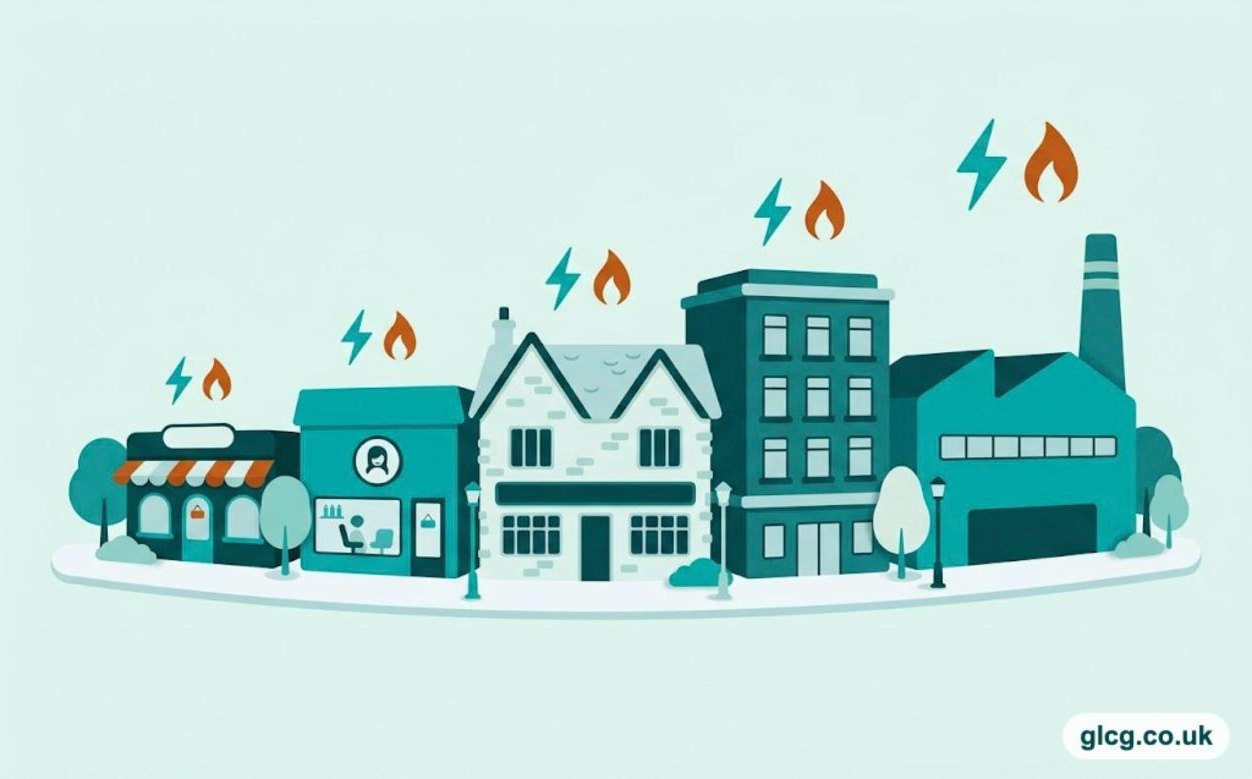
Illustration of a street of UK business premises from a cafe and salon to a pub, an office block and a factory, with energy symbols growing with size
The more energy a business uses, the lower the price per kWh tends to be.
Estimated business energy costs by size of business, at April to June 2026 average prices
Example business Electricity use a year Gas use a year Estimated annual cost Estimated monthly cost
Micro, such as a café or shop 15,000 kWh 20,000 kWh £7,410.50 £617.54
Small, such as an office or restaurant 60,000 kWh 100,000 kWh £25,522.00 £2,126.83
Medium, such as a hotel or workshop 1,000,000 kWh 1,000,000 kWh £314,700.00 £26,225.00
Large, such as a factory 10,000,000 kWh 10,000,000 kWh £2,847,000.00 £237,250.00

Usage figures are examples, not typical values. Costs use the DESNZ average price for each size band (electricity 37.67p, 27.87p, 27.09p and 24.61p per kWh; gas 8.80p, 8.80p, 4.38p and 3.86p per kWh), which include standing charges. They exclude VAT and the Climate Change Levy, and they are an illustration, not a quote.

The government figures are averages of what businesses actually paid, including contracts agreed months or years ago, so a new quote can be higher or lower. To see what your business would pay today, compare live business energy quotes.

Small business energy costs

Small businesses pay the most per kWh because they buy the least energy, and the standing charge is a bigger share of a small bill. Businesses using up to 20,000 kWh of electricity a year paid an average of 37.67p per kWh, compared with the UK average of 23.97p. For gas, businesses using up to 278,000 kWh a year paid 8.80p per kWh, compared with 4.94p.

If you are a small business, the standing charge, the contract length and the date your current deal ends matter as much as the unit rate. Shops, offices, cafés, salons and pubs usually fall into this group.

Large and multi-site business energy

Large energy users pay less per kWh. Sites using 2,000 to 19,999 MWh of electricity a year averaged 24.61p per kWh, and the biggest users paid less again. Large sites are usually priced individually on their half-hourly usage, and many buy on flexible or pass-through contracts rather than a simple fixed deal.

If you run several sites, bringing your contracts onto aligned end dates and one reporting view can save time as well as money. Read our guides to business energy procurement and multi-site energy management.

What large and multi-site buyers should check

  • Half-hourly usage data for every site.
  • Contract end dates, so sites can be aligned.
  • Fixed, flexible or pass-through purchasing.
  • One bill or one reporting view across all sites.
  • Exit terms if you open or close sites.

Business energy prices per kWh

Business electricity costs about five times as much per kWh as business gas. In the latest government figures, the UK average was 23.97p per kWh for electricity and 4.94p per kWh for gas, with standing charges included and before VAT and the Climate Change Levy.

Business electricity and gas prices per kWh, April to June 2026
Electricity Gas
UK average price per kWh 23.97p 4.94p
Smallest businesses 37.67p (up to 20 MWh a year) 8.80p (up to 278 MWh a year)
Change in a year Up 2.0% Down 0.7%
Typical contract lengths 1 to 5 years 1 to 5 years

Source: DESNZ, Quarterly Energy Prices, tables 3.4.1 and 3.4.2, published 29 September 2026. Change is against April to June 2025, excluding the Climate Change Levy. 1 MWh is 1,000 kWh.

For prices by business size, standing charges and worked examples for each fuel, see our full guides to business electricity prices and business gas prices.

  • ElectricityUp to 20 MWh a year 37.67p
  • ElectricityUK average 23.97p
  • GasUp to 278 MWh a year 8.80p
  • GasUK average 4.94p
Average price per kWh, April to June 2026, excluding VAT and CCL. Source: DESNZ.

Example: a micro business using both fuels

  • Electricity: 15,000 kWh × 37.67p = £5,650.50
  • Gas: 20,000 kWh × 8.80p = £1,760.00
  • Total: £7,410.50 a year, about £617.54 a month

Uses DESNZ averages for the smallest businesses, which include standing charges. Excludes VAT and the Climate Change Levy. An illustration, not a quote.

Business energy vs domestic energy

Business energy works differently from the energy you buy at home, and the differences can cost you if you are not ready for them.

  • No price cap. The Ofgem energy price cap only covers households. Business prices are set by the contract you agree.
  • Fixed terms, no cooling-off. Business contracts usually run for a fixed term and do not normally have a cooling-off period, so check the terms before you agree.
  • Higher VAT and the Climate Change Levy. Most businesses pay 20% VAT and the CCL. Households pay neither the CCL nor the full VAT rate.
  • Prices are tailored. Suppliers price each business on its usage, meter, location and credit profile, so there is no single published business tariff.
  • Contracts can roll over. If you do not act before your contract ends, you can move onto more expensive out-of-contract rates.

Working from home? Your home energy is usually a domestic supply, even if you run a business there. A business contract is for premises used mainly for business.

What makes up a business energy bill?

A business energy bill has two charges you agree with your supplier, a unit rate and a standing charge, plus taxes and costs set by others.

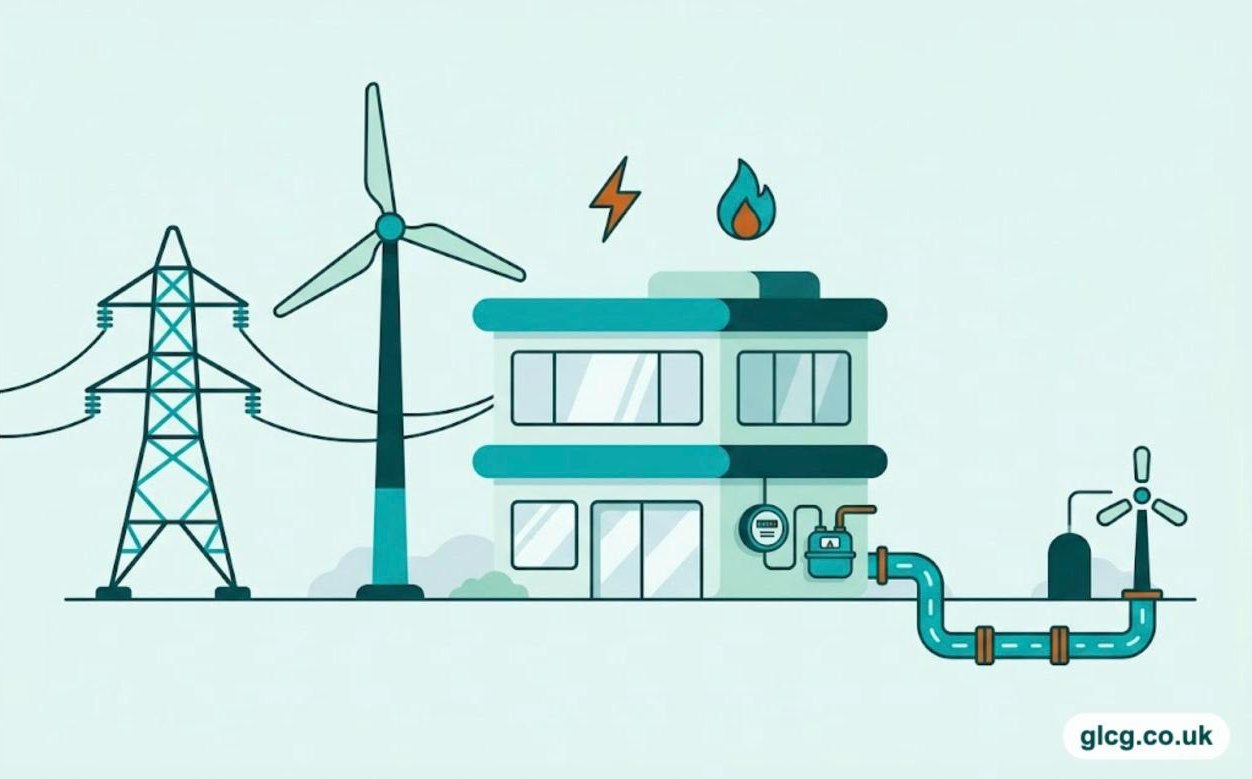
Illustration of a business building supplied with electricity from pylons and a wind turbine and with gas through an underground pipe, with an electricity meter and a gas meter
Most businesses buy two fuels, and each one is priced separately.
01

Unit rate

The price of each kWh of electricity or gas you use. This is the part that moves most with the wholesale market.

02

Standing charge

A fixed daily fee for keeping your premises connected, however much you use. Some tariffs have a 0p standing charge with a higher unit rate, which can suit seasonal or part-empty premises.

03

Network charges

The cost of moving electricity and gas through the national and local networks to your premises.

04

Policy costs

The cost of government schemes, built into your rates or passed through at cost.

05

Climate Change Levy (CCL)

A government tax on business energy use. The main rate is 0.801p per kWh on both electricity and gas.

06

VAT

Usually 20%. Sites using no more than 33 kWh of electricity a day, or 145 kWh of gas a day, and charities using energy for non-business purposes qualify for the reduced rate. For electricity in Great Britain, that is 0% from 1 October 2026 to 31 March 2027. Gas stays at 5%.

Not sure which VAT rate you pay? Send us recent bills and we will check them for you. See whether your business qualifies for 0% VAT on electricity.

Business energy contract types

Most small and medium businesses choose a fixed-rate business energy contract, because it makes bills predictable. The main types are:

01

Fixed-rate

Your rates are set for the contract term, usually one to five years.

02

Variable-rate

Your rates can go up or down with the market.

03

Deemed / out-of-contract

The default rates when you have no agreed contract. These are usually the most expensive.

04

Green tariffs

Electricity matched to renewable sources, or gas matched to biomethane.

05

Flexible / pass-through

Usually for larger users. Flexible contracts buy energy in blocks over time, and pass-through contracts pass network and policy charges on at cost.

Our guide to business energy contract types explains each one in detail, including which suits which business. Thinking of going green? Read how to switch to renewable energy.

Dual fuel: one supplier or two?

Many suppliers offer business electricity and gas together, but business dual fuel is not automatically cheaper. Each fuel is priced on its own, so the best electricity deal and the best gas deal can come from different suppliers.

  • One supplier can mean one account and one point of contact.
  • Two suppliers can mean lower prices if each is the cheapest for that fuel.
  • Either way, aligning both contracts to end on the same date makes renewals simpler and helps you avoid one fuel slipping onto out-of-contract rates.

We compare both fuels together and separately, then show you which option costs less in total.

Who is the cheapest business energy supplier?

There is no single cheapest business energy supplier. Each supplier prices every quote on your usage, location, meter, contract length and credit profile, so the cheapest supplier for one business can be among the most expensive for another. Prices also change daily with the wholesale market.

To find the best business energy deal for your own premises:

  • Compare the total annual cost, including standing charges, not just the unit rate.
  • Compare like for like: the same contract length, start date and payment method.
  • Check what is fixed and what can change during the contract.
  • Look at each supplier’s service and billing record as well as its price.

Our panel of 22 suppliers includes British Gas, EDF, E.ON, Scottish Power, SSE, TotalEnergies and Utilita. We show you the best business energy rates available for your business on the day.

How to compare business energy prices

To compare business energy prices, gather your usage details, get quotes from several suppliers for the same contract length, then compare the total annual cost and the terms side by side. A broker such as GLCG does this in one go across both fuels.

Illustration of a shop owner comparing business energy quotes for electricity and gas on a laptop with a GLCG energy advisor on a video call
We compare business electricity and gas quotes together and separately.

What you need for a business energy quote:

  • Your business name and the address of the premises.
  • Your MPAN for electricity and MPRN for gas. These supply numbers are on your bills.
  • Your current supplier and contract end date.
  • Your annual electricity and gas use in kWh, from a recent bill.

When we compare business energy quotes, we look at:

  • Unit rates and standing charges, and the total annual cost of each quote.
  • Contract length, and what each term does to the price.
  • Whether network and policy charges are fixed or passed through.
  • Exit and renewal terms, notice periods and early exit fees.
  • Payment terms, deposits and credit checks.
  • Green options, and the supplier’s record on billing and service.

Broker or business energy comparison site?

Both compare business energy prices for you. A comparison site shows prices from its panel online. A broker also checks your current contract, explains the terms and manages the switch for you. Whichever you use, ask how many suppliers are on the panel and how the service is paid for. Since 1 October 2024, Ofgem rules require any broker fee to be shown clearly in the principal terms of your contract.

GLCG has helped more than 15,000 businesses with their energy. We are a member of the Dispute Resolution Ombudsman and an official energy partner of Norwich City FC and West Bromwich Albion.

How to switch business energy supplier

Switching business energy supplier takes three steps, and we manage it from start to finish. Your supply is not interrupted, because the energy comes through the same cables, pipes and meters. Only the company that bills you changes.

1
We search
Tell us about your business in the short form. We search our supplier panel for business energy quotes that match your usage.
→
2
We compare
We weigh up unit rates, standing charges, contract terms and green options, then talk you through the best quotes.
→
3
You save
You choose the contract you want. We handle the paperwork and the switch, with no disruption to your supply.
→

When to renew your business energy contract

The best time to compare is before your current contract ends, not after. Suppliers will usually agree a new contract up to 12 months before it starts, so you can fix a price when the market suits you. For more on timing, read 4 questions to ask before your business energy contract renewal.

Avoid deemed and out-of-contract rates

Deemed rates apply when you move into premises and use energy before agreeing a contract. Out-of-contract rates apply when your fixed contract ends without a new one in place. Both are usually far higher than a fixed deal. Put your contract end dates in the diary, and if you are moving premises, arrange contracts as soon as you take on the property.

  • 6 months or more before your end date. Check your end date, notice period and annual usage.
  • 3 to 4 months before. Get quotes and compare contract lengths.
  • 1 to 2 months before. Agree your new contract, and give notice to your current supplier if it is needed.
  • On your end date. Your new rates start, with no gap in supply.

Your rights as a business energy customer

Ofgem, the energy regulator, gives extra protection to smaller businesses. You count as a microbusiness if you use no more than 100,000 kWh of electricity or 293,000 kWh of gas a year, or have fewer than 10 employees and a turnover or balance sheet of no more than £2 million.

Since December 2024, a wider small business group has extra protection too: fewer than 50 employees, or up to 200,000 kWh of electricity or 500,000 kWh of gas a year.

Source: Ofgem.

Your protections

  • Fair treatment. Ofgem’s Standards of Conduct apply to suppliers’ dealings with businesses of every size.
  • Broker fees shown upfront. Since 1 October 2024, any broker fee must be shown clearly in your contract’s principal terms.
  • Free dispute resolution. Micro and small businesses can take unresolved complaints about suppliers and brokers to an independent redress scheme such as the Energy Ombudsman.

Ways to cut your business energy costs

The quickest way to cut your business energy costs is to get onto competitive contracts for both fuels, then reduce how much energy you use. Start here.

  • Never roll onto out-of-contract rates. Compare before each contract ends.
  • Compare the whole cost. Check standing charges as well as unit rates, for both fuels.
  • Check your VAT and CCL. Low-usage sites and charities may qualify for reduced VAT.

Business energy for your sector

We compare business energy for companies of every size across England, Scotland and Wales, from Leeds and Liverpool to London. See how we help businesses like yours:

Business energy FAQs

It depends on your usage. At average government prices, a micro business using 15,000 kWh of electricity and 20,000 kWh of gas a year would pay about £617 a month, and a small business using 60,000 kWh of electricity and 100,000 kWh of gas about £2,127 a month, before VAT and the Climate Change Levy.

UK businesses pay an average of 23.97p per kWh for electricity and 4.94p per kWh for gas, with standing charges included and before VAT and the Climate Change Levy, according to the latest government figures.

No. The Ofgem energy price cap only covers households. Business energy prices are set by the contract you agree, which is why it pays to compare. Read more about the energy price cap.

There is no single cheapest business energy supplier. Quotes are priced on your usage, location, meter and contract length, and they change daily. The only reliable way to find your cheapest option is to compare quotes for your own business.

Not always. Each fuel is priced separately, so two suppliers can sometimes cost less than one. We compare both ways and show you the cheapest total.

Most switches are timed so that your new rates start the day your current contract ends. If you are on deemed or out-of-contract rates, you can usually move to a new contract quickly.

Sometimes. A supplier can object to a switch if you owe money, so it is best to agree a plan for the debt first. Speak to us and we will check your options.

You need your business name and address, your MPAN and MPRN, your current supplier, your contract end date and your annual usage in kWh. A recent bill for each fuel has all of this.

If you have not agreed a new contract, your supplier will usually move you onto out-of-contract rates, which are much higher than a fixed deal. Compare and agree a new contract before the end date to avoid this.

Suppliers will usually agree a new contract up to 12 months before it starts. Comparing early gives you more time to fix a price when the market suits you.

Usually not without a cost. Most fixed business contracts charge an exit fee if you leave before the end date. Deemed and out-of-contract rates are much easier to leave.

A supplier can only quote its own prices, while a broker compares many suppliers at once and manages the switch. Ask any broker how it is paid. Since October 2024, broker fees must be shown in your contract’s principal terms.

Tell your current supplier your moving date and give final meter readings. At the new premises, arrange a contract as soon as you take on the property so you do not pay deemed rates.

No. The same cables, pipes and meters supply your premises, and only the company that sends the bill changes.

Get business energy quotes

Comparing is the only way to know you are paying a fair price for your business energy. Tell us a few details and we will compare business electricity and gas quotes from our supplier panel, explain your options and handle the switch. It is free, and there is no obligation to go ahead.