
Compare business gas prices and switch supplier

UK businesses pay an average of 4.94p per kWh for gas, with standing charges included, according to the latest government figures. Smaller businesses pay more: those using up to 278,000 kWh a year pay an average of 8.80p per kWh. What you pay depends on how much gas you use, where your premises are, your meter and your contract length, so compare business gas prices before you agree a new contract.

Green Light Consultancy Group (GLCG) compares business gas prices from leading UK suppliers, explains your options in plain English and handles the switch for you. Fill in the short form for a free quote.

Last updated: October 2026
Rated 5 star on Google reviews
Step 1 of 6

Secure & confidential · Free & no obligation · No pushy salespeople · Member of the Dispute Resolution Ombudsman

Business gas prices at a glance

4.94pAverage price UK businesses pay per kWh
8.80pAverage for businesses using up to 278,000 kWh a year
0.7% lowerUK average compared with a year earlier
0.801pClimate Change Levy on each kWh of gas

Sources: Department for Energy Security and Net Zero (DESNZ), Quarterly Energy Prices, published 29 September 2026, excluding VAT and the Climate Change Levy. Climate Change Levy rate: HMRC.

What are business gas prices in the UK?

Business gas prices in the UK average 4.94p per kWh, or 5.28p with the Climate Change Levy, according to the latest government figures. Small businesses pay the most per kWh, and the largest users pay the least.

Every business gas tariff has two parts: a unit rate, which is the price of each kWh of gas you use, and a standing charge, which is a fixed daily fee for keeping your supply connected.

Average business gas prices by size of business, April to June 2026
Size of business Annual gas use Price per kWh (excluding CCL) Price per kWh (including CCL) Change in a year
Very small Up to 278 MWh 8.80p 9.31p Up 5.2%
Small 278 to 2,777 MWh 4.38p 4.86p Down 5.1%
Medium 2,778 to 27,777 MWh 3.86p 4.21p Down 7.1%
Large 27,778 to 277,777 MWh 3.68p 3.83p Down 4.1%
Very large 277,778 to 1,111,112 MWh 3.89p 3.97p Down 5.6%
UK average All sizes 4.94p 5.28p Down 0.7%

Source: Department for Energy Security and Net Zero, Quarterly Energy Prices, tables 3.4.1 and 3.4.2, published 29 September 2026. The latest figures are provisional. Prices are the average paid across all contracts, include standing charges and exclude VAT. Change is against the same quarter a year earlier, excluding CCL. 1 MWh is 1,000 kWh.

These are averages of what businesses actually paid, including contracts agreed months or years ago, so they will not match the unit rate on a new quote exactly. New quotes move with the wholesale gas market, so a price quoted today may not be available next week. For where prices are heading, read our business electricity price forecast, which covers the gas market that drives both fuels.

How business gas prices have changed

Business gas prices are far higher than before the energy crisis, but well below their peak. The UK average was 2.19p per kWh at the start of 2018 and peaked at 6.93p at the start of 2023. At 4.94p in the latest figures, it is about 29% below that peak and more than double the 2.40p businesses paid in the same months of 2021.

Small business gas prices

Small businesses pay the most per kWh because they buy the least gas. In the government figures, businesses using up to 278,000 kWh a year paid an average of 8.80p per kWh, about 1.8 times the UK average. That band covers most shops, offices, cafés, salons and small workshops. The standing charge is also a bigger share of a small bill, so it matters as much as the unit rate.

Commercial gas prices for larger sites

Larger commercial gas users pay less per kWh. Sites using 2,778 MWh to 27,777 MWh a year average 3.86p, and large users average 3.68p. Bigger sites are usually priced individually on their usage pattern and meter type, so an average is only a starting point and a tailored quote matters more. See commercial gas meters explained.

How much does business gas cost per kWh?

Business gas costs between about 3.7p and 8.8p per kWh on average, depending on the size of your business, with standing charges included. The UK average is 4.94p per kWh, or 5.28p with the Climate Change Levy.

The unit rate is only part of the cost, so the fair way to compare business gas prices per kWh is to work out the full annual cost of each quote, including the standing charge, the Climate Change Levy and VAT.

Worked example: a small business using 20,000 kWh of gas a year

  • Gas at 8.80p per kWh × 20,000 kWh = £1,760.00
  • Climate Change Levy at 0.801p per kWh × 20,000 kWh = £160.20
  • VAT at 20% on £1,920.20 = £384.04
  • Estimated annual cost: £2,304.24

This uses the government average for small businesses, which already includes standing charges. It is an illustration, not a quote.

A quote with a lower unit rate can still cost more over the year if its standing charge is high. We compare both parts across suppliers, so you see the total annual cost before you decide.

  • Very smallUp to 278 MWh 8.80p
  • Small278 to 2,777 MWh 4.38p
  • Medium2,778 to 27,777 MWh 3.86p
  • Large27,778 to 277,777 MWh 3.68p
  • Very large277,778 to 1,111,112 MWh 3.89p
  • UK averageAll sizes 4.94p
Average gas price per kWh by size of business, excluding VAT and CCL. Source: DESNZ.

What is a standing charge on business gas?

A standing charge is a fixed daily fee you pay for your gas supply, however much or little you use. It covers the cost of keeping your premises connected, including your meter and the gas network.

The less gas you use, the more the standing charge matters. A site that uses little gas, or only uses it in winter, can pay a large share of its bill in standing charges.

GLCG can find business gas tariffs with a 0p standing charge. These usually come with a higher unit rate, so they tend to suit low-usage sites, seasonal businesses and premises that sit empty for part of the year. Ask us to run the numbers for your usage.

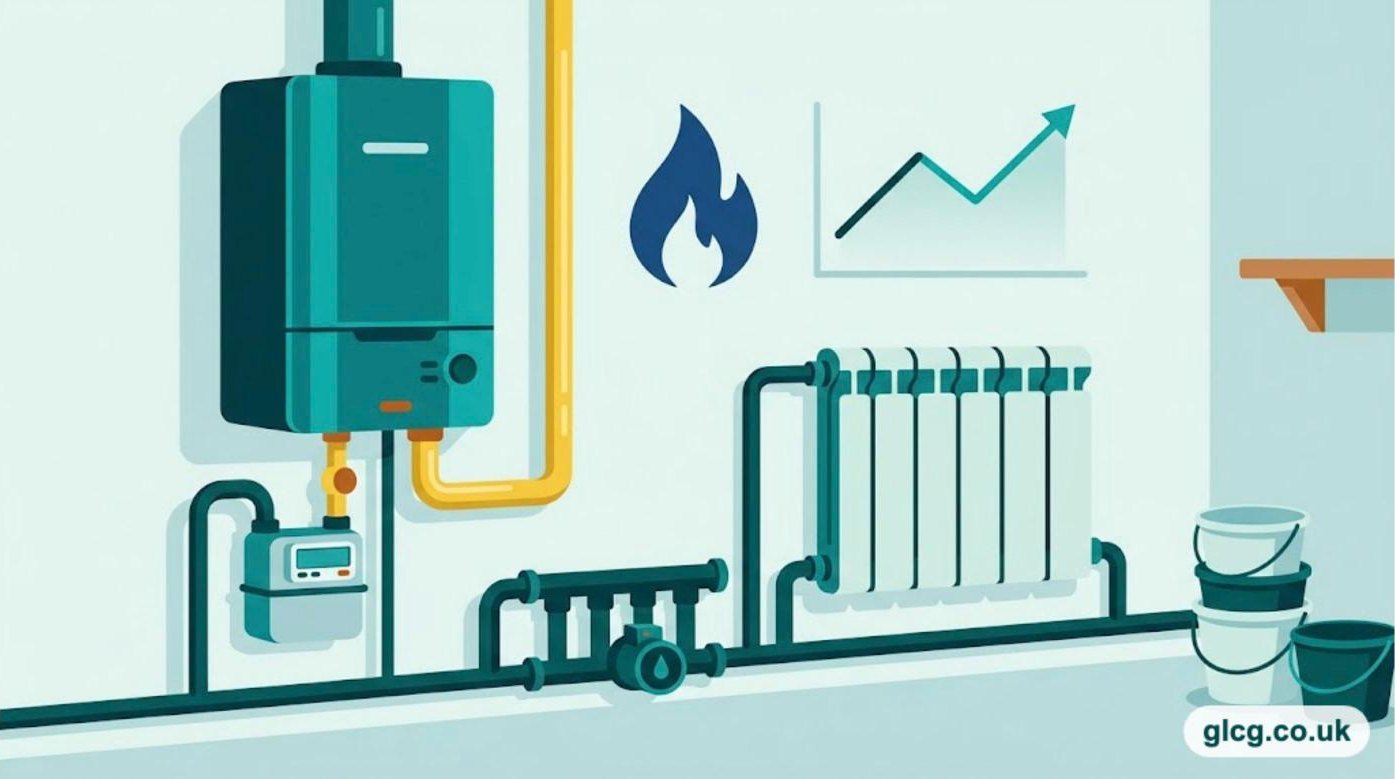
Illustration of a commercial gas boiler, gas meter and radiator, with a blue flame and a usage graph
How much gas you use, and when, shapes the unit rate and standing charge you pay.

What makes up a business gas bill?

A business gas bill is made up of wholesale gas, network charges, policy costs, supplier costs, the Climate Change Levy and VAT. Wholesale gas is the part that moves most with the market.

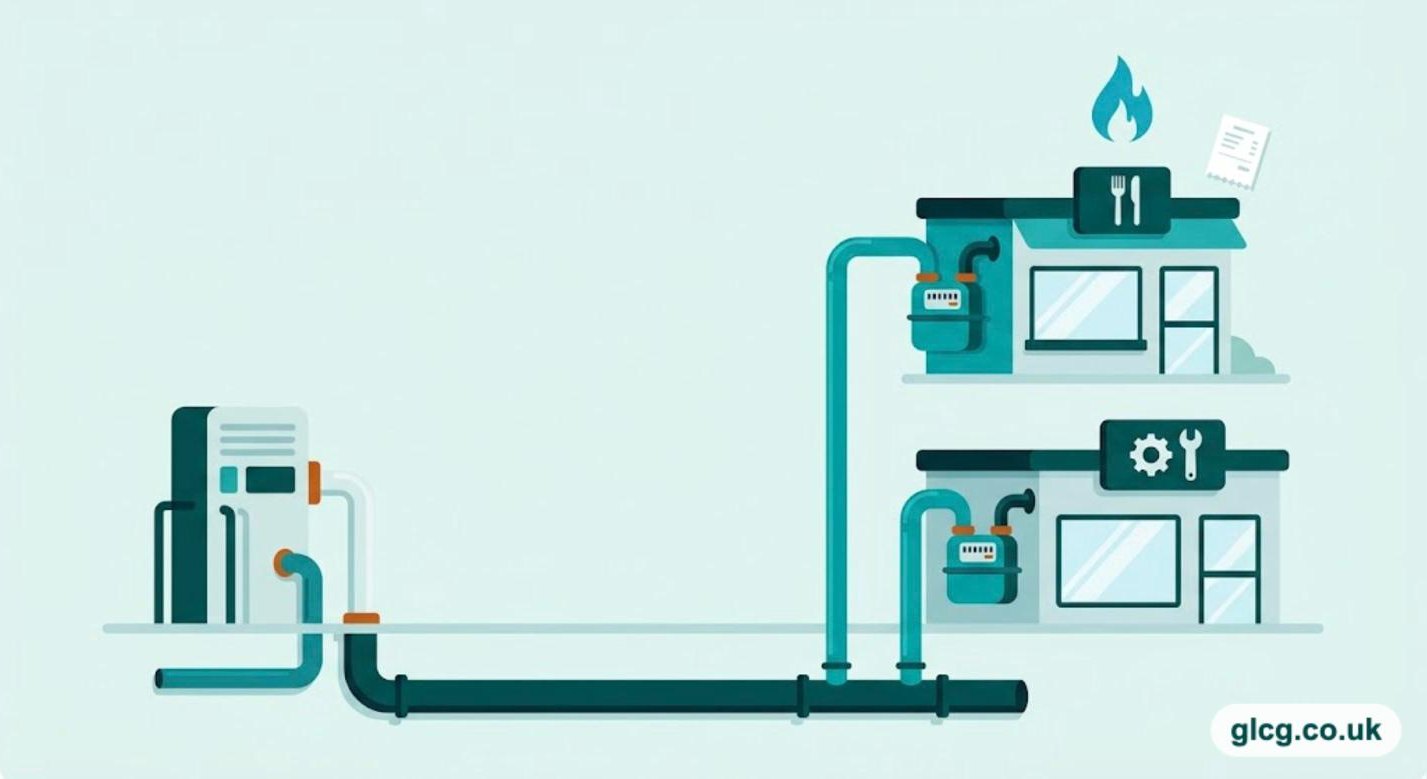
Illustration of gas pipes running from the gas network to a restaurant and a workshop, each with a commercial gas meter, and a gas bill
Gas comes through the same network pipes whichever supplier you choose.
01

Wholesale gas

The cost of the gas your supplier buys for you. This is the part that rises and falls with the market.

02

Network charges

The cost of moving gas through the national transmission system and your local gas distribution network to your premises.

03

Policy costs

Government schemes such as the Green Gas Levy, which supports biomethane being added to the gas grid.

04

Supplier costs and margin

Metering, billing, customer service and the supplier’s profit.

05

Climate Change Levy (CCL)

A government tax on business energy use. It is 0.801p per kWh on gas, rising to 0.827p in 2027.

06

VAT

Usually 20%. Sites using no more than 145 kWh of gas a day, or 4,397 kWh a month, and charities using gas for non-business purposes pay the reduced rate of 5%. The temporary cut to 0% from 1 October 2026 applies to electricity only, not gas.

Not sure which VAT rate you pay? Send us a recent gas bill and we will check it for you. For more ways to save, read our 7 business gas comparison tips.

Business gas contract types explained

The main business gas contract types are fixed-rate, variable-rate, deemed or out-of-contract, green gas, and flexible or pass-through. Most small and medium businesses choose a fixed-rate contract, because it makes bills predictable.

01

Fixed-rate

Your unit rate and standing charge are set for the contract term, usually one to five years. You are protected if prices rise, but you will not benefit if they fall, and there is normally a fee for leaving early.

02

Variable-rate

Your rates can go up or down with the market, usually at short notice. You get more flexibility and less certainty.

03

Deemed / out-of-contract

The default rates a supplier charges when you have no agreed contract. They are usually the most expensive way to buy gas, so treat them as a stopgap.

04

Green gas

Gas matched to biomethane produced in the UK, usually backed by Renewable Gas Guarantees of Origin (RGGOs). Ask us to show green and standard prices side by side.

05

Flexible / pass-through

For larger users. Flexible contracts let you buy gas in blocks over time. Pass-through contracts fix the gas cost and pass network and policy charges on at cost.

Not sure which fits? Our guide to business energy contract types has more detail, or ask us and we will recommend a contract for your usage.

Deemed and out-of-contract gas rates, and how to avoid them

Deemed and out-of-contract rates are the default prices you pay when you have no agreed gas contract with your supplier. They are usually much higher than a fixed deal, so it pays to avoid them.

  • Deemed rates apply when you move into new premises and start using gas before you have agreed a contract.
  • Out-of-contract rates apply when your fixed contract ends and you have not agreed a new one.

How to avoid deemed and out-of-contract rates

  • Find your contract end date. It is on your bill or in your contract.
  • Start comparing early. You can usually agree a new contract well before your current one ends.
  • Give notice if your contract requires it, so you are not rolled over.
  • Moving premises? Arrange a gas contract as soon as you take on the property.
  • Already on these rates? Ask us for quotes. You can usually move to a fixed contract quickly.

Who is the cheapest business gas supplier?

There is no single cheapest business gas supplier. Each supplier prices every quote on your usage, location, meter type, contract length and credit profile, so the cheapest supplier for one business can be among the most expensive for another. Prices also change daily with the wholesale market.

To find cheap business gas for your own premises:

  • Compare the total annual cost, not just the unit rate.
  • Compare like for like: the same contract length, start date and payment method.
  • Check what is fixed and what can change during the contract.
  • Look at the supplier’s service and billing record as well as its price.

We compare our panel of 22 suppliers and show you the best business gas rates available for your business on the day. For more ideas, read our 7 business gas comparison tips.

How to compare business gas prices

To compare business gas prices, gather your usage details, get quotes from several suppliers for the same contract length, then compare the total annual cost and the contract terms side by side. A broker such as GLCG does this for you in one go.

Illustration of a chef in a commercial kitchen comparing business gas quotes on a tablet with a GLCG energy advisor on a video call
We compare business gas quotes and talk you through them.

What you need for a business gas quote:

  • Your business name and the address of the premises.
  • Your MPRN (Meter Point Reference Number), which is on your gas bill.
  • Your current supplier and contract end date.
  • Your annual gas use in kWh. If your bill shows cubic metres, multiply by 1.02264, then by the calorific value on your bill, then divide by 3.6.

When we compare, we look at:

  • The unit rate and standing charge, and the total annual cost of both.
  • Contract length, and what each term does to the price.
  • Whether network and policy charges are fixed or passed through.
  • Exit and renewal terms: notice periods, rollover terms and early exit fees.
  • Payment terms, deposits and credit checks.
  • Green gas options, and the supplier’s record on billing and service.

Should I use a broker or a comparison site?

Both compare business gas prices for you. A comparison site shows prices from its panel online. A broker also checks your current contract, explains the terms and manages the switch. Whichever you use, ask how many suppliers are on the panel and how the service is paid for.

GLCG has helped more than 15,000 businesses with their energy. We are a member of the Dispute Resolution Ombudsman and an official energy partner of Norwich City FC and West Bromwich Albion.

How to switch business gas supplier

Switching business gas supplier takes three steps, and we manage it from start to finish. Your supply is not interrupted, because the gas comes through the same pipes and meter. Only the company that bills you changes.

1
We search
Tell us about your business in the short form. We search our supplier panel for business gas quotes that match your usage.
→
2
We compare
We weigh up unit rates, standing charges, contract terms and green options, then talk you through the best quotes.
→
3
You save
You choose the contract you want. We handle the paperwork and the switch, with no disruption to your supply.
→

When to renew your business gas contract

The best time to compare is before your current contract ends, not after. Suppliers will usually agree a new contract up to 12 months before it starts, so you can fix a price when the market suits you. Gas prices often rise ahead of winter, so it can pay to look early.

For more on timing, read 4 questions to ask before your business energy contract renewal.

  • 6 months or more before your end date. Check your end date, notice period and annual usage.
  • 3 to 4 months before. Get quotes and compare contract lengths.
  • 1 to 2 months before. Agree your new contract, and give notice to your current supplier if it is needed.
  • On your end date. Your new rates start, with no gap in supply.

Ways to cut your business gas costs

The quickest way to cut your business gas costs is to get onto a competitive contract, then reduce how much gas you use. Start here.

  • Never roll onto out-of-contract rates. Put your contract end date in the diary and compare before it arrives.
  • Compare the whole cost. Check the standing charge as well as the unit rate.
  • Check your VAT. Low-usage sites and charities may qualify for 5% VAT on gas.
  • Get the right meter. A smart or automated meter gives accurate bills instead of estimates. See commercial gas meters explained.
  • Service your boiler and controls. An efficient boiler, timers and thermostats cut the gas you use.
  • Insulate and draught-proof. Heat that stays in the building is gas you do not pay for.

Business gas FAQs

There is no single cheapest business gas supplier in the UK. Quotes are priced on your usage, location, meter and contract length, and they change daily. The only reliable way to find your cheapest option is to compare quotes for your own business.

UK businesses pay an average of 4.94p per kWh for gas, with standing charges included and before VAT and the Climate Change Levy, according to the latest government figures. Small businesses using up to 278,000 kWh a year pay an average of 8.80p per kWh.

No, there is no price cap on business gas. The Ofgem energy price cap only covers households. Business gas prices are set by the contract you agree, which is why it pays to compare before you sign.

The UK average business gas price is 4.94p per kWh in the latest government figures, 0.7% lower than a year earlier and about 29% below the peak of 6.93p at the start of 2023. It is still more than double what businesses paid in 2021, and the wholesale gas market can move quickly. A fixed contract is the usual way to get certainty.

Most businesses pay 20% VAT on gas. Sites using no more than 145 kWh a day, or 4,397 kWh a month, and charities using gas for non-business purposes pay 5%. A VAT-registered business can usually reclaim the VAT on gas used for business purposes.

Yes, most businesses pay the Climate Change Levy on gas. The main rate is 0.801p per kWh and rises to 0.827p per kWh on 1 April 2027. Your supplier adds it to your bill.

Usually not without a cost. Business gas contracts do not normally have a cooling-off period, and most fixed contracts charge an exit fee if you leave before the end date. Deemed and out-of-contract rates are much easier to leave. Send us your contract and we will check your options.

Yes. Businesses using up to 278,000 kWh a year pay an average of 8.80p per kWh, compared with 3.68p for large users. Suppliers offer lower prices for higher volumes, and standing charges weigh more on a small bill.

Yes, some business gas tariffs have a 0p standing charge, and GLCG can find them for you. They usually have a higher unit rate, so they suit low-usage and seasonal sites best.

You need your business name and address, your current supplier, your contract end date and your annual gas use in kWh. A recent bill has all of this, along with your MPRN, the supply number for your gas meter.

The time it takes to switch business gas supplier depends on your current contract and your new supplier. Most switches are timed so that your new rates start the day your current contract ends.

No, your gas supply is not interrupted when you switch. The same pipes and meter supply your premises, and only the company that sends the bill changes.

Compare the best business gas rates

Comparing is the only way to know you are paying a fair price for your business gas. Tell us a few details and we will compare business gas deals from our supplier panel, explain your options and handle the switch. It is free, and there is no obligation to go ahead.