Oops! Something went wrong while submitting the form.
B2B contract renewal is one of the most commercially important points in the supplier lifecycle. The decision is not simply whether to accept a new price. Businesses need to understand when the existing agreement ends, when notice must be served, whether automatic renewal applies, how the supplier has performed and what alternatives are available in the market.
For business energy contracts, failing to arrange a replacement agreement before expiry can result in higher out-of-contract or deemed pricing, depending on the circumstances and the wording of the existing agreement. These rates can be materially more expensive than a negotiated contract, making contract-expiry management an important financial control.
The same underlying problem exists across other B2B agreements. Telecoms, software, utilities and managed-service contracts can all contain notice provisions, renewal mechanisms and post-term pricing that make the commercial deadline much earlier than the apparent contract end date.
Many business owners believe new consumer protection laws will save them. They've heard about the Digital Markets, Competition and Consumers Act (DMCCA) 2024, which introduces a new consumer subscription-contract regime that is expected to commence in 2027. However, these protections are aimed at trader-to-consumer subscription contracts and do not create a general statutory renewal regime for ordinary B2B agreements.
For most businesses, the safest assumption is therefore that the renewal process will be governed by the contract they signed, together with any sector-specific protections that apply to their organisation.
This guide bridges that gap. We’ll walk you through the B2B-specific rules, show you how to audit your contracts, and provide clear scripts for renegotiating better terms.
What is a B2B contract renewal?
A B2B contract renewal is the process of reviewing an existing business-to-business agreement before or at the end of its current term and deciding what should happen next.
The organisation may renew with the incumbent supplier, renegotiate the commercial terms, allow the agreement to continue under an existing post-term mechanism or terminate the arrangement and move to another provider.
Effective contract renewal management therefore covers much more than the renewal quotation. It should consider the expiry date, termination notice window, automatic-renewal provisions, current supplier performance, market pricing, future requirements, exit obligations and internal approval process.
The central principle is simple: the commercial renewal decision should be made deliberately rather than determined by a missed deadline.
Contract renewal vs renegotiation vs switching
Renewal means continuing the supplier relationship for another contract term. The commercial terms may remain similar or be replaced by a new offer.
Renegotiation means using the renewal point to change price, duration, service levels, liability, notice periods or other terms before committing to another period.
Switching means ending the incumbent relationship and moving the service to an alternative provider. That decision normally requires enough lead time to complete market comparison, approvals, termination and supplier transition before the existing agreement ends.
These options are not mutually exclusive during the review process. A business may benchmark the market and prepare to switch while simultaneously negotiating with the incumbent. That credible alternative can strengthen the renewal negotiation.
When should you start reviewing a B2B contract?
The most important renewal date is often not the expiry date. It is the last date on which valid termination notice can be served.
A good renewal process therefore works backwards from the contract end date. First identify the formal notice deadline. Then establish an internal decision deadline that leaves enough time for market benchmarking, negotiation, commercial or legal review and approval before notice must be served.
For simple, lower-value agreements, this process may be relatively short. Complex, high-value or operationally critical contracts may need to be reviewed several months ahead of expiry, particularly where switching requires implementation or data migration.
The key rule is: your commercial deadline is usually earlier than your expiry date.
A central contract register or renewal calendar should record at least the contract end date, notice period, renewal mechanism and internal owner so that the business is not dependent on individual employees remembering critical deadlines.
The 2026-2027 regulatory reality: who is actually protected?
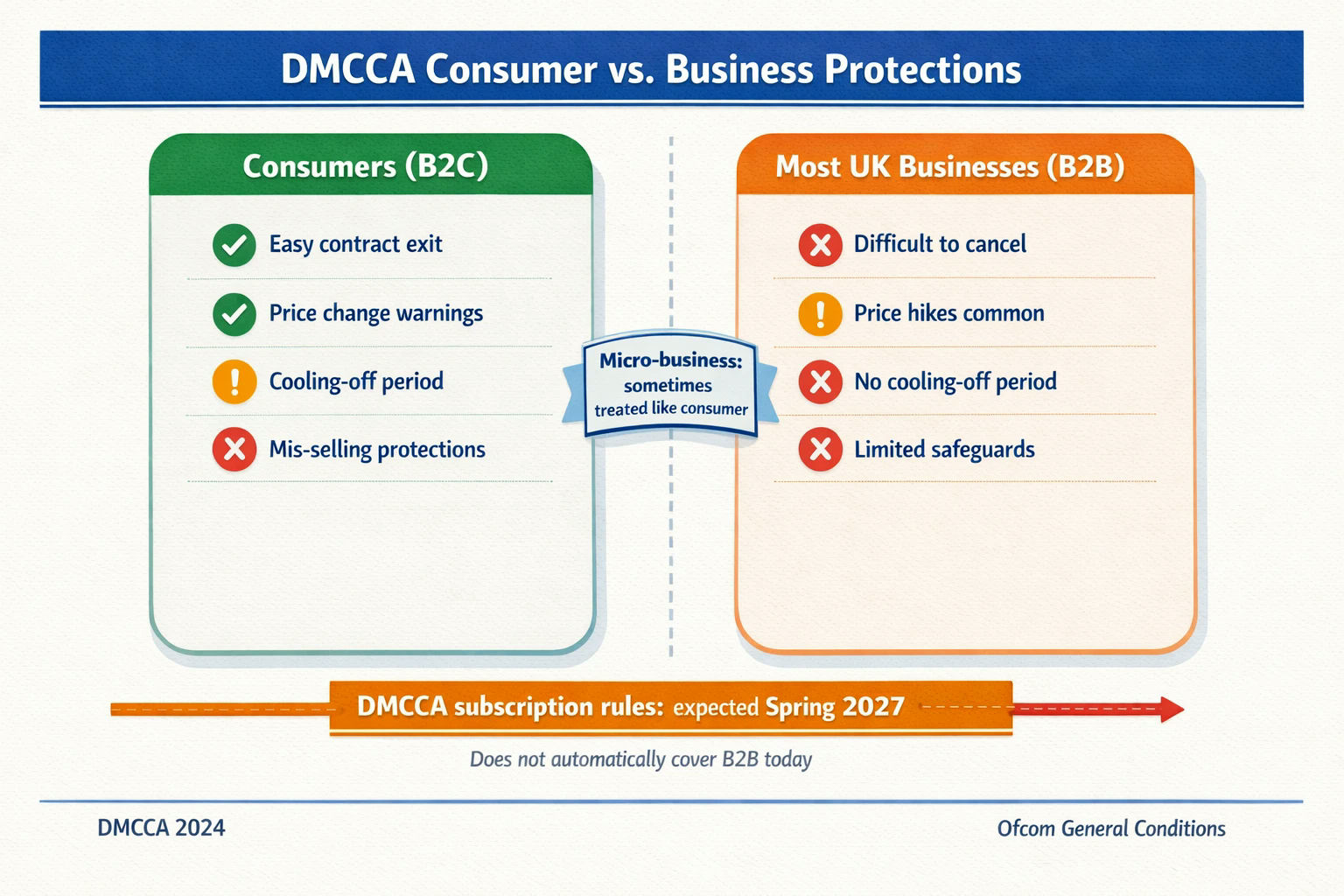
While the DMCCA brings significant changes for consumers, its new subscription regime isn't expected to commence until Spring 2027, and even then, its application to businesses is extremely limited. For now, you are bound by the terms you signed.
However, there is one critical exception you need to know about: the "micro-business" definition. Regulators like Ofgem and Ofcom provide certain small businesses with consumer-level protections. If your company meets the criteria, you may have more leverage than you think.
Clarify the rules first: most DMCCA-style subscription protections don’t apply to B2B today. Use this table to see where micro-business status may change your leverage.
A business is generally considered a micro-business if it meets one of these criteria:
Employs fewer than 10 people (or full-time equivalent) and has an annual turnover or balance sheet of no more than €2 million.
Uses less than 100,000 kWh of electricity per year.
Uses less than 293,000 kWh of gas per year.
If you qualify, your energy supplier must send you renewal reminders and cannot lock you into a rollover contract for more than 12 months. Understanding your status is the first step in any renewal strategy.
The exit vs. stay audit: a four-step decision framework
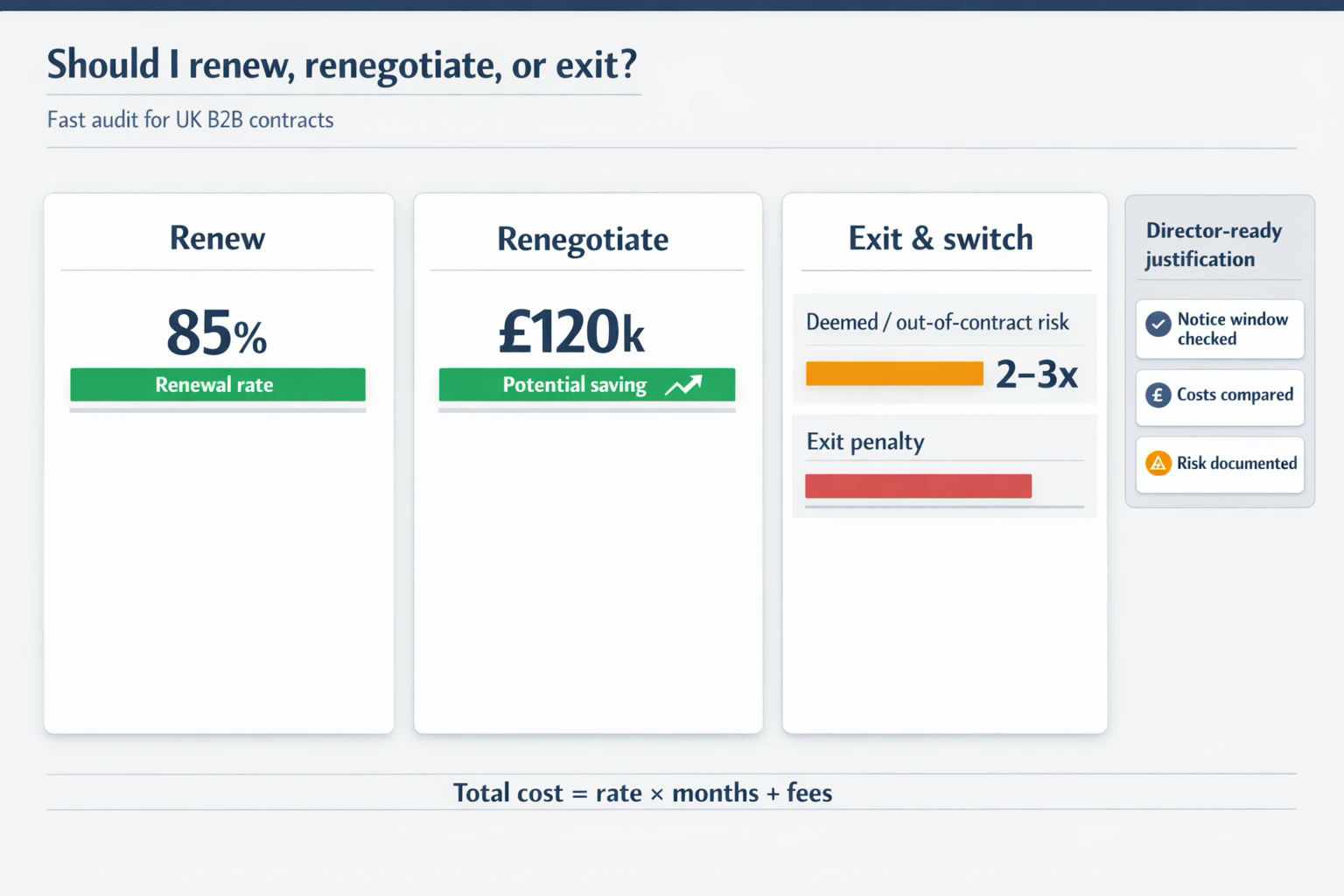
Before you can negotiate effectively, you need a clear-eyed view of your financial position. The goal is to avoid making a purely emotional decision and instead build a business case for your next move. This is the exact kind of analysis you'll need to justify your decision to a director or financial controller.
Calculate the Renewal Cost: What is the supplier's proposed renewal price? Multiply this by your expected usage over the new term to get a total contract value (TCV).
Quantify the Deemed Rate Risk: What is the supplier’s out-of-contract or "deemed" rate? Calculate what one or two months on this rate would cost if you fail to secure a new deal in time. This is your risk exposure.
Identify the Exit Penalty: Review your current contract. Is there an early termination fee (ETF)? Note the exact amount. Many suppliers will waive this in the final months if you're moving to a new contract with them, but you need to know the number.
Compare Against the Market: This is the most crucial step. What could you be paying with another supplier? A comprehensive market comparison gives you the benchmark needed to assess if the renewal offer is truly competitive. Getting an independent view of your business utility contracts is essential here.
Use a simple cost audit before you act: compare renewal pricing, out-of-contract risk, and exit fees—then document the logic for internal approval.
Review supplier performance before you renew
The renewal process is also the point at which the incumbent supplier's actual performance should be compared with the promises made when the original contract was awarded.
Look at billing accuracy, response times, SLA performance, unresolved disputes, implementation of contract changes, data quality and the amount of internal management time the relationship has required.
Recurring failures should not disappear from the decision simply because the supplier offers an attractive renewal price. Poor performance has a commercial cost, even where that cost does not appear directly on an invoice.
Conversely, evidence of consistently strong performance can have genuine value where switching creates operational disruption or implementation risk.
This is why effective [utility contract management] and supplier relationship management should feed directly into renewal. The business should enter renegotiation with evidence of what the incumbent actually delivered, not simply a memory of the most recent interaction.
What gives you leverage in a contract renewal?
Renewal negotiations are strongest when the business has credible alternatives and reliable evidence. Asking an account manager for a discount without either usually produces limited leverage.
The strongest source of leverage is a realistic ability to leave. If alternative suppliers have been benchmarked and the organisation has enough time to switch, the incumbent knows that retaining the account depends on presenting a competitive proposition.
Supplier underperformance can also create leverage where documented failures relate to service commitments, billing accuracy or contractual obligations. Increased spend or volume may strengthen the customer's commercial position, while consolidating several contracts with one provider can sometimes create additional negotiating value.
A longer commitment may also have value to the supplier, but it should only be exchanged for worthwhile improvements in price, flexibility, service or other terms. Businesses should avoid accepting a longer lock-in simply because it produces a small headline discount.
Negotiating leverage comes from alternatives and evidence, not simply from asking for a lower price.
A map of common contract traps by sector
Generic advice won't protect you from sector-specific pitfalls. Suppliers in energy, telecoms, and software have perfected their renewal processes to maximize revenue. Here’s what to look out for.
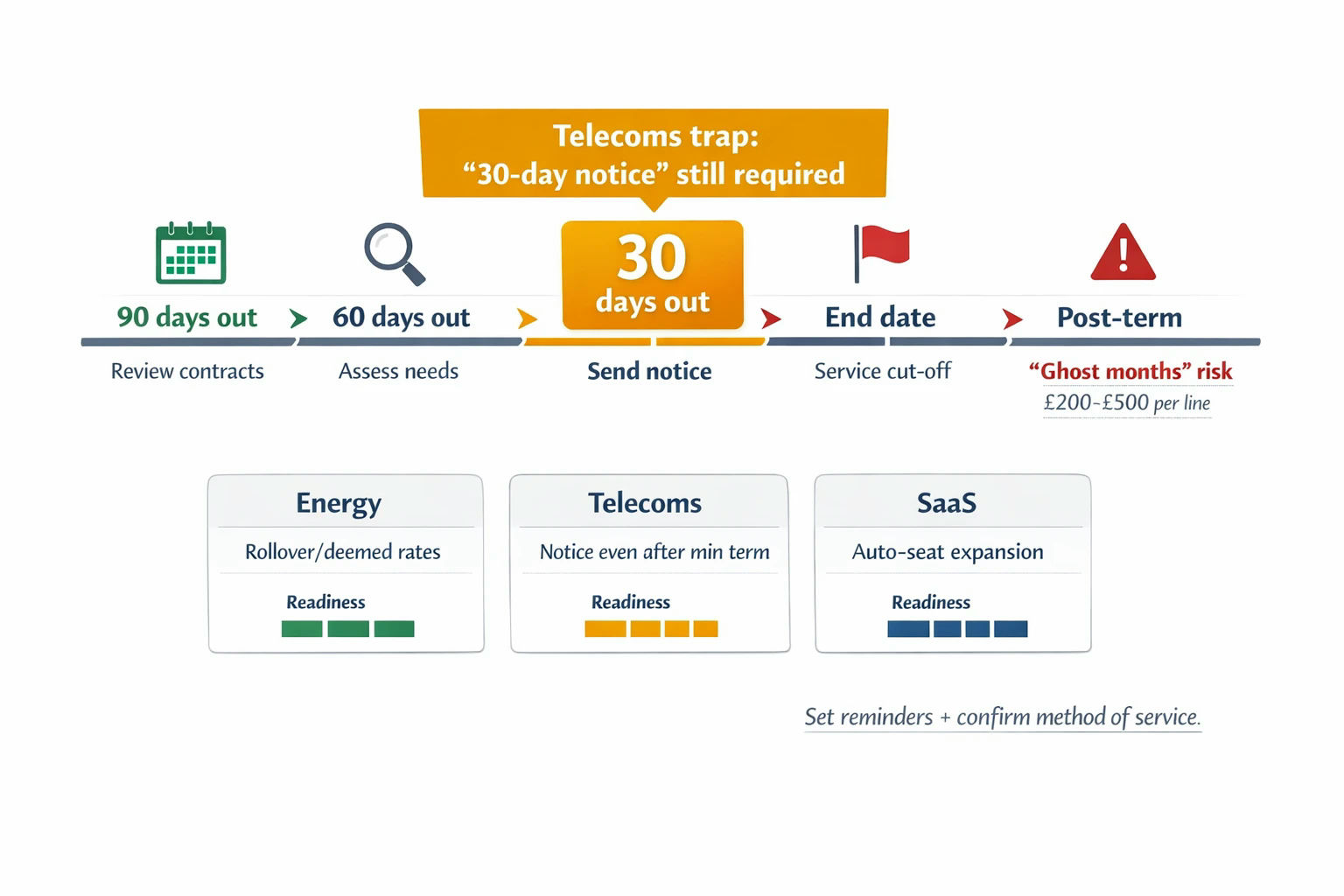
Deadlines drive outcomes. This timeline helps you map notice windows by sector so you avoid auto-renewal, rollover pricing, and costly post-term ‘ghost months’.
Energy: the rollover and the deemed rate
The biggest trap in business electricity contracts is the automatic "rollover." If you fail to provide notice within your supplier's defined window (often 60-120 days before expiry), you can be automatically locked into a new 12-month term at uncompetitive rates. If your contract simply ends and you do nothing, you’re moved onto those punishing deemed rates we mentioned earlier.
Telecoms: the 30-day 'ghost month'
In B2B telecoms, a minimum term end date does not mean the contract stops. With providers like EE, you must still provide 30 days' notice after your 24-month term is over. Missing this detail means you continue to pay for service you may not want. For a small business with several lines, this "ghost month" can easily cost £200-£500 per missed cycle.
SaaS: the auto-seat expansion
Many software-as-a-service (SaaS) contracts include a clause for automatic user seat increases. If your team grew from 20 to 25 people during the year, your contract might auto-renew for 25 seats for the next 12 months, even if some of those team members have since left. You must proactively audit your usage and right-size your license count before the notice window closes.
What happens if you miss a contract renewal deadline?
Missing the contractual notice deadline does not produce the same result in every agreement. The consequences depend on the contract, customer type and sector.
An agreement may automatically extend for another term, move onto different pricing, continue on a rolling basis or require notice before termination can take effect. In business energy, the outcome may involve an out-of-contract rate or, in different circumstances, a deemed contract.
The first step after discovering a missed deadline is therefore to read the applicable renewal, termination and post-term provisions carefully rather than assuming that the business is automatically locked in for a particular period.
If the commercial impact is significant or the contractual position is unclear, appropriate legal or specialist advice may be warranted. Businesses can also approach the supplier commercially, but any concession or waiver should be documented rather than assumed from an informal conversation.
The longer-term control is straightforward: record renewal dates centrally and trigger review before the notice deadline rather than at the expiry date.
The renegotiation playbook: three scripts for better terms
Once you’ve done your audit and know your deadline, it’s time to talk to your supplier. Vague requests get vague responses. Use clear, direct language based on your research.
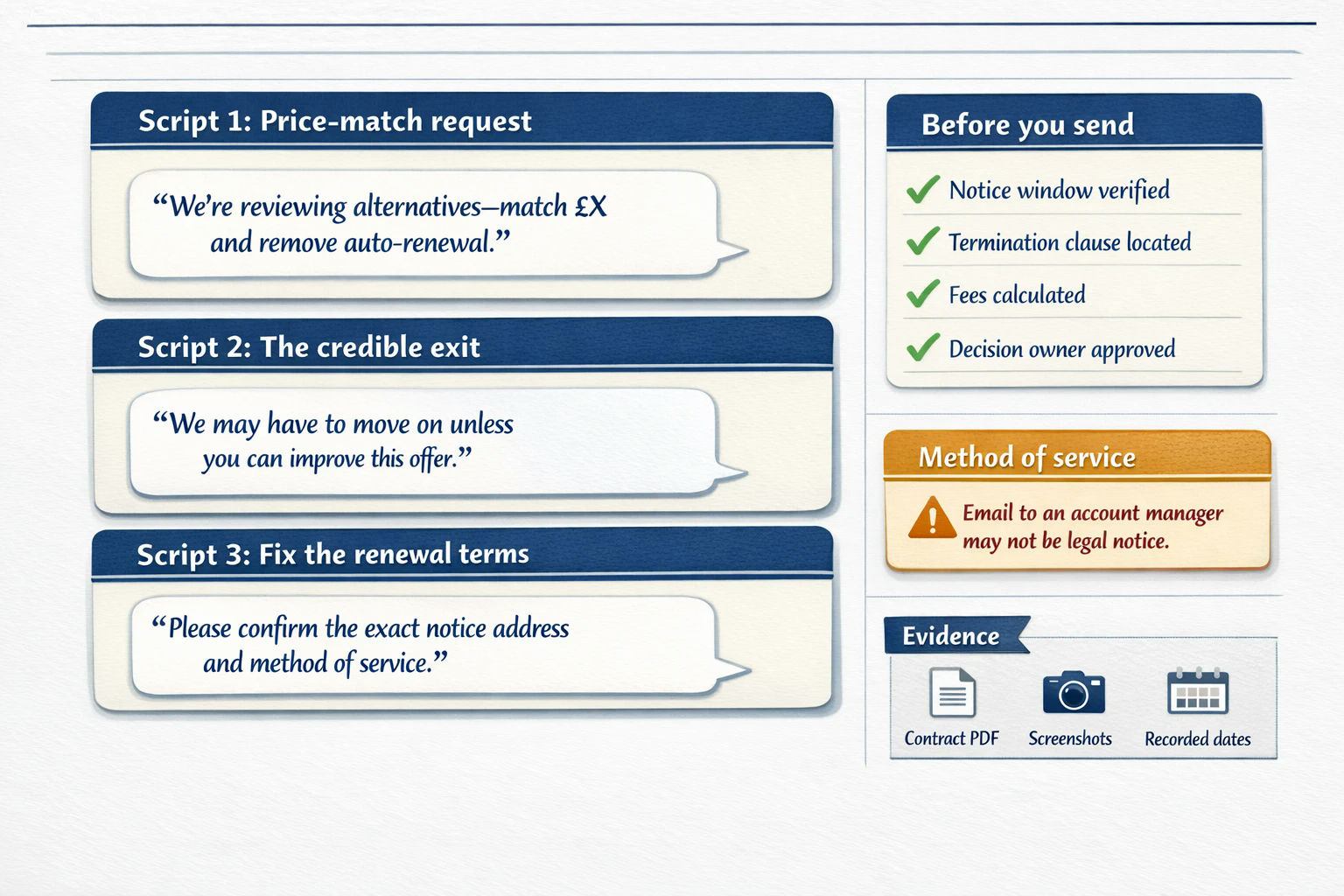
Don’t just understand the clause use it. These short scripts and pre-send checks help you renegotiate pricing, make exit credible, and avoid invalid notice mistakes.
1. The Price Match Script
Use this when you like your current provider but their renewal offer is uncompetitive.
"Hi [Account Manager Name], we're reviewing our renewal offer of [£X]. Based on our market analysis, a competitive rate for our usage profile is closer to [£Y]. Can you match this figure to retain our business for another term?"
2. The Credible Exit Script
Use this when you are prepared to leave and have an alternative offer lined up.
"Hi [Account Manager Name], please accept this email as formal notice that we will not be renewing our contract, which expires on [Date]. We have received a more favourable offer from another supplier. If you are able to present a counter-offer before [Date 14 days from now], we will consider it."
3. The 'Clarify the Process' Script
Use this before sending formal notice to avoid procedural mistakes.
"Hi [Account Manager Name], we are preparing to make a decision on our contract ending [Date]. To ensure we follow the correct procedure, could you please confirm the required method of service for a termination notice and the exact last day to provide it?"
One final check: serving a valid notice
Sending an email to your day-to-day account manager often isn't enough. Many B2B contracts specify a "Method of Service," which might require you to send a letter by recorded post to a specific legal department or submit a form through a designated online portal. Failing to follow this process can render your termination notice invalid, triggering a costly auto-renewal. Always check the fine print.
Build an internal renewal approval process
Supplier delays are not the only reason businesses miss renewal opportunities. Internal decision-making can create just as much risk.
Every material B2B contract should have an internal owner responsible for initiating the renewal review. That person does not necessarily make the final commercial decision, but they should ensure the process starts before the notice deadline.
The review may then involve procurement or commercial teams for market benchmarking, finance for budget approval, operational stakeholders for supplier-performance input and legal advisers where material contractual changes need review.
Signature authority should also be established before negotiations conclude. It creates unnecessary risk to negotiate against a hard supplier deadline and only then discover that the proposed renewal requires another layer of internal approval.
A simple internal sequence is therefore: owner initiates review → market and performance assessment → renew/renegotiate/switch recommendation → commercial approval → contractual review where required → authorised signature or valid termination notice.
How to measure contract renewal performance
Businesses with multiple supplier contracts should measure whether their renewal process itself is working.
One useful metric is the proportion of material contracts reviewed before their notice deadline. Another is the percentage of significant renewals that are competitively benchmarked rather than accepted without comparison.
You can also track unintended automatic renewals, savings or cost avoidance against the incumbent's initial renewal offer, average time from review to decision and the number of renewals delayed by missing internal approvals.
The purpose is not simply to record savings. A strong renewal process should reduce commercial surprises, prevent avoidable continuation costs and improve the quality of supplier decisions.
Take control of your next renewal cycle
Navigating the end of a business contract doesn't have to be a reactive scramble. By understanding the real regulations, performing a clear-eyed cost audit, and communicating with suppliers from a position of strength, you can turn a moment of risk into an opportunity for significant savings.
If you’re facing a complex renewal for your energy, water, or telecoms contracts, you don't have to manage it alone. The experts at GLCG provide honest advice and human support to find clear, competitive solutions tailored to your business.
Get expert support to review your energy, water or telecoms contracts, benchmark the market and secure competitive terms before critical renewal deadlines.