Oops! Something went wrong while submitting the form.
Business energy contract negotiation is no longer simply about securing the lowest unit rate. In volatile utility markets, a poorly structured contract can expose a business to unexpected charges, restrictive terms, billing disputes and operational risk long after the agreement has been signed.
For UK businesses, the most important commercial risks often sit beyond the headline price. Pass-through charges, volume tolerance, renewal provisions, termination rights, billing responsibilities and service obligations can all affect the real value of an energy contract.
This isn't about finding boilerplate legal advice. This is about gaining commercial intelligence. It's about understanding how to structure an agreement that protects you from market shocks, holds suppliers accountable, and prevents disputes before they begin.
At Green Light Consultancy Group, we help businesses move beyond surface-level negotiations and assess the complete commercial structure of an energy agreement, from pricing and contractual risk to supplier accountability and long-term contract management.
What is business energy contract negotiation?
Business energy contract negotiation is the process of agreeing the commercial, pricing, operational and risk terms of an electricity or gas supply agreement between a business and an energy supplier.
The objective is not simply to reduce the quoted price. A strong negotiation should determine how costs are calculated, which charges can change, what happens if consumption differs from forecast, how billing errors are handled, when the contract can be terminated and what service standards the supplier must meet.
In practical terms, energy contract negotiation sits between supplier selection and contract award. Once a preferred supplier has been identified, the business needs to confirm that the proposed terms reflect the commercial assumptions made during the tender and do not introduce risks that were overlooked during bid evaluation.
Energy procurement vs contract negotiation
Energy procurement and energy contract negotiation are closely related, but they are not the same process.
Business energy procurement covers the wider journey: analysing consumption, assessing the market, choosing a sourcing strategy, issuing a tender, evaluating suppliers and selecting a preferred offer. Contract negotiation focuses on the specific terms that govern the relationship once a supplier has been shortlisted or selected.
That means procurement determines which supplier and commercial structure best fit the business, while contract negotiation determines exactly what the business is agreeing to.
For a broader view of the sourcing process, see our guide to the business energy procurement process.
How to prepare for a business energy contract negotiation
A successful negotiation starts before commercial terms are discussed. Suppliers price and structure contracts around the information provided by the customer, so incomplete or inaccurate data can weaken the negotiating position from the outset.
Before entering negotiations, a business should understand its historical consumption, current contract end date, meter and site details, expected changes in demand and any operational factors likely to affect future usage. Multi-site businesses may also need to reconcile site lists, MPAN or MPRN data and individual contract arrangements before approaching the market.
Internal objectives should also be clear. A business seeking maximum budget certainty may negotiate very differently from one willing to accept greater price exposure in exchange for flexibility. Contract duration, risk appetite, cash-flow requirements and future expansion or closure plans can all influence the terms worth prioritising.
Just as importantly, the organisation should establish who has authority to negotiate, approve and sign the contract before supplier discussions begin.
Choosing your pricing model: Fixed vs. flexible in 2026
The first major decision in any energy contract negotiation is the pricing structure. This choice goes far beyond a simple rate comparison; it defines your business's entire approach to risk management in the utility market. Many businesses default to one model without fully evaluating how it aligns with their operational needs and financial forecasts.
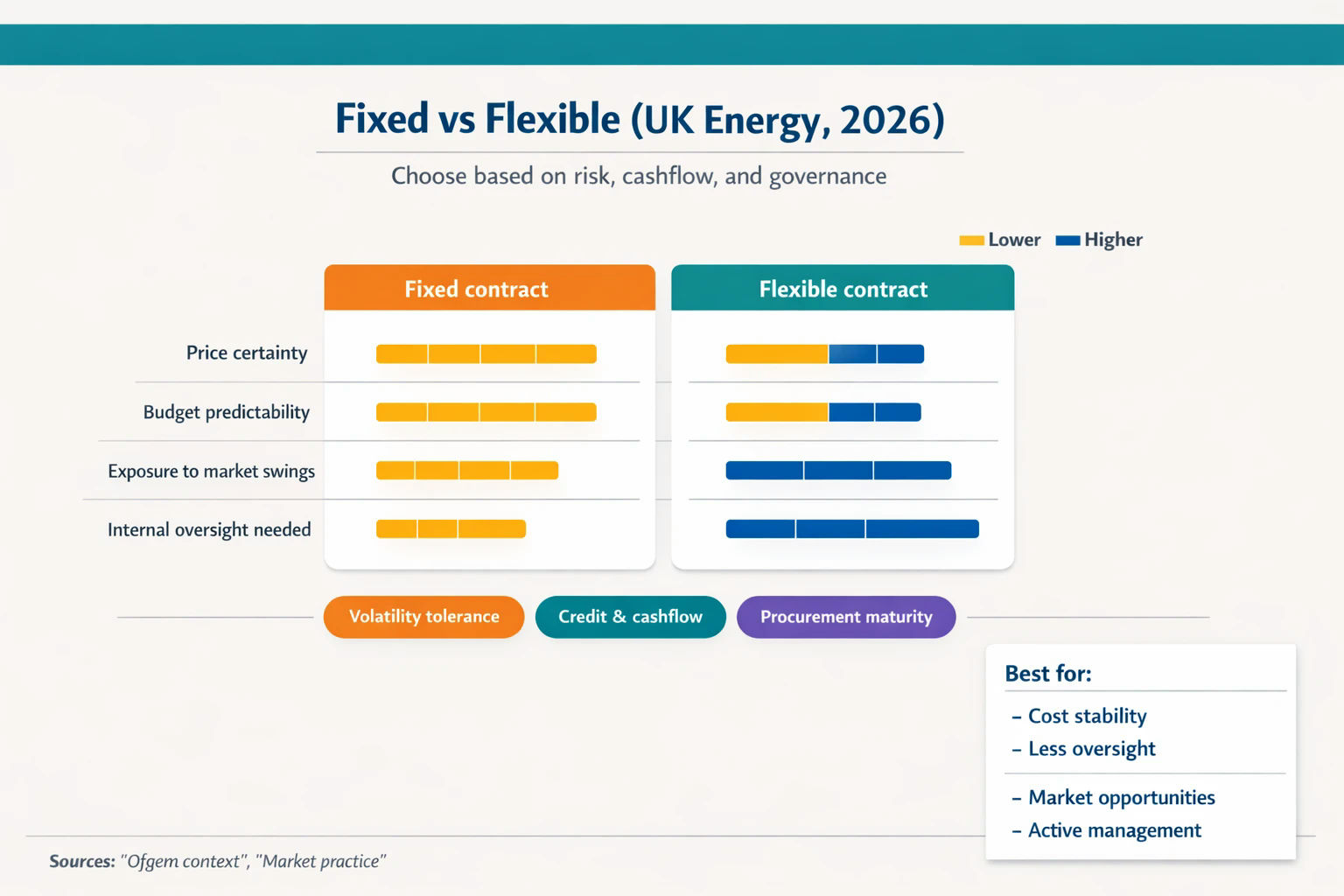
A fixed-price contract offers budget certainty by locking in a specific rate for the duration of the term. This is often ideal for businesses with predictable consumption patterns and a low appetite for risk. In contrast, a flexible or pass-through contract allows you to buy energy in tranches from the wholesale market, offering potential savings if the market moves in your favour but also exposing you to price spikes. Evaluating your own volume tolerance and cash flow is the critical first step before you even begin to discuss rates with a supplier.
A fast way to sanity-check whether fixed or flexible pricing fits your risk appetite before you negotiate unit rates, volume tolerances, and pass-through clauses.
The 60% rule: Uncovering the costs you aren't negotiating
Non-commodity costs can represent a substantial proportion of a UK business eletricity bill. The exact percentage varies according to the customer, consumption profile, contract structure and prevailing network, policy and market costs, so any specific "60% rule" should be supported by current evidence relevant to the customer type being discussed.
The commercial principle behind the rule remains important: negotiating only the kWh rate can mean concentrating on one part of the total energy cost while overlooking contractual mechanisms that determine exposure elsewhere.
Business energy bills can include commodity costs alongside network charges, policy-related costs and other non-commodity components. Although a business cannot negotiate away a statutory charge or regulated network cost, it can examine how its supplier proposes to treat that cost within the contract.
This makes the distinction between fixed and pass-through costs particularly important. The contract should make clear which components are incorporated into the agreed price, which can change and how future adjustments will be calculated.
Focusing solely on the kilowatt-hour (kWh) rate means you are effectively ignoring other potentially significant elements of your final bill. A strategic negotiation focuses on the structure of the contract to mitigate exposure to changing costs where the contractual terms allow them to be passed through.
The 60% rule: Uncovering the costs you aren't negotiating
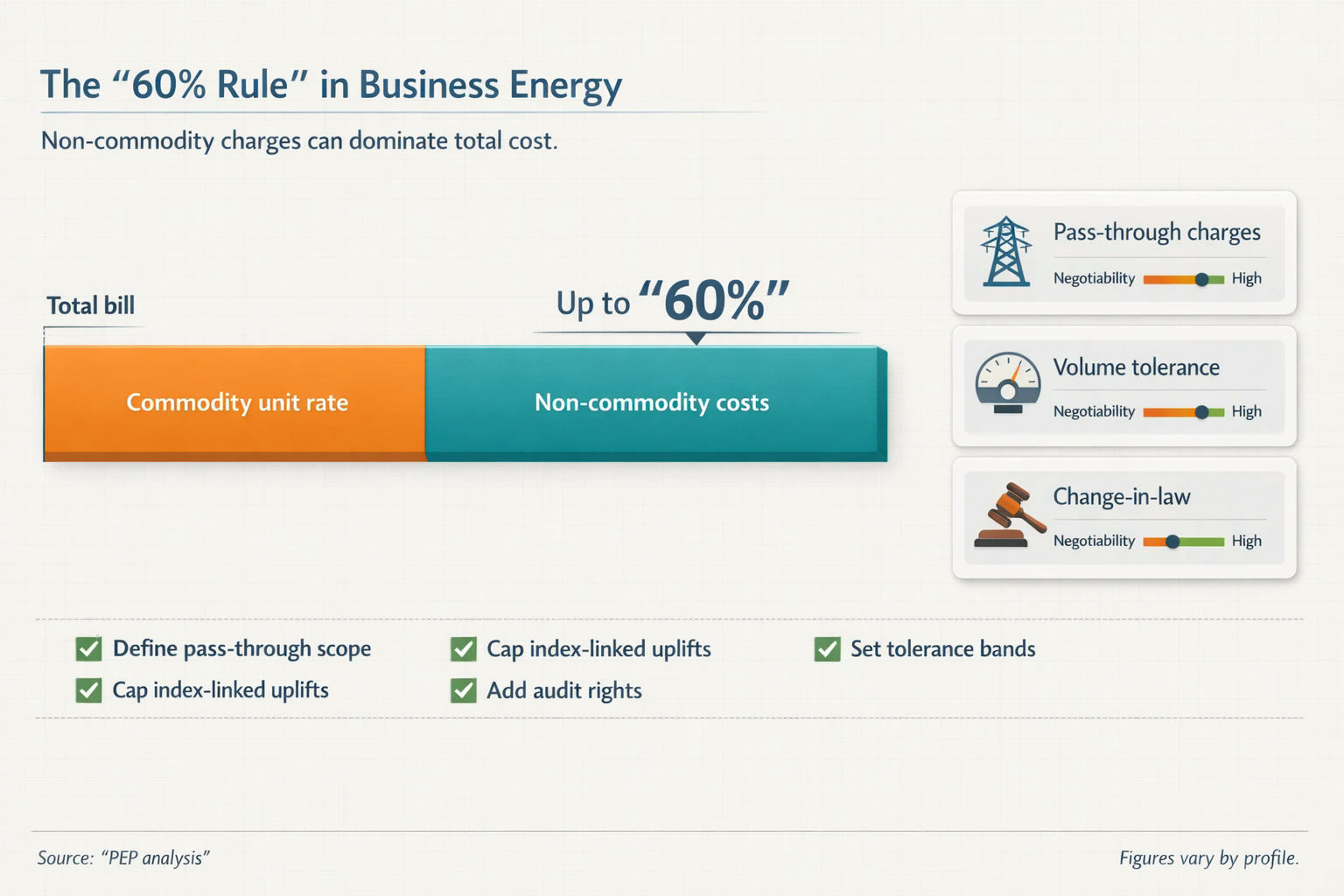
Here's a fact that surprises most decision-makers: up to 60% of a UK business energy bill is composed of non-commodity costs. These are the taxes, levies, and distribution charges that are often presented as non-negotiable. While you can't change the tax rate itself, you can absolutely negotiate the contractual clauses that determine your exposure to these fluctuating costs.
Focusing solely on the kilowatt-hour (kWh) rate means you are effectively ignoring the majority of your potential bill. A strategic negotiation focuses on the structure of the contract to mitigate these pass-through charges.
Auditing for hidden risk: Key clauses to scrutinise
Volume Tolerance: This clause defines how much your actual energy usage can deviate from your forecast before financial penalties are applied. A tight tolerance of 5-10% can be costly for a growing or seasonal business, whereas negotiating a wider band of 20-30% provides critical operational flexibility.
Pass-Through Charges: Your contract must clearly define which non-commodity costs are passed through to you and how. Can the supplier introduce new charges mid-contract? Is there a cap? Without explicit terms, you are exposed to unpredictable cost increases that have nothing to do with your consumption.
If you only negotiate the unit rate, you may miss most of the bill. Use this audit view to pinpoint the clauses that control non-commodity exposure.
Other clauses deserve the same scrutiny. Change-of-law provisions can determine whether regulatory or industry changes permit price adjustments. Payment and credit clauses can create requirements for deposits or additional security. Site addition and removal clauses can affect businesses whose estates are changing, while metering and data provisions determine responsibility when consumption information is incomplete or inaccurate.
The important question for every clause is therefore the same: what event triggers it, who bears the resulting risk and how is the financial impact calculated?
If you only negotiate the unit rate, you may miss the contractual mechanisms that determine how other elements of the bill are treated. Use this audit view to identify where additional cost exposure may sit.
Termination, renewal and change-of-law clauses
Some of the most important business energy contract terms only become relevant when circumstances change. Termination, renewal and change-of-law provisions should therefore be reviewed before signature rather than when the business eventually needs to rely on them.
Termination rights
The contract should specify when either party can terminate, the notice required and the financial consequences of early termination. Businesses should also understand what happens if a site closes, a property is sold or another operational change means the original supply requirement no longer exists.
A termination clause that appears unimportant at contract award can become commercially significant when the organisation restructures or its property portfolio changes.
Renewal provisions
Businesses should identify the contract end date, any notice requirements and what happens if no replacement contract is agreed before expiry. Where renewal mechanisms apply, the organisation should understand whether terms or prices change and what action is required to prevent an unwanted extension.
Contract renewal dates should be actively managed rather than discovered shortly before expiry. Starting the review process early also gives the business greater time to assess the market and negotiate from a stronger position.
Change-of-law provisions
A change-of-law clause can allocate costs arising from new legislation, regulation or industry requirements. Businesses should understand what qualifies as a relevant change, whether the supplier can adjust charges and what evidence or calculation must support that adjustment.
The objective is not necessarily to transfer every external risk to the supplier. It is to ensure that the mechanism for dealing with change is clear and proportionate.
Setting the standard: Your 2026 SLA benchmark matrix
A Service Level Agreement (SLA) without specific, measurable targets is commercially useless. Vague terms like "reasonable efforts" or "prompt response" leave you with no recourse when service fails. In 2026, market standards for key utilities have become much clearer, and your contracts should reflect this reality.
When evaluating a telecoms, energy, or payment services contract, you need to compare the proposed SLAs against current industry benchmarks. This ensures you're not accepting sub-standard service terms that could impact your operations.
What market-standard performance looks like in 2026
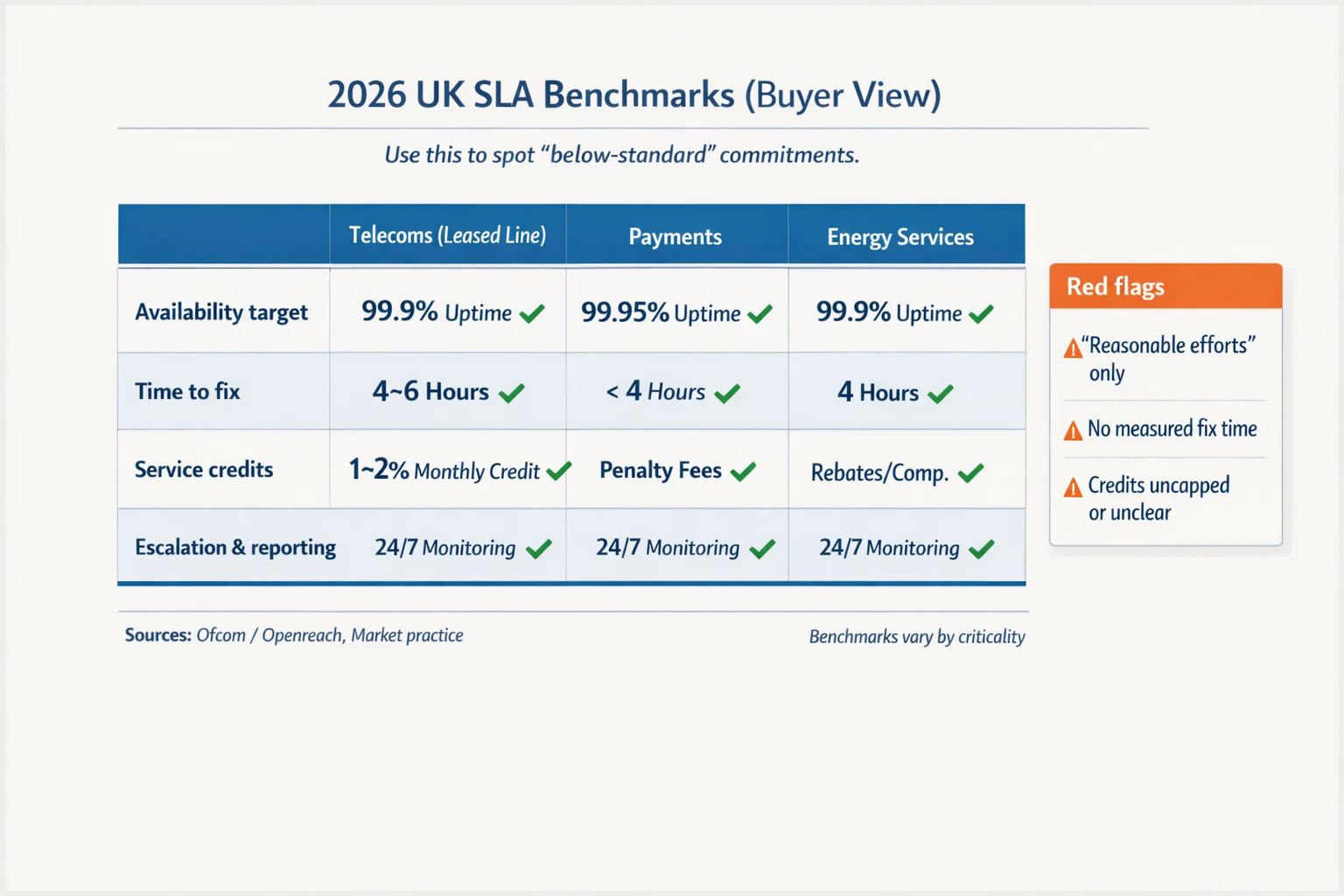
Business Telecoms: For critical services like leased lines, the target "fix time" for a complete outage is now between 4 and 6 hours, according to Ofcom and Openreach regulatory KPIs. Any SLA proposing a 24-hour fix time is no longer competitive for a business-critical connection. Uptime guarantees should be 99.9% or higher.
Payment Services: Transaction processing uptime should be at least 99.95%. The SLA should also specify the resolution time for settlement or funding delays, which can directly impact your cash flow.
Energy Metering: Your contract should clearly state the supplier's responsibility and timeline for resolving meter faults or data communication errors, as these can lead to inaccurate billing and costly estimates.
Bring this benchmark table to negotiations to challenge vague SLAs and quantify what happens when performance drops below standard.
From contract to control: A framework for preventing disputes
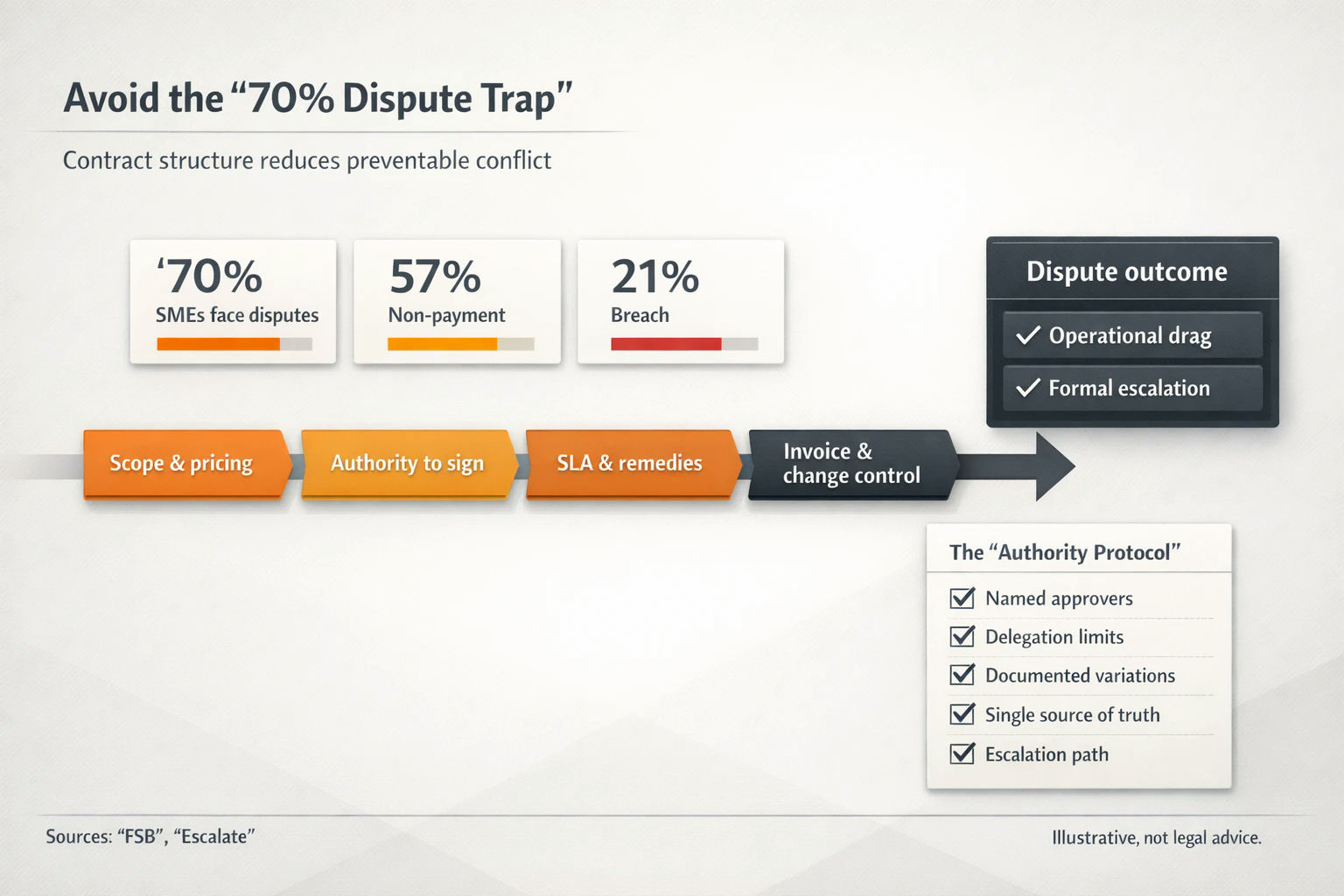
The fact that 70% of SMEs face commercial disputes highlights a systemic failure in how contracts are managed from the outset. A strong contract is your first and best line of defense. Prevention starts long before a signature is required. It requires a clear internal framework for negotiation, authority, and ongoing management.
The authority protocol: Defining who can commit the business
A common trigger for disputes is a misunderstanding over who has the authority to agree to terms. A salesperson might agree to a verbal change, or a junior manager might sign a renewal without proper diligence. Your business needs a clear protocol that defines:
Who has the financial authority to sign contracts of different values.
The mandatory internal review process before any contract is signed.
How contract variations and renewals are approved and documented.
Without this governance, you risk being locked into unfavourable terms by a well-intentioned but unauthorised employee.
A robust contract isn't a restrictive document; it's an operational tool that provides clarity, sets expectations, and protects your business. By shifting your focus from just the price to the underlying structure, you build commercial resilience that pays dividends long after the negotiation is over.
Create a formal change-control process
Energy contracts can run for several years, during which sites, consumption requirements, regulations and commercial circumstances may change. Contract variations should therefore be controlled rather than agreed informally.
Each material variation should identify what is changing, why the change is required, who approved it, when it becomes effective and whether it alters price, risk or supplier obligations.
Verbal assurances should not be relied upon where the issue is commercially important. If a supplier agrees that a charge will not apply or that a particular service will be provided, the commitment should be incorporated into the contract or formally documented.
Define the dispute escalation process
The contract should also establish what happens when the parties disagree. Routine account queries should have a clear escalation path so they can be addressed before developing into formal disputes.
Billing disputes in particular should specify how an invoice is challenged, what evidence is required, whether disputed sums remain payable and when the issue moves to formal escalation.
Disputes are rarely “bad luck.” Clear authority, measurable SLAs, and disciplined change control reduce the most common triggers before they become costly escalations.
What should you check before signing a business energy contract?
Before signing, review the proposed energy agreement as a complete commercial package rather than checking only whether the unit rate matches the supplier's quotation.
Confirm exactly what is included in the price and which charges can change. Check the contract duration, consumption assumptions, volume tolerance, payment terms, billing responsibilities and any credit or security requirements. The business should also understand the supplier's service obligations and what remedies are available if those standards are not achieved.
Termination and renewal provisions deserve a final review. Confirm the end date, notice requirements, early termination consequences and what happens if a site closes or the business's requirements change.
The detailed agreement should also be compared with the tender response and commercial proposal. Any material difference between what was offered and what appears in the final terms should be resolved before signature.
Finally, make sure the person signing the agreement has appropriate authority and that the executed contract, schedules, agreed amendments and supporting commercial documents are stored together.
Where the financial or legal consequences are significant, appropriate professional legal and commercial review should be obtained before execution.
Common business energy contract negotiation mistakes
One of the most common mistakes is spending most of the negotiation on a small reduction in the unit rate while giving limited attention to clauses capable of creating much larger costs later.
Another is assuming that "fixed price" means the entire bill cannot change. The contract itself should determine which elements are genuinely fixed and which remain adjustable.
Businesses can also weaken their negotiating position by using inaccurate consumption data, overlooking existing termination requirements or failing to account for expected changes in their property portfolio or operations.
Relying on verbal assurances is another avoidable risk. Material commitments relating to pricing, service, renewals or charges should be documented within the contractual framework.
Finally, contract negotiation should anticipate the full lifecycle of the agreement. Billing problems, site changes, consumption fluctuations, regulatory developments, disputes, renewal and eventual exit are all foreseeable events that can be addressed before signature.
If you're concerned about the hidden risks in your current utility contracts or preparing for a critical renewal, a professional review can provide the clarity you need. Our team at GLCG offers independent, expert analysis to help you secure terms that are fair, transparent, and built for the realities of the 2026 market.
Protect Your Business Before You Sign
Get an independent review of your business energy contract to uncover hidden costs, reduce commercial risk and negotiate clearer, stronger terms.