Oops! Something went wrong while submitting the form.
Accepting card payments is no longer a choice for most UK businesses; it is a necessity. Yet, the cost of this service can vary dramatically, with complex statements and hidden charges often obscuring the true price. A low advertised transaction rate rarely tells the whole story, making a direct comparison between providers difficult without a deeper understanding of how the system works.
Business card payment services have become an essential part of modern commerce. Whether customers pay in-store, online, over the phone, or through mobile devices, businesses need secure, reliable payment processing that supports customer expectations while protecting profitability. Selecting the right merchant services provider affects transaction costs, cash flow, customer experience, and the ability to grow efficiently.
This guide explains how business card payment services work, compares merchant fees and providers, explores the different types of payment solutions available, and provides a practical framework for choosing the right merchant account for your business.
Why Business Card Payment Services Matter
The way customers choose to pay has changed dramatically over the past decade. Contactless cards, digital wallets, online payments, and mobile transactions have become everyday expectations across almost every industry. Businesses that offer fast, secure, and flexible payment options often improve customer satisfaction while reducing abandoned purchases and lengthy checkout times.
Modern business card payment services also provide operational advantages beyond simply accepting payments. Integrated reporting, automated reconciliation, cloud-based dashboards, fraud protection, and faster settlement times help businesses manage cash flow more effectively while reducing administrative work.
As organisations continue adopting digital technologies, payment processing has become an important part of the wider customer experience. Choosing the right provider therefore supports both operational efficiency and long-term business growth.
What Are Merchant Services?
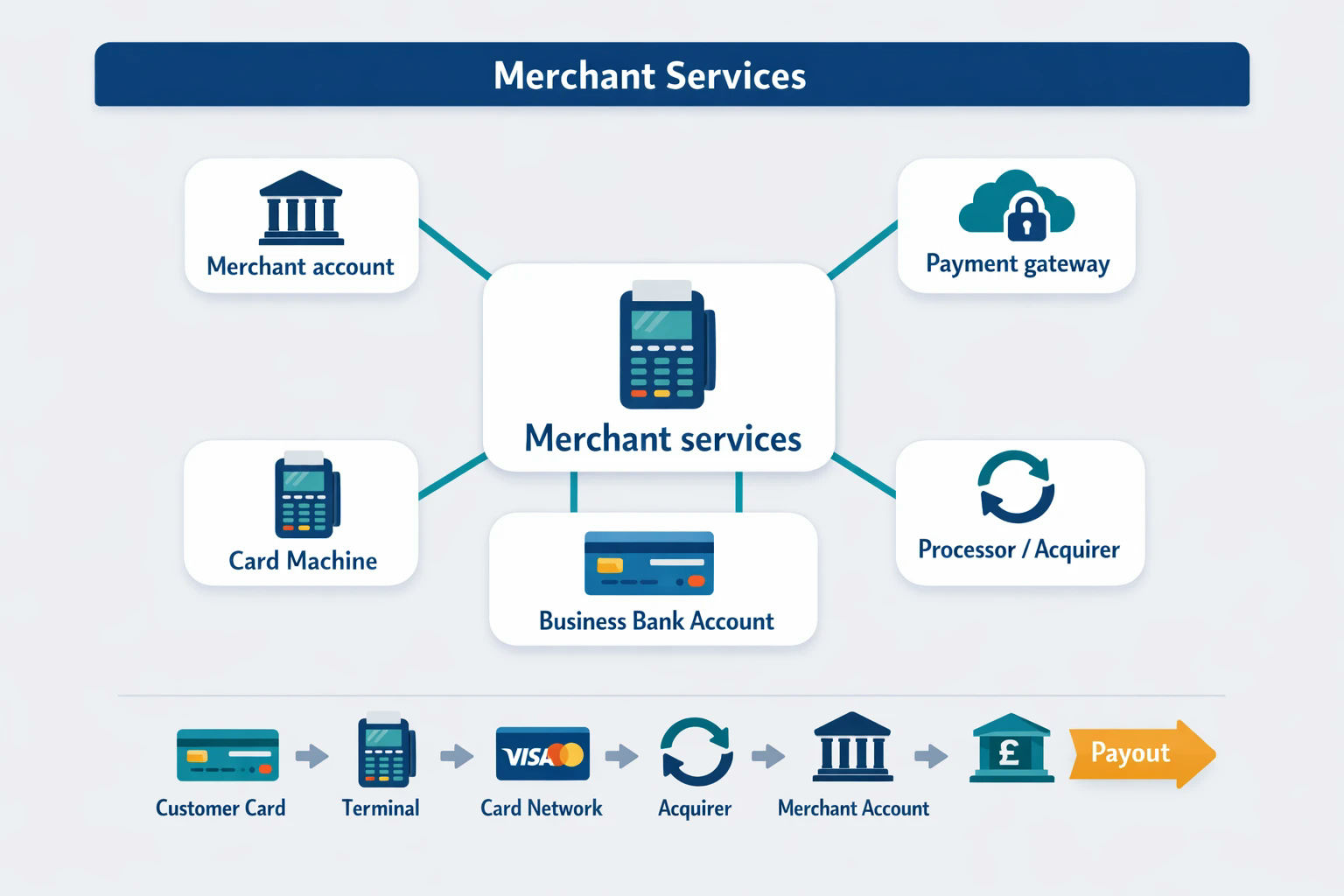
Merchant services are the systems and accounts that let a business accept card payments from customers. These services act as the essential link between your customer's bank, your business bank account, and card networks like Visa and Mastercard. To enable business card payments, you typically need a merchant account to receive the funds, a payment gateway to securely process the transaction, and the hardware or software to capture the card details.
Business card payment services include all the technology, financial infrastructure, and software required to process debit card, credit card, contactless, and digital wallet payments securely. They support businesses operating in physical locations, online stores, mobile environments, or a combination of multiple sales channels.
Although many businesses refer to these services simply as "merchant services," they actually consist of several connected components working together. Payment terminals capture customer card details, payment gateways securely transmit transaction data, merchant accounts receive settlement funds, acquiring banks authorise transactions, and payment processors coordinate communication between every stage of the payment journey.
Understanding how these components interact makes it much easier to compare providers and identify where costs are generated.
Types of Business Card Payment Services
Business card payment services are available in several forms depending on how customers make purchases. Many organisations use more than one payment method to create a seamless customer experience across different sales channels.
In-Store Card Payments
Traditional face-to-face transactions remain the most common form of card payment for retailers, hospitality businesses, healthcare providers, and many service industries. Customers pay using card machines, contactless devices, smartphones, or digital wallets such as Apple Pay and Google Pay.
Online Payment Processing
Businesses selling products or services online require a payment gateway that securely authorises digital transactions. Online payment services integrate directly with eCommerce platforms, allowing customers to complete purchases using debit cards, credit cards, or digital payment methods.
Telephone Payments
Many businesses continue accepting payments over the phone, particularly within professional services, travel, hospitality, and business-to-business sales. Secure virtual terminals allow staff to process customer card details without requiring physical card readers.
Recurring Payments
Subscription-based businesses often use recurring payment services that automatically collect regular customer payments. These solutions reduce administration while improving payment consistency for memberships, software subscriptions, maintenance contracts, and ongoing services.
Together, these payment methods allow businesses to create an omnichannel payment strategy that meets customer expectations regardless of how they choose to buy.
How Card Payment Fees Work
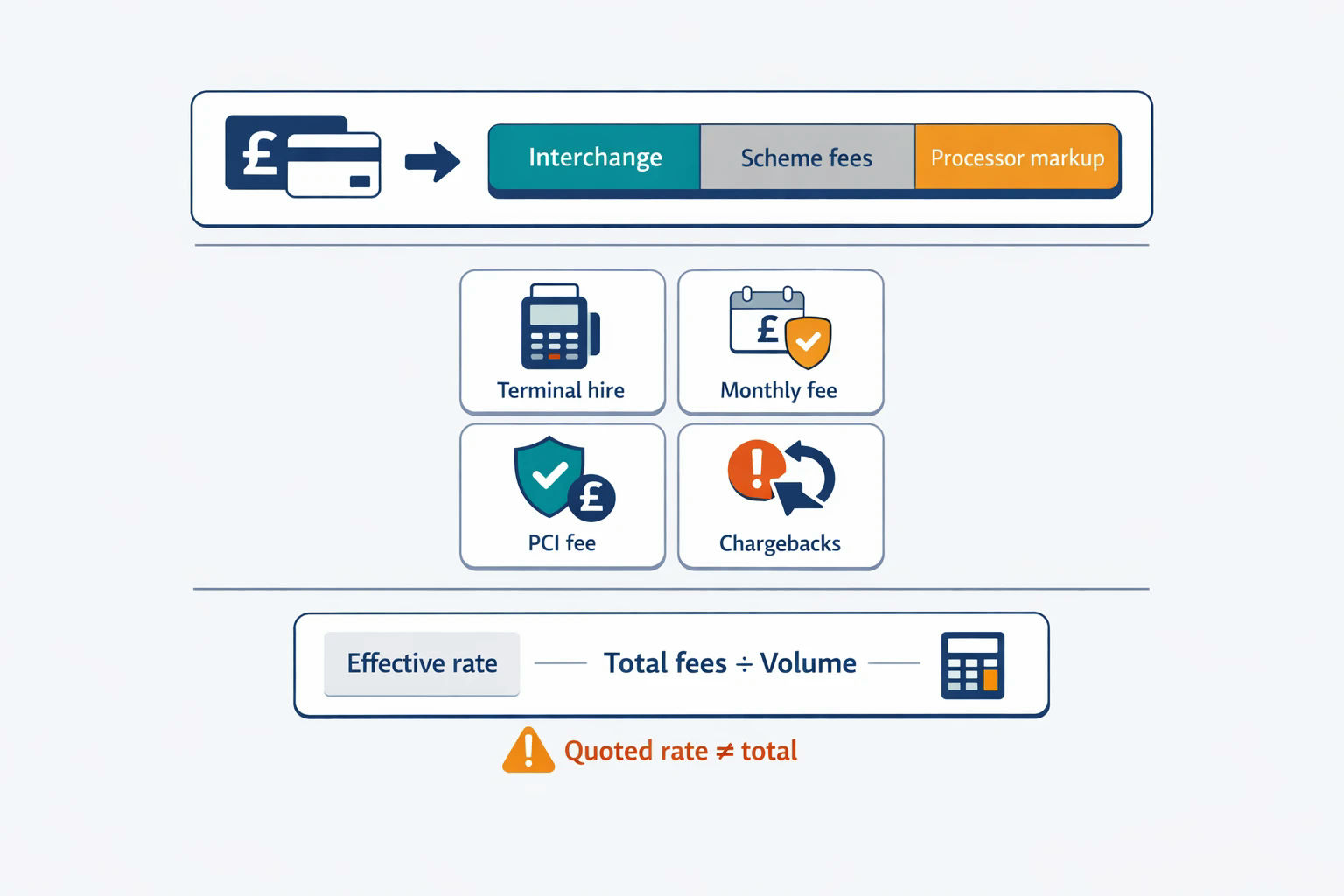
Card payment fees are the charges a business pays to a provider for processing a customer's card transaction. These fees are not a single charge but a combination of several different costs that are bundled together. Understanding this bundle is the first step to uncovering your true processing costs.
Key components of your payment processing fees include:
Interchange Fee: This is the largest part of the fee, paid to the customer's card-issuing bank (e.g., Lloyds, Barclays). The rate is set by the card scheme (Visa, Mastercard) and varies based on card type, with corporate credit cards costing more to process than standard debit cards.
Scheme Fee: A smaller fee paid to the card scheme itself for using its network.
Merchant Service Charge (MSC): This is the acquirer's or processor's markup. It is their profit for facilitating the transaction and is the most negotiable part of the fee.
Terminal Hire: A fixed monthly cost for renting the card machine.
Other Monthly Fees: Providers may also charge for services like PCI compliance (data security), minimum monthly service charges if your transaction volume is low, and statement fees. These are often where hidden costs accumulate.
Merchant Account vs Payment Gateway
One of the most common areas of confusion when comparing business card payment services is the difference between a merchant account and a payment gateway. Although they work closely together, they perform completely different functions.
A merchant account is a specialist business account used to temporarily hold customer payment funds after transactions are authorised. Once processing is complete, the funds are settled into your normal business bank account according to your provider's settlement schedule.
A payment gateway, by contrast, securely transfers payment information between your customer, card network, acquiring bank, and merchant account. It encrypts sensitive payment data, performs fraud screening, and authorises transactions in real time.
Businesses accepting online payments require both services. Even businesses operating solely in physical locations often rely on gateway technology built directly into modern payment terminals. Understanding this distinction helps businesses compare providers more accurately while avoiding unnecessary service duplication.
Types of Card Machines and Readers
A card machine for business is the physical device used to accept face-to-face payments. The three main types serve different operational needs.
Countertop: These devices connect via a cable to your point-of-sale system and are ideal for businesses with a fixed payment location, such as a retail shop or reception desk.
Portable: Working via Bluetooth or Wi-Fi, these machines allow you to take payments away from the till but within your premises. They are common in restaurants and cafes for taking payment at the table.
Mobile: A mobile card reader for business uses a mobile data connection (SIM card) or pairs with a smartphone, allowing you to accept payments anywhere. This makes them perfect for tradespeople, market stalls, and delivery services.
Benefits of Modern Business Card Payment Solutions
Today's business card payment services provide considerably more value than simply processing customer transactions. Modern payment solutions improve operational efficiency, customer experience, reporting accuracy, and business scalability.
One of the biggest advantages is faster checkout. Contactless payments, mobile wallets, and integrated payment terminals reduce transaction times while improving the customer experience during busy periods.
Integrated reporting provides another significant benefit. Many merchant services platforms automatically generate sales reports, reconcile transactions, and provide real-time dashboards that help businesses monitor performance without relying on manual administration.
Security has also improved substantially. PCI-compliant payment systems, encrypted transactions, tokenisation, and fraud detection technologies help protect sensitive customer payment information while supporting regulatory compliance.
Modern payment solutions also integrate with accounting software, EPOS platforms, inventory management systems, and customer relationship management (CRM) software. These integrations reduce duplicate data entry while improving financial reporting and operational visibility.
Finally, scalable payment infrastructure allows businesses to expand confidently. Additional payment terminals, online payment channels, new locations, and remote payment options can often be added without replacing the underlying merchant services platform.
Comparing Merchant Service Providers
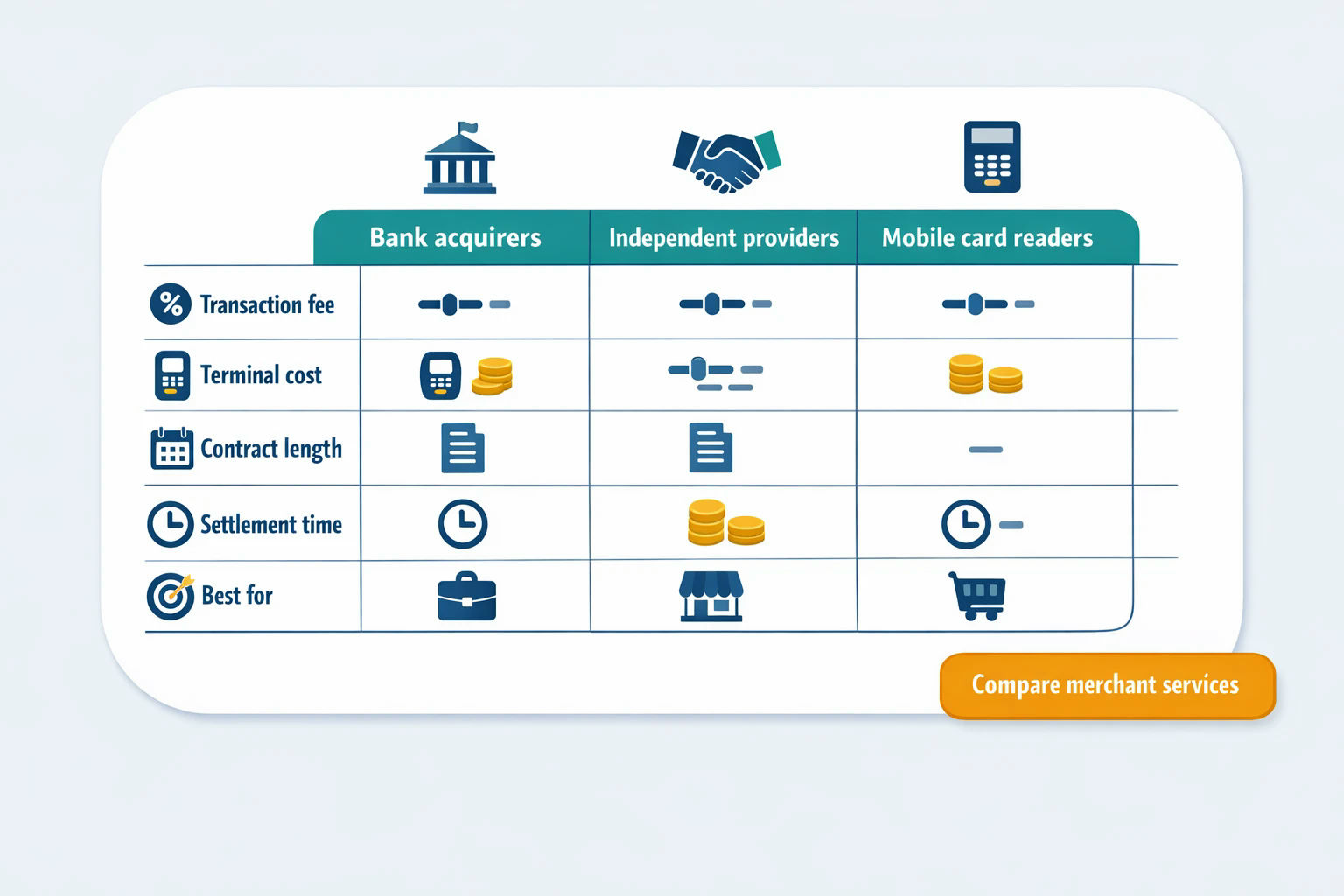
Choosing a card payment provider involves comparing more than just the headline transaction rate. Businesses in the UK typically choose from bank acquirers, independent providers, or mobile-first solutions, each with its own model.
Here is how you can compare merchant services across different provider types:
Feature
Bank Acquirers (e.g., Barclaycard, Tyl by NatWest)
Typically lower variable rates based on transaction volume and card type.
Competitive pricing with tailored models including blended or interchange-plus pricing.
Simple flat-rate pricing for all cards.
Hardware
Monthly terminal rental.
Monthly terminal rental or purchase options.
Usually one-off purchase of the card reader.
Contract Length
Commonly 12–24 months.
Usually 12–36 months.
Pay-as-you-go with no long-term commitment.
Settlement Times
Typically 1–3 business days.
Usually 1–3 business days, with some next-day options.
Often 1–2 business days.
Best For
Established businesses with higher transaction volumes.
SMEs seeking personalised pricing and support.
Small businesses, start-ups, mobile traders, and occasional users.
When comparing providers, businesses should also evaluate factors beyond transaction pricing. Settlement speed affects cash flow, while customer support, reporting capabilities, software integrations, scalability, and technical assistance all influence the overall value of a merchant services provider.
Some providers specialise in particular industries, offering integrated hospitality, retail, healthcare, or professional services solutions that streamline daily operations. Choosing a provider with experience in your sector can often simplify implementation while improving long-term support.
How to Choose a Merchant Services Provider
Choosing the right provider requires a methodical approach that prioritises clarity and aligns with your business operations. Follow these steps to make an informed decision and secure the best terms for your merchant account.
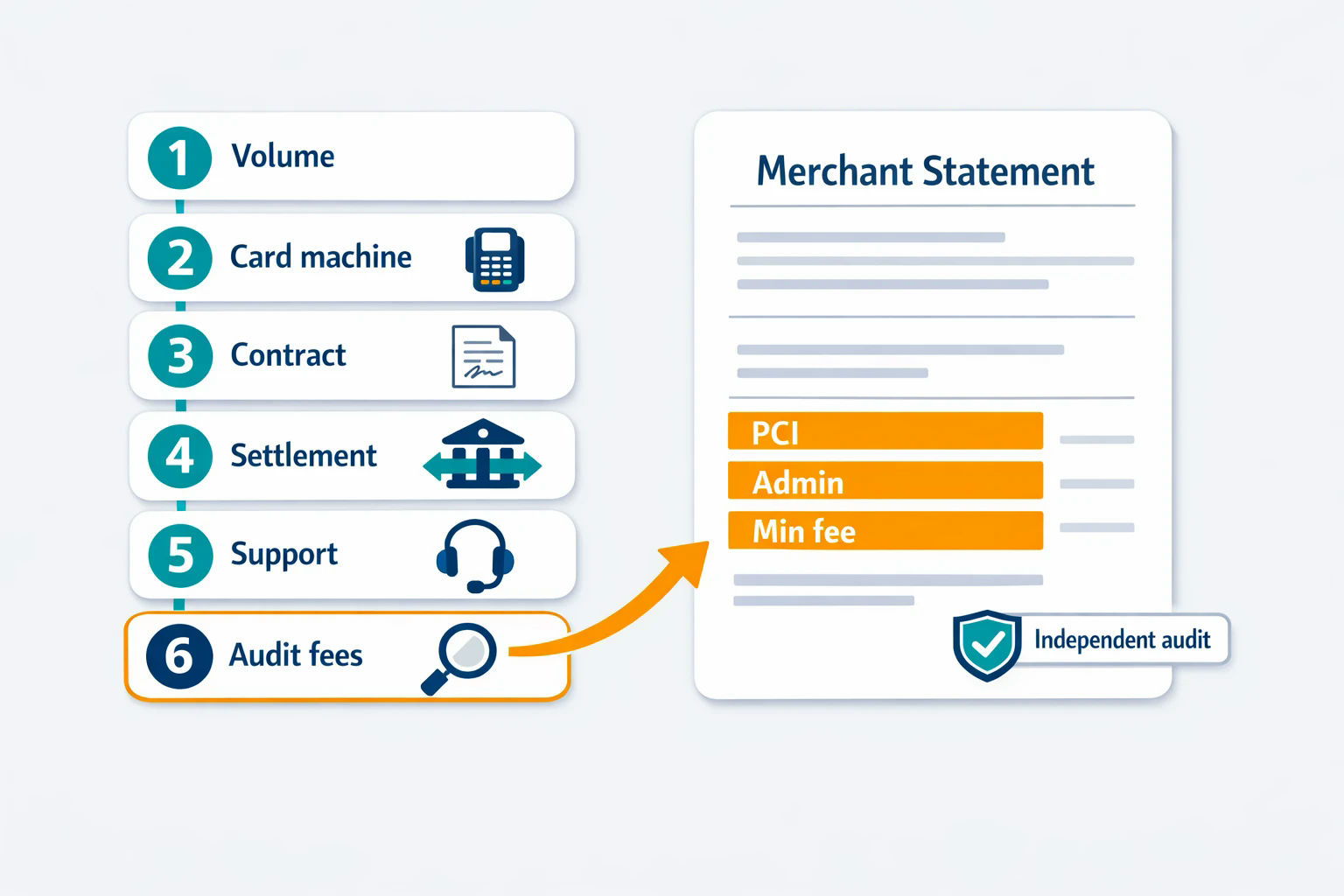
Assess Your Sales Volume: Calculate your average monthly card turnover and the number of transactions. Higher volumes often qualify for lower percentage rates.
Identify Your Transaction Type: Determine if you primarily take payments in person, online, or over the phone. This will dictate the hardware and software you need.
Compare Hardware and Software: Does the provider's card machine and point-of-sale software fit your workflow? Check for one-off purchase costs versus ongoing rental fees.
Scrutinise the Contract: Look carefully at the contract length, early termination fees, and any monthly minimum charges. Avoid getting locked into long-term agreements without understanding the exit clauses.
Demand Fee Transparency: Ask for a full fee schedule. The most critical step is to understand every potential charge beyond the transaction rate. Hidden fees for PCI compliance, authorisations, and other administrative tasks can significantly increase your total cost.
The complexity of provider statements makes it difficult for business owners to spot these extra charges. An independent audit of your existing merchant statements can uncover hidden fees and provide a clear, like-for-like comparison of what you could be paying. This ensures your final decision is based on the true, effective cost.
Common Mistakes When Choosing Merchant Services
Choosing the wrong business card payment services provider can increase operating costs, reduce profitability, and create unnecessary administrative work. Many businesses focus on the advertised transaction rate while overlooking the wider factors that determine the true cost and effectiveness of a payment solution.
Comparing Transaction Fees Only
A low headline transaction percentage may appear attractive, but it rarely reflects the total cost of payment processing. Monthly service fees, PCI compliance charges, terminal rental, gateway costs, authorisation fees, and minimum monthly charges can significantly increase your overall costs. Always compare the effective monthly cost rather than a single advertised percentage.
Ignoring Contract Terms
Long-term contracts often include automatic renewals, notice periods, and early termination charges. Understanding these conditions before signing allows businesses to retain flexibility if operational requirements change or more competitive providers become available.
Choosing the Wrong Payment Terminal
Selecting payment hardware that doesn't match your business operations can reduce efficiency. For example, restaurants often benefit from portable terminals, retailers typically require countertop devices integrated with EPOS systems, while mobile businesses usually need portable card readers operating over mobile data networks.
Overlooking Software Integration
Modern business card payment services should integrate with accounting software, EPOS systems, inventory management platforms, customer relationship management (CRM) software, and eCommerce platforms wherever possible. Integration reduces manual administration while improving reporting accuracy and operational efficiency.
Not Reviewing Settlement Times
Settlement speed directly affects business cash flow. Businesses with high transaction volumes or tight operating margins should understand exactly how quickly providers transfer processed funds into their business bank account. Faster settlements can improve working capital and day-to-day financial management.
Ignoring Customer Support
Technical problems with payment processing can immediately impact revenue. Choosing a provider with responsive UK-based support, dedicated account management, and strong service level agreements helps minimise disruption if issues arise.
At Green Light Consultancy Group, we specialise in simplifying complex commercial services. Our experts analyse your current payment processing statements to identify hidden costs and find fairer, more transparent providers tailored to your business needs, offering ongoing support to ensure you always have the best solution in place — and can bundle it with your business energy for a single, simpler set of bills.
Find a Better Card Payment Deal
Unsure whether you’re paying too much for merchant services? Green Light Consultancy Group can review your current fees, identify hidden charges, and help you compare transparent payment solutions suited to your business. Speak to our experts today and start reducing unnecessary costs.