Oops! Something went wrong while submitting the form.
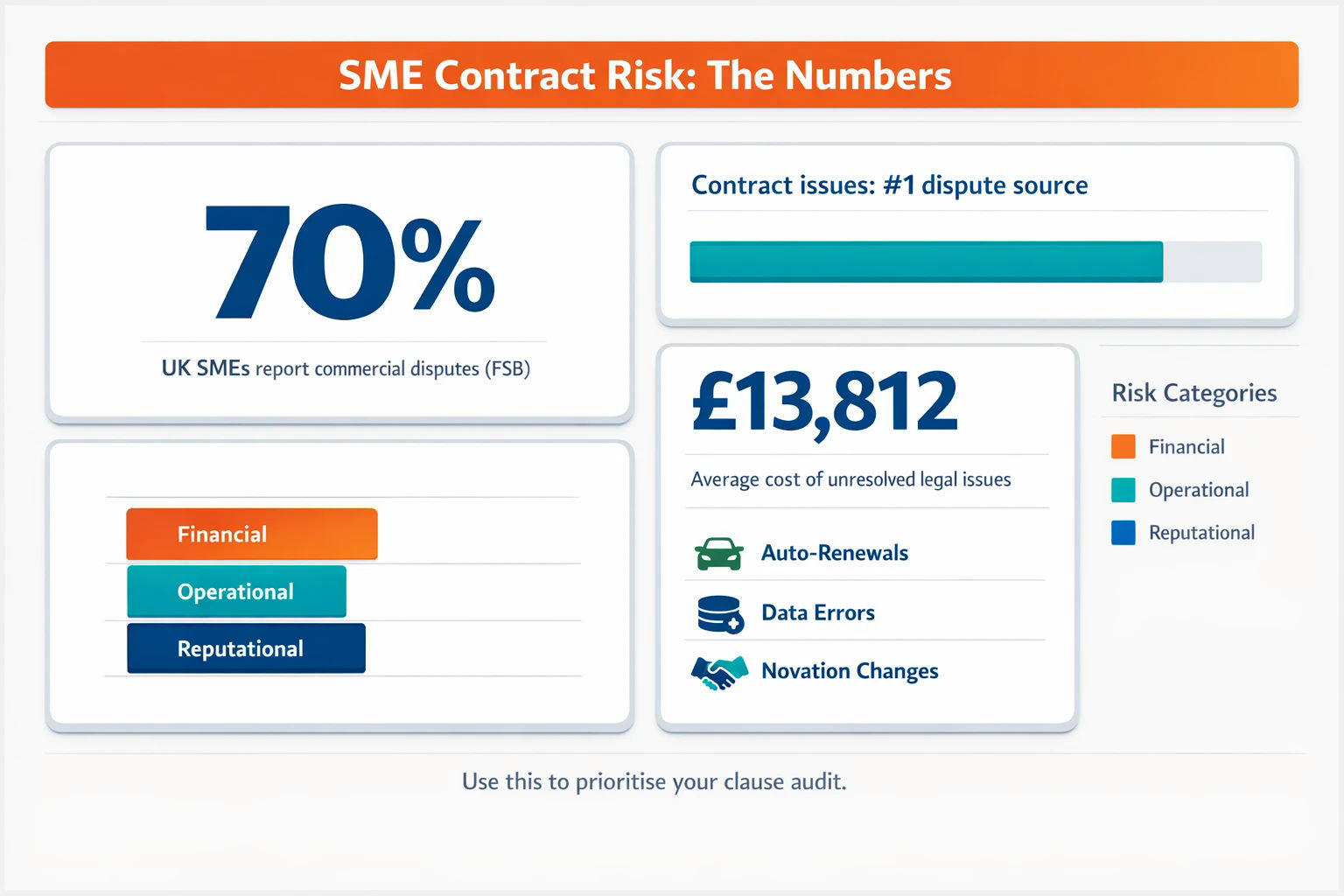
For UK businesses, contracts can feel like a necessary formality: negotiated, signed and then filed away. But this approach can allow commercial, financial, operational and compliance risks to remain hidden until they become expensive problems. Historical Federation of Small Businesses research found that 70% of surveyed members had experienced at least one legal dispute between 2010 and 2015, demonstrating how easily unresolved commercial issues can affect SMEs.
In 2026, effective contract risk management requires more than checking the fine print before signature. Businesses need to identify contractual risks, assess their potential impact, establish appropriate controls and continue monitoring those risks throughout the contract lifecycle.
Regulatory change adds another dimension. Developments affecting areas such as heat networks and data protection can change the environment in which existing agreements operate. Meanwhile, familiar contractual risks including automatic renewals, price variation, termination rights, liability and poorly controlled contract changes can create exposure even where no regulation has changed.
This guide provides a practical contract risk management framework for identifying those risks early, prioritising them and establishing controls that protect the organisation's finances, operations and reputation.
What is contract risk management?
Contract risk management is the process of identifying, assessing, controlling and monitoring the risks created by a contractual relationship throughout its lifecycle.
Those risks do not exist only in obviously unfavourable clauses. Exposure can arise from missed deadlines, unclear responsibilities, supplier underperformance, changing prices, inadequate data protection arrangements, uncontrolled variations, poor record keeping or a failure to act before renewal.
The purpose of contract risk management is therefore not to eliminate every possible risk. Commercial agreements inevitably allocate risk between parties. The objective is to understand that allocation, decide which exposures are acceptable and put appropriate controls around risks that could materially affect the business.
Contract risk management vs contract management
Contract management is the broader process of administering an agreement throughout its lifecycle, including implementation, performance, changes, payments, renewals and exit.
Contract risk management is a specific discipline within that process. It asks what could go wrong, how likely that event is, what its consequences would be and what action can reduce either its likelihood or impact.
For example, contract management may track the expiry date of a supplier agreement. Contract risk management considers what happens if the notice window is missed, whether an automatic renewal would create financial exposure and what control should prevent that outcome.
The two disciplines work together: good contract management provides the information and governance needed to manage contractual risk effectively.
What are the main types of contract risk?
Most commercial contract risks can be grouped into several connected categories. Understanding those categories helps businesses assess contracts consistently rather than focusing only on individual clauses.
Commercial and financial risk
Commercial and financial risks affect what the agreement ultimately costs or the value the organisation receives. They can arise from price variation mechanisms, minimum commitments, penalties, payment provisions, unexpected pass-through costs or liabilities that are disproportionate to the value of the contract.
Operational risk
Operational risk concerns the organisation's ability to continue functioning as expected. Supplier failure, service disruption, weak performance obligations, dependency on a critical provider or difficulty transferring services at termination can all create operational exposure.
Legal and liability risk
Contracts allocate responsibilities between the parties. Unclear obligations, broad indemnities, inappropriate liability provisions or poorly drafted remedies can create uncertainty about who bears the financial consequences when something goes wrong.
Compliance risk
Some contracts interact with legislation, regulation or industry requirements. Data protection is an obvious example, but sector-specific obligations may also affect how a contract must operate. Compliance risk therefore needs to be considered both when the agreement is signed and when the regulatory environment changes.
Reputational risk
A contractual failure can extend beyond its immediate financial cost. Supplier misconduct, service failures, data incidents or public disputes may affect customers, employees and other stakeholders, creating reputational consequences that are difficult to quantify in advance.
Why contract governance is now a critical business function
Weak contract management isn't just a potential legal headache; it's a direct financial drain. Research shows that unresolved legal problems cost small and medium-sized businesses an average of £13,812 each. These aren't one-off events. They are the slow-drip costs of ambiguous clauses, missed renewal dates, and inherited liabilities that quietly erode profitability.
The shift is from asking "what does this clause mean?" to "how does this clause expose my business to risk next year?" This requires a focus on three core areas:
Financial Risk: Unexpected price hikes, penalties for non-compliance, and costly dispute resolution.
Operational Risk: Service disruptions, being locked into underperforming supplier agreements, and challenges when trying to transfer services.
Reputational Risk: Damage from data breaches or public disputes with suppliers or customers.
Viewing your contracts through this lens transforms them from static legal documents into active management tools for protecting your business.
hjgh
How to carry out a contract risk assessment
A contract risk assessment converts a potentially complex agreement into a prioritised set of exposures and actions. The process should begin by identifying events or contractual provisions capable of causing material harm.
Next, assess both likelihood and impact. A severe contractual outcome that is highly unlikely may need different treatment from a recurring billing or operational problem with a smaller individual impact. A simple low, medium and high scoring system can be sufficient if it is applied consistently.
Each material risk should then have an owner. Risk ownership matters because identifying a problem without assigning responsibility for controlling it rarely changes the outcome. The owner should be someone with sufficient knowledge and authority to monitor the exposure and act when necessary.
The next step is mitigation. Depending on the risk, this might involve renegotiating a clause, establishing an approval control, monitoring supplier performance, obtaining specialist advice, improving insurance arrangements or creating an escalation process.
Finally, review the risk throughout the contract term. Changes to the business, supplier, market or regulatory environment can alter both likelihood and impact after the original assessment.
How to create a contract risk register
A contract risk register provides a central record of material contractual exposures and the controls used to manage them. It is particularly valuable where an organisation has multiple high-value or business-critical agreements.
For each material risk, record the affected contract, description of the risk, likelihood, potential impact, risk owner, existing controls, required mitigation, review date and current status.
For example, an automatic renewal provision might be rated as a high financial risk where missing a notice date would lock the business into another expensive term. The mitigation could be an expiry alert owned by procurement, with formal review beginning several months before the contractual notice deadline.
The register should be a working governance tool rather than a document completed once and forgotten. Significant contract changes, supplier failures and regulatory developments should trigger reassessment.
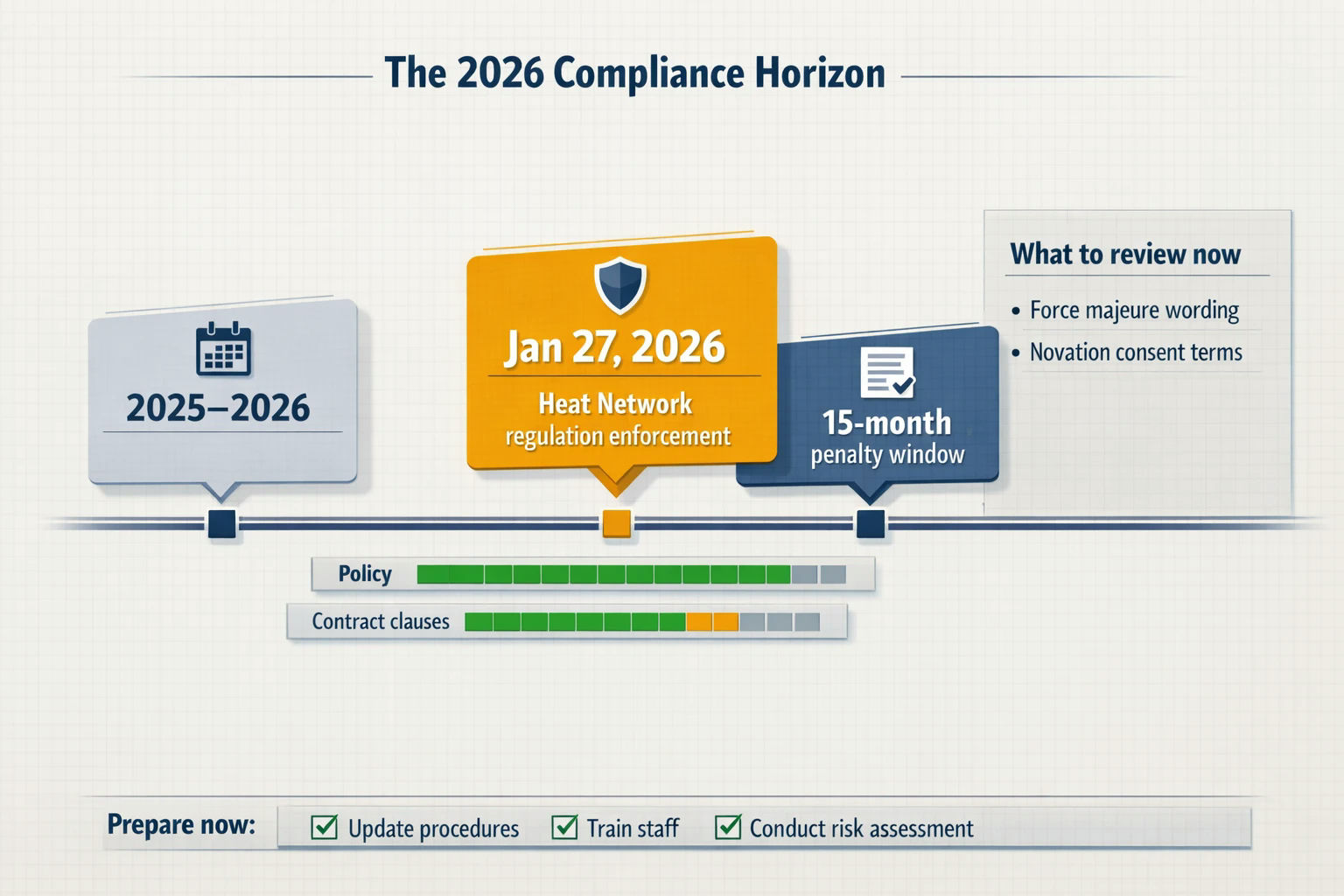
The 2026 compliance horizon: What’s changing?
Several regulatory shifts are creating new compliance pressures for UK businesses. Ignoring them means exposing your business to sanctions that were not a factor when your current contracts were signed.
OFGEM's new rules for business energy
The energy market is undergoing significant regulatory change. Ofgem's updated review brings two critical points into focus for businesses. First, the deadline for compliance with new heat network regulations is January 27, 2026. Businesses operating or managing these systems must ensure their contracts and operations align with the new standards to avoid penalties.
Second, changes to penalty timelines mean that compliance issues in your business energy contracts can have consequences faster than ever before. Waiting for a problem to arise is no longer a viable option. Proactive auditing of your gas and electricity agreements is essential.
The B2B data protection myth
A common misconception is that GDPR and ICO data protection rules don't apply to business-to-business contracts. This is incorrect and dangerous. The Information Commissioner's Office (ICO) is clear: if personal names, email addresses, or direct contact numbers appear anywhere in your contracts or related communications, personal data rules apply.
For service agreements like business telecoms contracts or payment processing, this has major implications. You must ensure your supplier contracts include adequate data protection clauses and that you understand how your business data, including customer and employee details, is being handled. A data breach originating from a supplier is still your responsibility.
Auditing for hidden risks: The contract traps you can't afford to ignore
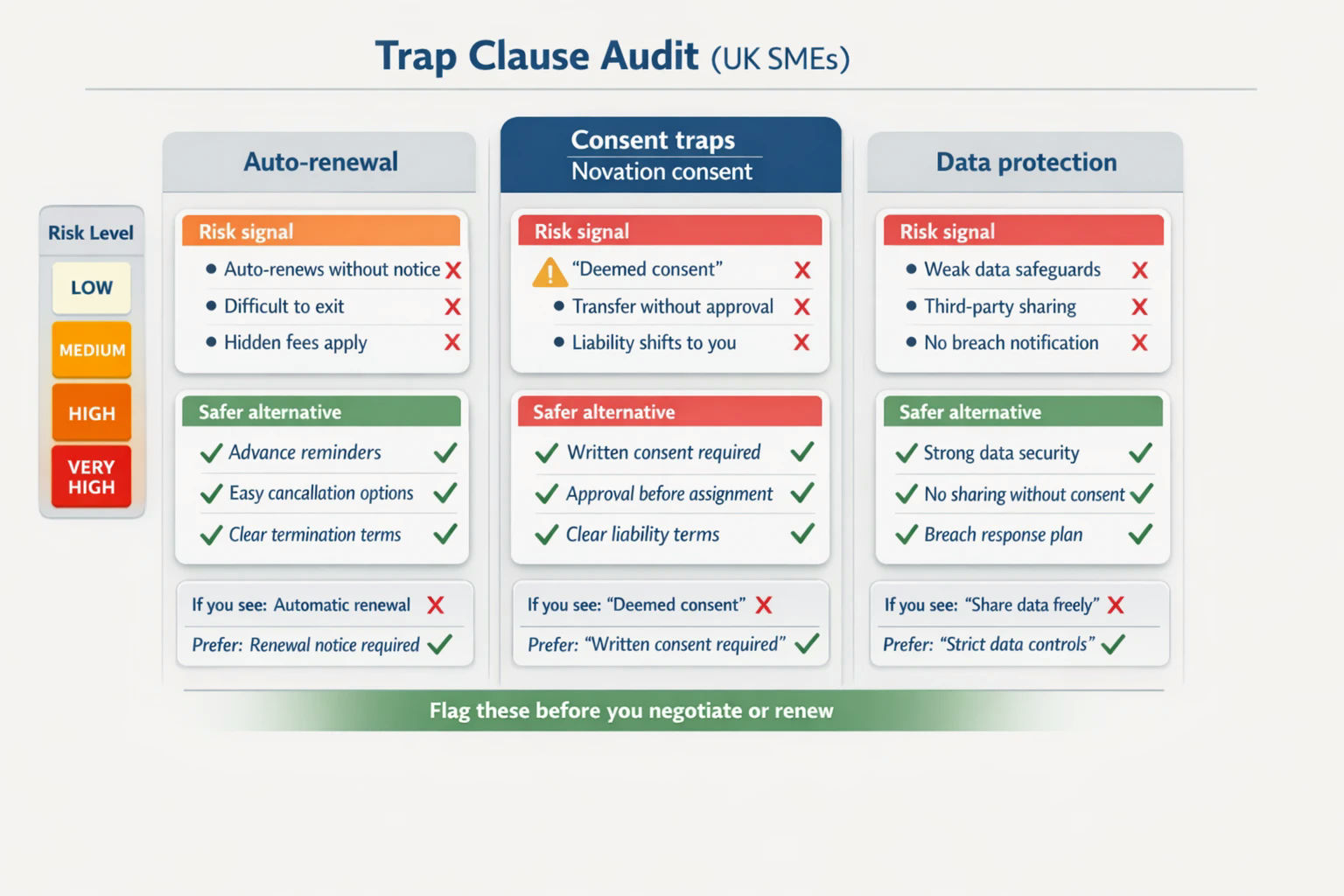
Beyond regulatory compliance, many standard business contracts contain clauses that are designed to benefit the supplier at your expense. Identifying these "trap clauses" is the first step to regaining control.
Auto-renewal clauses: Moving from passive acceptance to proactive control
The most common trap is the automatic renewal. A supplier might require a 90-day notice period, but the window to provide it is often intentionally narrow and easily missed. This locks you into another term, often at a less competitive rate, preventing you from exploring better options. The solution is rigorous calendar management and starting your review process at least six months before the contract end date.
Novation consent traps: The risk of inheriting debt or being blocked from change
Novation is the process of transferring a contract from one party to another, common during a sale or restructuring. But it's filled with risks. One hidden danger is "implied novation by conduct," where you could inadvertently take on the previous party's liabilities simply by acting as if the contract is yours.
Another challenge is when the other party refuses to sign the novation agreement, which can stall business operations. This is a common pain point where businesses need negotiation leverage, not just a legal definition. Understanding these nuances before you need to transfer a contract is crucial for a smooth transition.
Novation vs assignment: what's the difference?
Novation and assignment are related concepts but should not be treated as interchangeable. At a high level, an assignment generally transfers certain contractual rights or benefits, subject to the agreement and applicable law, while novation substitutes a contracting party through a new arrangement and can transfer both relevant rights and obligations.
The practical distinction matters during acquisitions, restructurings and supplier changes because the consent requirements and consequences can differ. Businesses should check the actual agreement and obtain legal advice where the transfer has significant legal or financial consequences.
Liability and indemnity clauses
Liability provisions determine the extent to which one party may be financially responsible when contractual obligations are breached or loss occurs. A contract risk assessment should examine liability caps, exclusions, carve-outs and whether different categories of loss are treated differently.
Indemnities also require careful review because they can allocate responsibility for specified losses or claims between the parties. Their commercial effect depends on the precise drafting and surrounding agreement.
The objective is not automatically to demand the lowest possible liability. It is to understand whether the allocation is proportionate to the value, risk and responsibilities associated with the contract.
Termination clauses
Termination provisions determine how and when the relationship can end. Review termination for breach, insolvency or other specified events, together with any termination-for-convenience mechanism where one exists.
Notice requirements, exit charges, outstanding payment obligations, data return and transition assistance can be as important as the right to terminate itself.
For business-critical suppliers, also consider operational exit risk. A contractual right to terminate has limited practical value if the business cannot transfer the service without significant disruption.
Price variation clauses
A price agreed on day one may not necessarily remain unchanged throughout the contract term. Review any provisions allowing indexation, pass-through costs, regulatory adjustments or unilateral price changes.
The contract should make it possible to understand what can change, what triggers the change, how the adjustment is calculated and what rights the customer has in response.
This is particularly relevant to utility agreements, where different components of the overall charge may be treated differently.
Change control
Contracts often fail operationally because the original agreement is modified through informal emails, conversations or inconsistent internal processes.
A defined change-control procedure should establish who can request a variation, who can approve it, how commercial and risk impacts are assessed and when the change becomes contractually effective.
Material changes should also trigger a review of the contract risk register. A seemingly straightforward variation can alter price, liability, compliance requirements or operational dependency.
Service levels and remedies
Service-level agreements should convert important supplier obligations into measurable performance expectations. Vague commitments such as providing a service "promptly" or using "reasonable efforts" may be difficult to monitor operationally without supporting definitions or performance measures.
Where performance is critical, establish how it is measured, how failures are reported and what contractual remedies or escalation rights apply. Repeated failures should also feed into supplier-performance and renewal decisions.
Data protection and security
Where contracts involve personal data or access to important business systems, review security requirements, processing responsibilities, access controls, subcontracting provisions, incident notification and data return or deletion at exit.
The contractual controls should reflect the nature of the data and the risks associated with the service rather than relying on generic boilerplate wording.
Dispute resolution and governing law
A contract should establish what happens when the parties cannot resolve an issue through normal account management. Review escalation stages, notification requirements and any agreed mechanism for formal dispute resolution.
The governing-law and jurisdiction provisions should also be understood, particularly in cross-border agreements. These clauses can materially affect the complexity and cost of enforcing contractual rights.
Contract red flags businesses should investigate
Contract red flags are not necessarily proof that an agreement is unacceptable. They are signals that additional scrutiny may be required.
Unclear pricing mechanisms and broad unilateral change rights deserve attention because they can make future costs difficult to predict. Automatic renewal provisions become risky where notice dates are poorly controlled, while unlimited or disproportionate liability can create exposure far beyond the contract's commercial value.
Weak termination rights, vague service obligations and missing change-control processes can reduce the organisation's ability to respond when supplier performance deteriorates. Data-protection wording should also be scrutinised where personal information or sensitive systems are involved.
Finally, unclear dispute processes and conflicting documents should not be overlooked. If the order form, proposal, schedules and standard terms say different things, establish which document takes precedence before signing.
A practical framework for assessing your contract risk
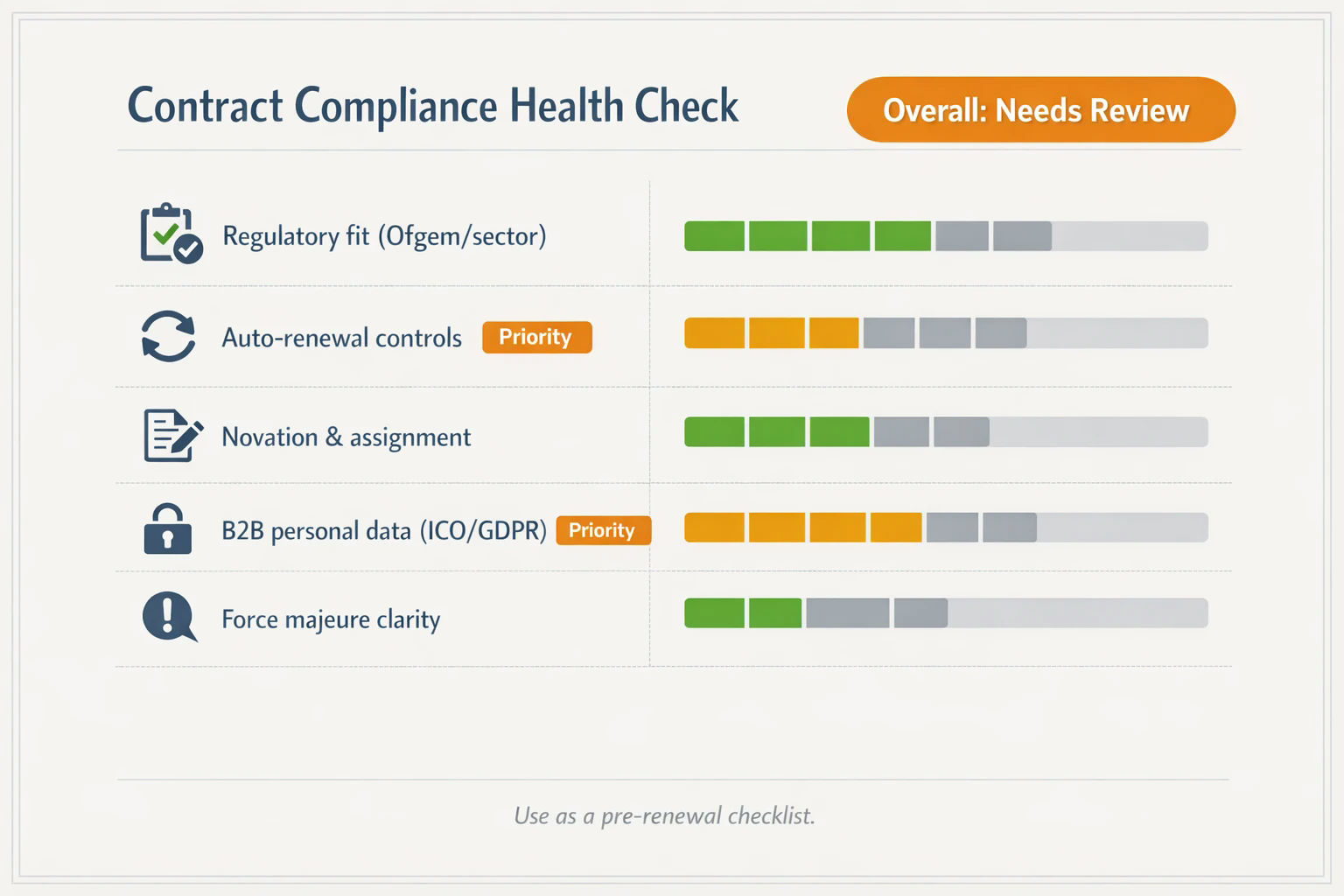
You don't need to be a solicitor to start identifying potential problems. A simple health check can help you triage your agreements and decide where to focus your attention. By scoring your key contracts, you can create a clear picture of your company's risk profile.
This allows you to move from a state of uncertainty to one of informed control. It helps align your team on priorities and provides a clear basis for seeking expert advice on the most pressing issues, whether that involves renegotiating terms, planning a supplier switch, or updating your internal processes.
How to manage contract renewal risk
Renewal is one of the points where contract risk can increase quickly because commercial deadlines and operational pressures collide.
Before renewal, review more than the supplier's new price. Examine performance history, unresolved disputes, changing business requirements, current liability provisions, data arrangements, service levels and clauses that created operational problems during the existing term.
Important notice dates should be centrally recorded rather than relying on an individual employee's diary. The review should begin early enough to benchmark alternatives, negotiate changes and complete any required procurement or approval process before the contractual deadline.
This also creates an opportunity to remove outdated provisions. A contract originally negotiated several years ago may no longer reflect the organisation's technology, data processing, property portfolio, consumption or risk appetite.
Contract risk doesn't stop after signature
Signing the agreement changes the type of risk; it does not end it.
Throughout the contract term, businesses should monitor supplier performance, contractual changes, compliance developments, disputes and significant changes in their own operations. Material developments should trigger an update to the relevant risk assessment.
Contract risk management should also connect to renewal and exit. Performance evidence collected during the contract provides valuable information when deciding whether to renew, renegotiate or replace a supplier.
This creates a continuous lifecycle: identify risk → assess exposure → establish controls → monitor performance → review changes → reassess at renewal or exit.
Build your contract protection plan
Proactive contract governance isn't a legal chore; it's a strategic advantage that protects your bottom line and supports your business's stability. By understanding the current regulatory environment and learning to spot hidden risks, you can avoid costly disputes and ensure your supplier agreements truly work for you.
Don't wait for a renewal notice or a dispute letter to find the weaknesses in your contracts. Our experts can provide a complimentary, no-obligation review of your current energy, telecoms, and water agreements to help you identify these hidden risks and uncover savings opportunities. Let's work together to build a clear, simple, and effective contract protection plan for your business.
Protect Your Business From Hidden Contract Risks
Get a complimentary, no-obligation review of your energy, telecoms and water agreements to identify hidden risks, prevent costly surprises and uncover potential savings.