Oops! Something went wrong while submitting the form.
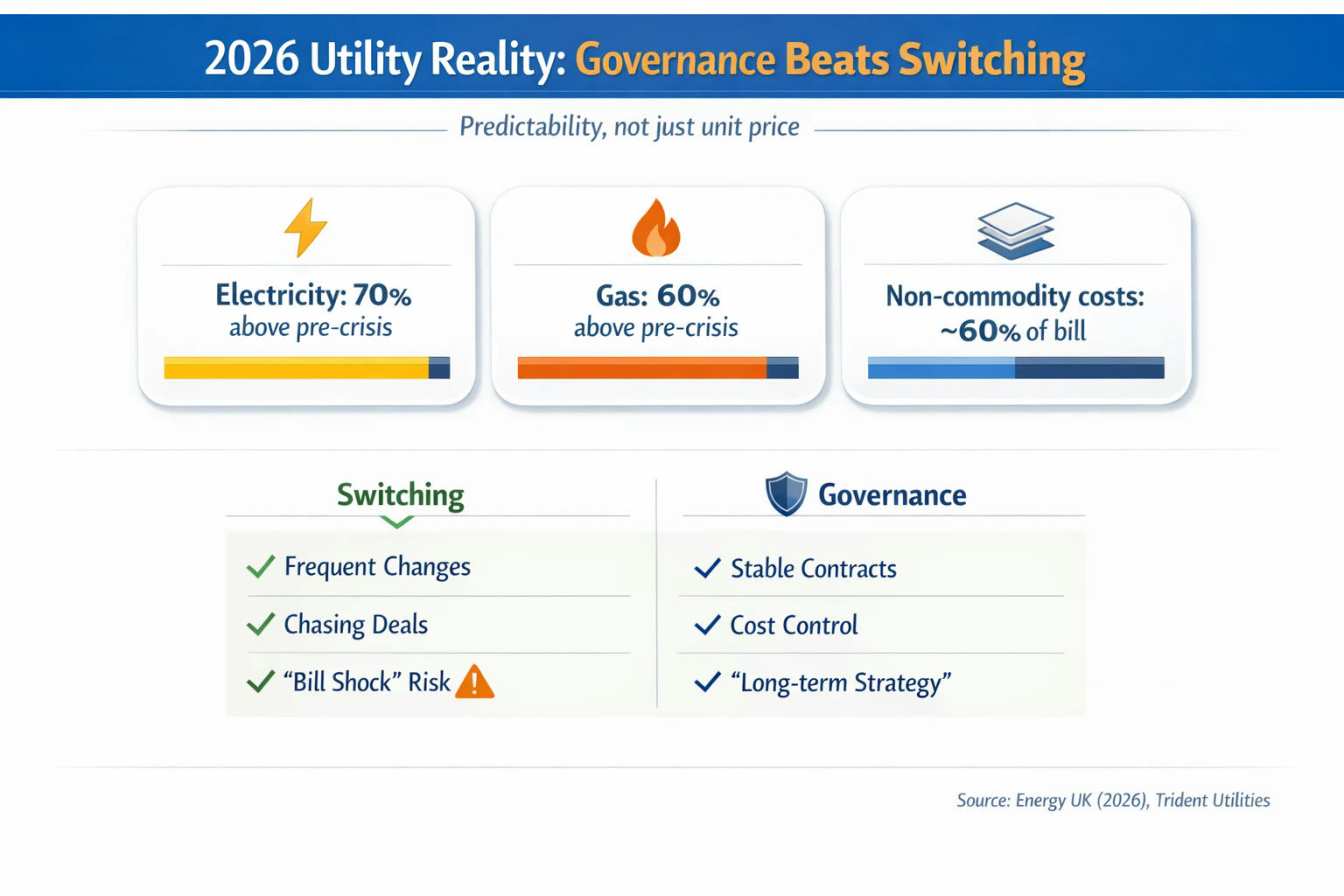
Even in mid-2026, UK business electricity costs are holding at 70% above pre-crisis levels, with gas not far behind at 60% higher. For many leaders, the endless cycle of switching suppliers feels like a losing battle against market volatility. The problem is that focusing on unit price alone misses the bigger picture.
According to analysis from Trident Utilities, by this year, non-commodity costs like network charges and government levies make up roughly 60% of a typical business electricity bill. This is why the old model of simply switching is broken. True cost control in 2026 comes from governance and utility portfolio optimisation, where energy, water, telecoms and payment services are managed as a single interconnected system. It's about finding synergies, eliminating hidden fees, and building predictability back into your overheads.
In 2026, savings come from governance: understanding non-commodity charges and prioritising predictable outcomes over endless switching cycles.
What is cross-utility cost optimisation?
Cross-utility cost optimisation is the process of reducing overall business utility expenditure by managing energy, water, telecommunications, and payment services as a connected portfolio rather than separate operational costs. Instead of focusing solely on supplier switching or unit rates, organisations identify opportunities where improvements in one utility area create savings or efficiencies in another.
For UK businesses, cross-utility cost optimisation increasingly involves improving visibility across utility contracts, monitoring consumption data, reducing hidden fees, and implementing technologies that support multiple operational objectives. This approach helps organisations improve cost predictability, strengthen governance, and maximise value across their entire utility portfolio.
A successful strategy combines procurement, monitoring, operational efficiency, and financial oversight to deliver sustainable savings beyond traditional supplier comparison exercises.
The synergy stack: How your utilities work together
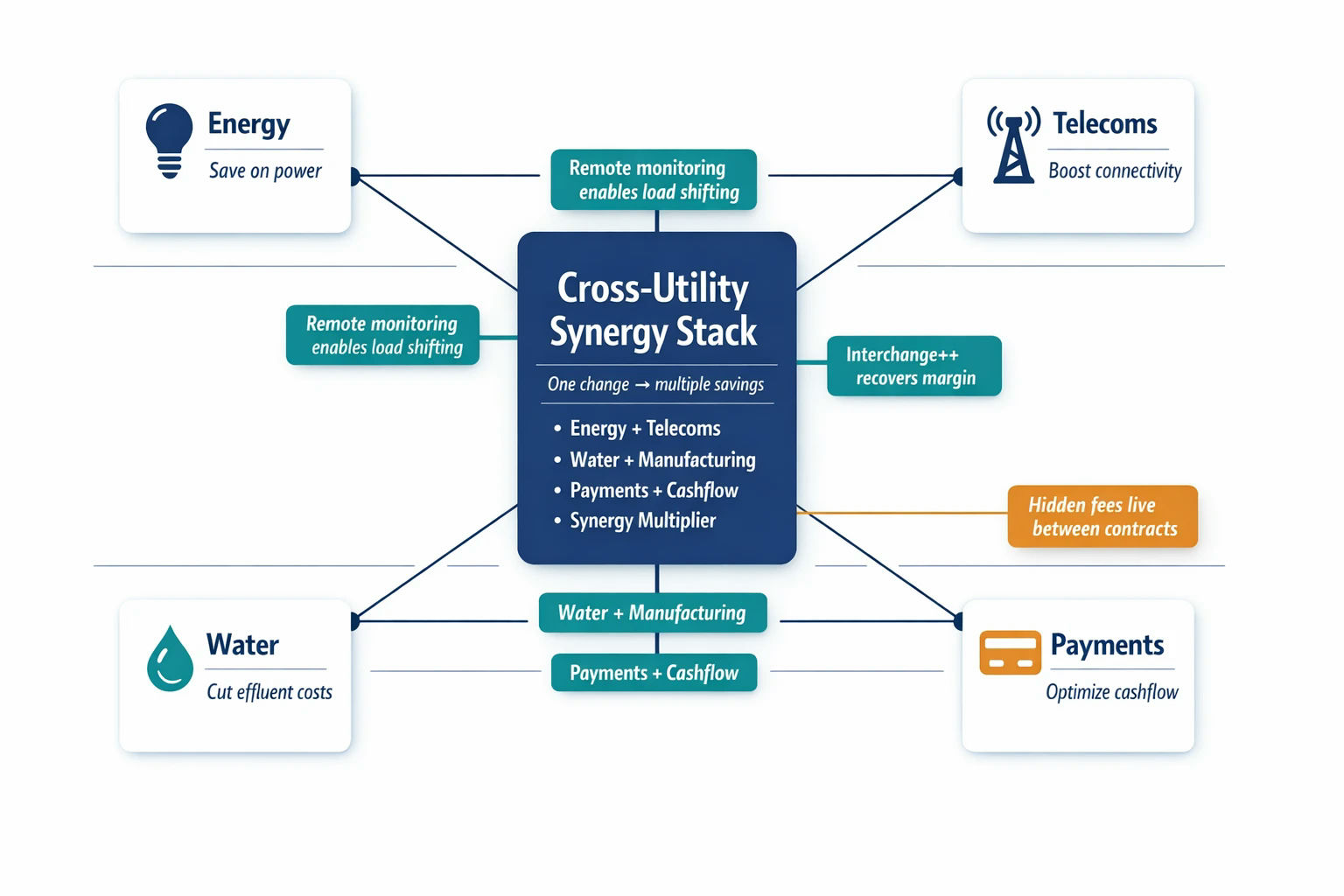
Viewing your utilities in isolation leaves significant savings on the table. A portfolio approach treats them as an interconnected system, where an improvement in one area creates opportunities in another. This is the synergy multiplier effect.
Utility portfolio optimisation treats these services as an interconnected system, where improvements in one area can create measurable savings in another.
Energy and telecoms: A direct link to efficiency
Outdated on-premise phone systems and server rooms are often an overlooked source of energy waste. These "always-on" assets contribute to your baseload electricity demand, driving up costs 24/7.
Migrating to modern cloud-based telecom solutions, like Voice over IP (VoIP), not only improves communication but also directly reduces energy consumption by decommissioning power-hungry hardware. This single move also lays the groundwork for further savings. With a robust data network, you can deploy Internet of Things (IoT) sensors forreal-time energy monitoring, giving you the granular data needed to make smarter decisions about your business electricity and gas consumption.
Water and manufacturing: From overhead to asset
For industrial businesses, water isn't just a utility; it's a critical production input. Yet many companies still overlook the significant costs associated with trade effluent, the wastewater discharged into the public sewer system. Charges are based on both volume and the concentration of contaminants (the Mogden formula).
By installing real-time sensors to monitor effluent volume and strength, you can gain precise control over your discharge. This data allows you to optimize treatment processes, reduce contamination levels, and potentially re-negotiate your consent to discharge with your water company, turning a major cost centre into a managed expense. A thorough review of your business water services can uncover these opportunities.
Payments and cashflow: Unlocking hidden margins
Transaction fees can feel like a fixed cost of doing business, but the pricing model you use makes a significant difference. Many businesses are on "Blended" pricing, where a single percentage is charged for all card transactions. This model often hides higher margins for the payment processor.
Switching to an Interchange++ model provides complete transparency. You pay the direct interchange fee from the card issuer (e.g., Visa, Mastercard), a small scheme fee, and a fixed acquirer markup. For businesses with a high volume of B2B or corporate card transactions, this move can recover up to 0.5% in margin, directly improving cash flow without a single change to your sales process. Evaluating your business payment services is a crucial step in a holistic utility audit.
Your advanced audit: Finding the fees that cause bill shock
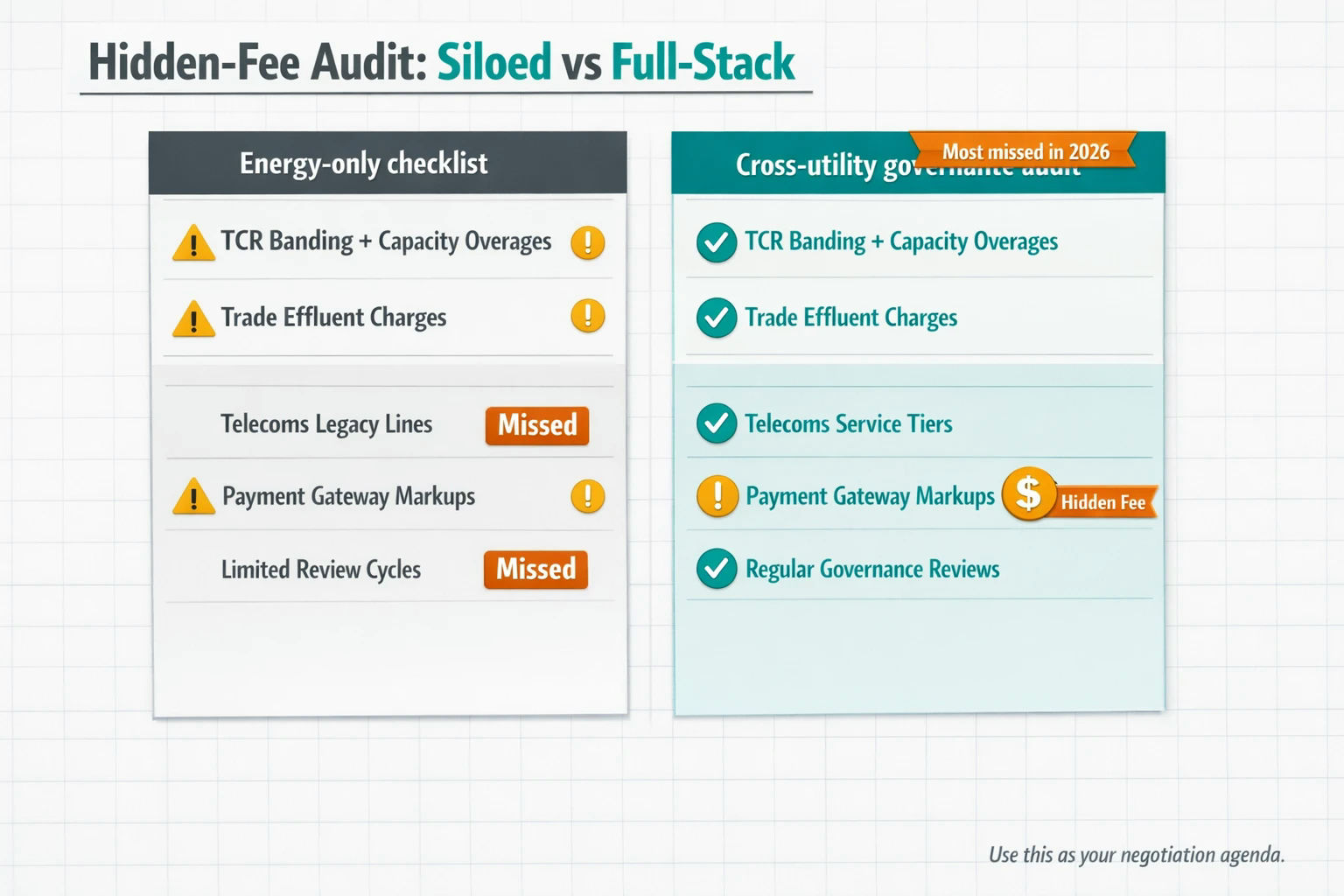
Predictable costs are the foundation of good governance. To achieve this, you need to look beyond the headline unit rate and identify the complex, often hidden, charges that drive bill shock. A comprehensive audit should be your negotiation agenda.
Use the right-hand audit as a negotiation agenda: it surfaces the fees that drive bill shock—beyond unit rates—across energy, water, telecoms and payments.
Key areas for your deep-dive audit:
Targeted Charging Review (TCR) Banding: Ofgem's TCR reforms changed how network charges are calculated. Are you in the correct band for your site's voltage level and consumption? Being in the wrong band can cost thousands per year.
Capacity Overages: For half-hourly settled meters, exceeding your agreed supply capacity (kVA) results in punitive excess charges. An audit can determine if your capacity level is correctly set or if you need to implement load management.
Trade Effluent Charges: As mentioned, are your effluent charges based on accurate, real-time data or outdated assumptions? Verifying the volume and composition of your wastewater is essential.
Payment Gateway Markups: On a Blended pricing model, what is the processor's margin on different card types? An Interchange++ statement breaks this down, revealing where you might be overpaying.
How do you optimise utility costs across multiple services?
Effective utility cost optimisation requires businesses to look beyond individual contracts and evaluate how utility services interact across the organisation. A structured approach helps identify opportunities that may be missed when energy, water, telecoms, and payment services are managed independently.
A practical optimisation process includes:
1. Consolidate utility data
Create a central view of utility contracts, invoices, consumption data, and supplier arrangements across all services.
2. Identify hidden costs
Review non-commodity energy charges, trade effluent fees, telecom service duplication, and payment processing markups to uncover avoidable expenditure.
3. Evaluate cross-utility synergies
Assess whether investments in one area can deliver benefits elsewhere, such as telecoms upgrades that enable energy monitoring or water monitoring systems that support sustainability reporting.
4. Implement monitoring and controls
Use data-driven monitoring tools to improve visibility, identify anomalies, and support ongoing optimisation efforts.
5. Review performance regularly
Track utility spend, operational efficiency, and supplier performance to ensure savings opportunities continue to be identified as business requirements evolve.
By treating utilities as an interconnected portfolio, businesses can improve cost control, reduce bill shock, and create a more resilient operating model.
A focused approach for manufacturing and industrial sites
For the manufacturing sector, the potential for cross-utility savings is even greater due to high energy and water intensity.
AI-driven load management is a prime example. These systems analyse energy price signals and your operational schedule to automatically shift non-essential processes, like battery charging or water heating, to off-peak hours when electricity is cheapest. This intelligent load shifting can deliver immediate savings of 5-15% by simply avoiding peak-rate windows, requiring no major hardware changes.
Similarly, implementing circular water systems that treat and reuse water on-site can drastically reduce both freshwater intake costs and trade effluent charges, delivering a powerful dual benefit for your bottom line and your ESG targets.
An implementation roadmap for 2026
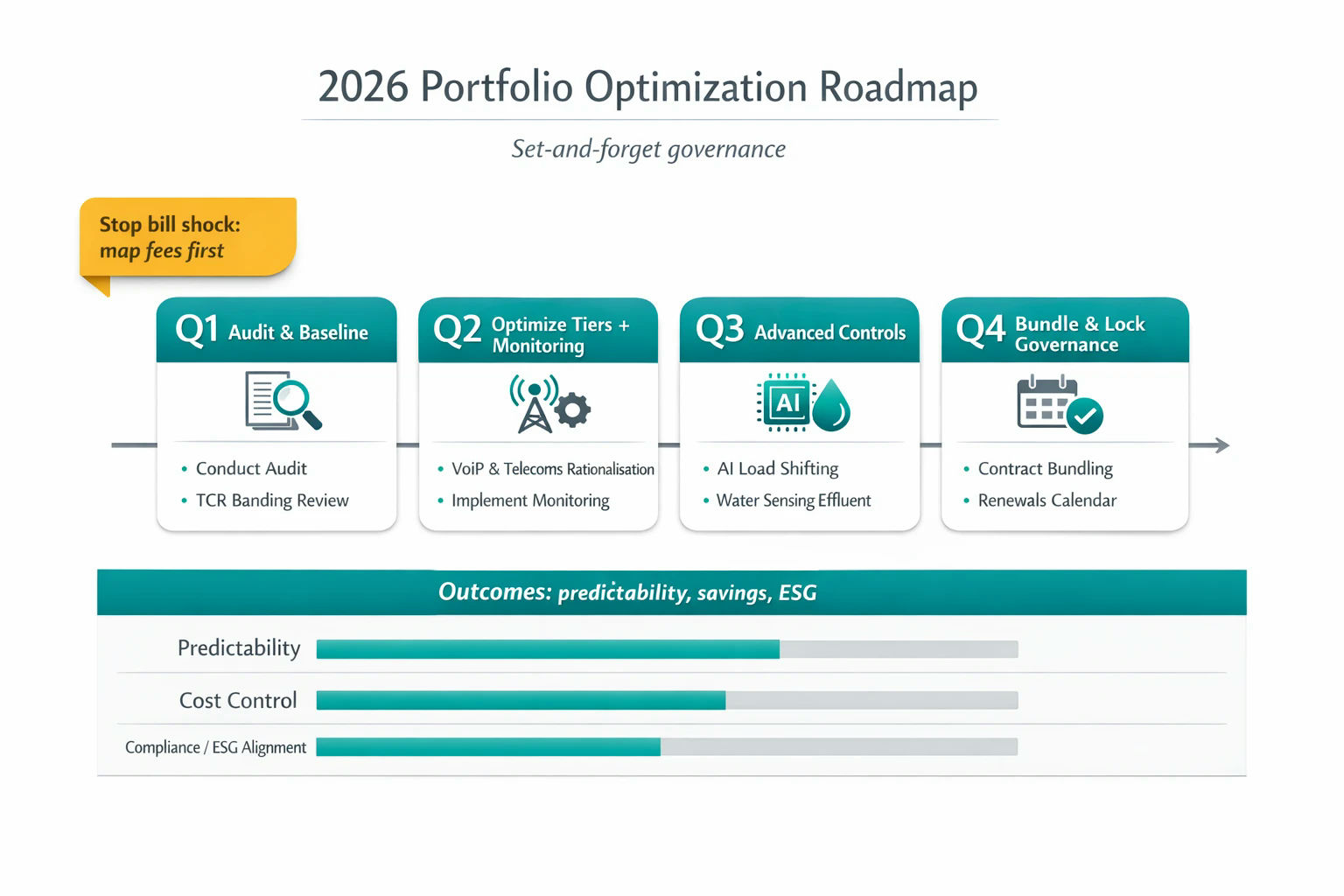
Moving from a reactive, price-focused approach to a proactive, governance-based model requires a structured plan. This quarterly roadmap provides a repeatable rhythm for your leadership team to take back control of your utility portfolio.
A quarterly plan turns cross-utility optimisation into a repeatable governance rhythm—front-load fee visibility, then layer monitoring, advanced controls and bundled contracts.
Quarter 1: Gain Visibility. Conduct the advanced "hidden fee" audit across your entire portfolio. Identify your TCR band, analyse your supply capacity, and demand transparent statements from your payment processor. This is your data-gathering phase.
Quarter 2: Implement Monitoring. Deploy the necessary tools based on your Q1 findings. This could mean installing sub-meters, effluent sensors, or activating the detailed reporting features in your new cloud telecom system.
Quarter 3: Deploy Controls. Use the data from your monitoring tools to take action. Implement AI load shifting, adjust water treatment processes, and train staff on new, more efficient operational procedures.
Quarter 4: Consolidate and Negotiate. Armed with a full year of granular data, approach the market from a position of strength. Explore bundled contracts, negotiate with suppliers based on your actual usage profile, and lock in predictable terms.
This structured approach transforms utility management from a tactical chore into a strategic advantage, using utility portfolio optimisation to create long-term cost predictability and operational efficiency. If you're ready to move beyond switching and build a resilient, cost-effective utility strategy, the first step is a conversation with an independent expert.
At Green Light Consultancy Group, we provide the honest advice and clear solutions needed to navigate today's complex utility market.Contact us for a no-obligation review of your current utility portfolio and discover where your greatest savings opportunities are hiding.
Optimise Every Utility Cost in One Strategy
Gain better control over energy, water, telecoms, and payment costs with a joined-up utility optimisation strategy that improves visibility, reduces hidden fees, and strengthens long-term cost predictability.