Oops! Something went wrong while submitting the form.
UK businesses managing multiple sites need a portfolio-based utility strategy, not site-by-site price comparison. With over half of UK firms facing electricity bill increases, this guide explains how to reduce risk, control costs, and centralise utilities across all locations.
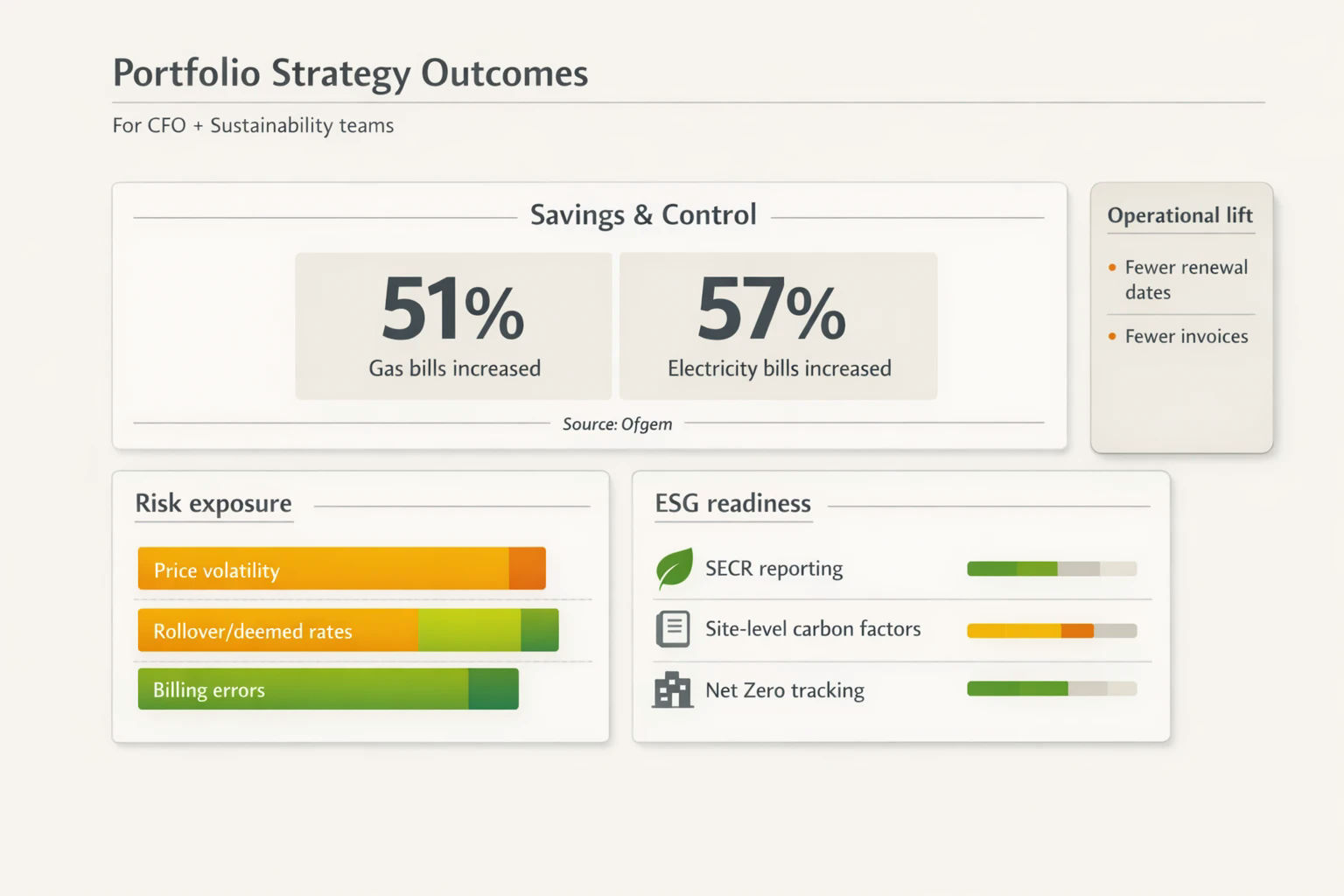
With 57% of UK businesses reporting electricity bill increases in the past 12 months, managing a multi-site utility portfolio has shifted from an administrative task to a strategic financial risk. For organisations operating 10, 50, or 100+ locations, fragmented contracts, invoice errors, and inconsistent data now create measurable cost exposure.
The traditional approach of seeking a cheaper quote for each site in isolation misses the core issue. Unaligned contract end dates, deemed rates, and billing inaccuracies often outweigh any unit-rate savings. The real opportunity lies in moving from reactive procurement to a unified, portfolio-level utility management model.
This guide outlines how finance, operations, and sustainability leaders can reduce risk, unlock savings, and convert utility data into a strategic asset.
What is utility portfolio management?
Utility portfolio management is the process of overseeing utility contracts, consumption, billing, and compliance across multiple business locations through a single strategic framework. Rather than managing each site independently, organisations treat utilities as a portfolio of assets and obligations that can be centralised, analysed, and optimised at scale.
For businesses operating multiple locations, utility portfolio management improves visibility, reduces administrative complexity, and creates opportunities for cost reduction through consolidated procurement, bill validation, and portfolio-wide reporting. It also provides the foundation for sustainability initiatives, including SECR reporting and Net Zero planning.
As utility costs become more complex, a portfolio-based approach enables businesses to move beyond individual supplier contracts and manage utilities as part of a broader operational and financial strategy.
Where do multi-site utility portfolios typically lose money?
Most multi-site portfolios lose money through missed renewals, poor change-of-tenancy controls, invoice errors, and sites left on deemed rates. Identifying these risks early prevents costs that can be two to three times higher than contracted prices.
Before building a strategy, you must identify where money, time, and compliance risk are leaking. In multi-site estates, losses usually go unnoticed until contracts expire or errors accumulate across dozens of invoices.
Key leakage points include:
Contract end dates: Are sites aligned to a single renewal date, or spread across the calendar with inconsistent terms?
“Ghost” sites: Are you still paying utilities at locations you no longer occupy due to a weak Change of Tenancy (CoT) process?
Bill validation: Are invoices checked line by line for incorrect meter reads, wrong tariffs, or Climate Change Levy (CCL) miscalculations?
Deemed rates: Are new or inherited sites temporarily supplied under deemed contracts, which are often two to three times more expensive than negotiated rates?
Answering these questions quantifies your true administrative burden and financial exposure. It also establishes the internal business case for centralisation.
What utility management models are available for multi-site businesses?
Multi-site businesses typically choose between consolidated invoicing, aggregated billing, or a full portfolio management portal. Each model offers increasing levels of data visibility, cost control, and compliance support.
Once portfolio risks are clear, the next decision is how utilities are operationally managed. The market offers three distinct models, each suited to different levels of complexity.
Consolidated invoicing
This model provides one combined invoice covering all sites, reducing admin time. However, data visibility is limited, and billing errors may still go unnoticed.
Aggregated billing
Invoices remain supplier-issued but are collected, validated, and reported centrally. This enables error detection and basic portfolio-level insights.
Full portfolio management portal
This model provides a single, centralised system for billing, consumption data, contract tracking, and compliance reporting. Finance, operations, and sustainability teams access consistent, site-level and portfolio-wide data in real time.
If the goal is administrative relief, consolidation may be sufficient. If the goal is financial control, forecasting accuracy, and ESG reporting, a full portal is required.
How do you manage utilities across multiple business locations?
Managing utilities across multiple business locations requires a structured approach that centralises data, aligns contracts, and provides visibility across the entire portfolio. Without a consistent process, organisations often face billing errors, missed renewals, and rising administrative costs.
A successful multi-site utility management strategy typically includes the following steps:
1. Create a centralised utility inventory
Document every utility account, meter, supplier, contract end date, and site location. This creates a complete portfolio view and helps identify gaps, duplicate accounts, or sites operating on out-of-contract rates.
2. Standardise contract management
Review renewal dates across the portfolio and, where possible, align contracts to reduce administrative complexity. A central contract register helps prevent missed renewals and exposure to costly deemed rates.
3. Implement bill validation procedures
Utility invoices should be reviewed regularly for incorrect meter readings, tariff discrepancies, Climate Change Levy (CCL) errors, and duplicate charges. Even small billing mistakes can create significant costs when repeated across multiple locations.
4. Establish portfolio-wide reporting
Finance, operations, and sustainability teams should have access to consistent utility data across all sites. Centralised reporting improves forecasting accuracy, supports budget planning, and highlights underperforming locations.
5. Monitor consumption and performance
Where appropriate, energy monitoring technology and half-hourly data can be used to identify unusual consumption patterns, equipment inefficiencies, or opportunities for demand reduction.
6. Support compliance and sustainability objectives
A centralised utility strategy simplifies Streamlined Energy and Carbon Reporting (SECR), carbon reporting, and broader ESG initiatives by providing a single source of consumption data across the estate.
By managing utilities at portfolio level rather than site level, businesses gain greater control over costs, reduce operational risk, and create a more scalable framework for future growth.
How does portfolio management deliver ROI and reduce risk?
Portfolio-based utility management reduces exposure to deemed rates, improves supplier leverage, and corrects billing errors. Industry benchmarks show 28% to 40% first-year savings through consolidation and validation alone.
For CFOs and sustainability leaders, justification depends on quantifiable outcomes. Portfolio management delivers value in three measurable areas.
First, it reduces rollover and deemed-rate exposure, often the single largest source of unnecessary cost. Second, it increases negotiating power by presenting suppliers with aggregated demand. Third, it identifies historic billing errors that can be recovered.
Beyond cost control, centralised utility data supports Streamlined Energy and Carbon Reporting (SECR) by automating consumption reporting across all sites. What was previously a manual, site-by-site exercise becomes a repeatable, auditable process supporting ESG and Net Zero goals.
What is the roadmap for transitioning to a unified utility strategy?
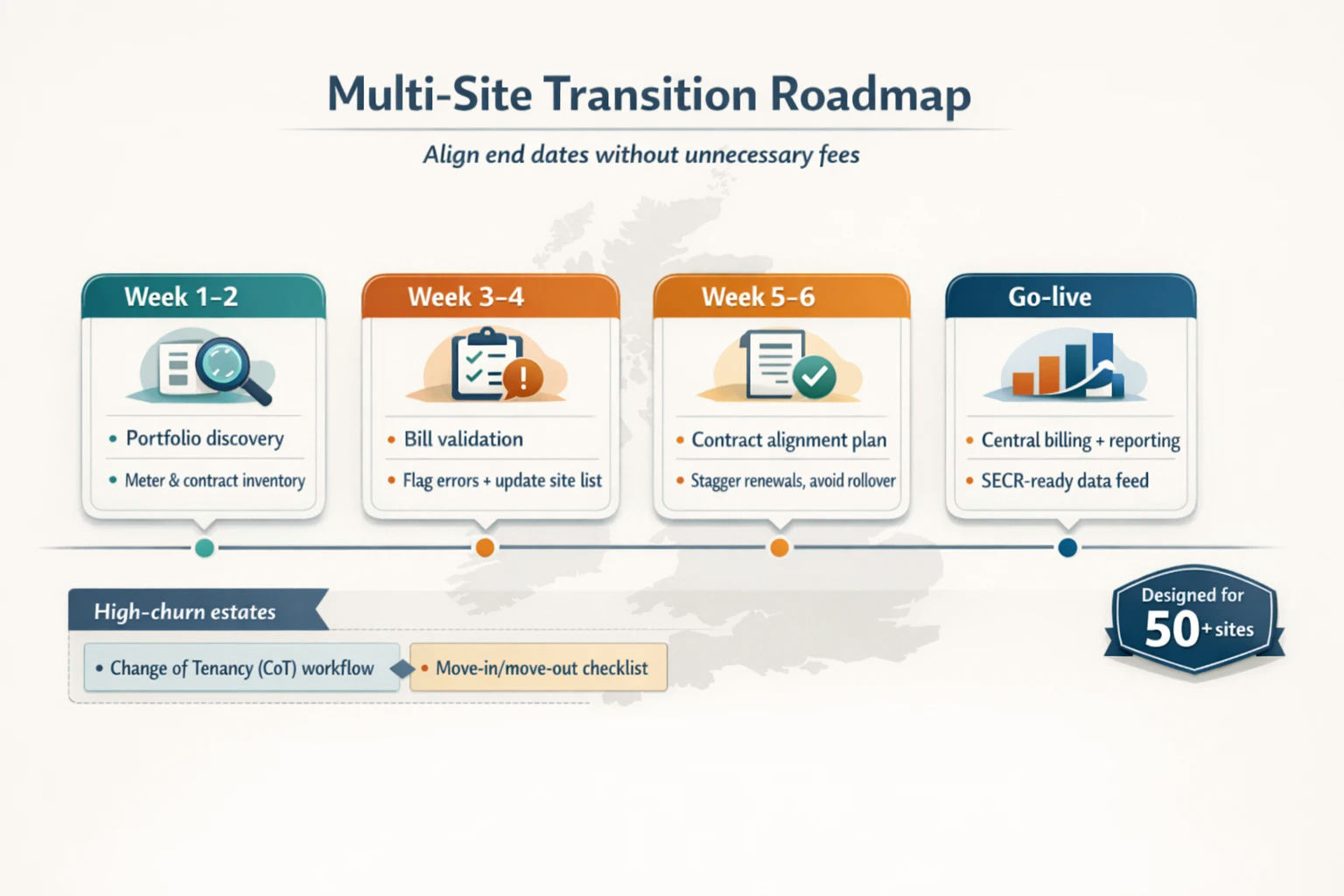
A structured four-stage transition process allows multi-site businesses to centralise utilities without service disruption, missed sites, or contract penalties.
Migrating dozens of sites can appear complex, but a defined roadmap removes risk.
1. Inventory and discovery
All contracts, meters, and invoices are identified to build a complete portfolio baseline.
2. Validate and cleanse
Ownership is confirmed, ghost sites are removed via Change of Tenancy, and historical invoices are audited for errors.
3. Align and procure
Contracts are aligned to a common end date, and procurement is conducted using portfolio leverage.
4. Go-live and manage
Sites transition under a single strategy with ongoing bill validation, reporting, and account management.
This phased approach ensures continuity of supply while eliminating rollover risk.
Should multi-site businesses deploy energy monitoring technology?
Energy monitoring hardware can provide deeper consumption insight, but only when deployed with clear ownership, correct meter compatibility, and centralised data integration.
Energy monitoring and IoT sensors are often misunderstood as purely software-driven. In reality, physical deployment across multiple sites requires coordination with site managers and an understanding of half-hourly (HH) and non-half-hourly meters.
Without proper implementation, monitoring tools generate fragmented data. When deployed correctly, they enhance forecasting accuracy and support demand-side optimisation across the portfolio.
How should businesses approach multi-site utility management going forward?
Multi-site utility management in the UK now requires a portfolio mindset. Centralisation, validation, and aligned contracts are essential to control cost, reduce risk, and support sustainability reporting.
Managing utilities site by site is no longer viable at scale. A portfolio strategy delivers cost predictability, operational clarity, and compliance confidence.
At Green Light Consultancy Group, we help organisations design transparent, defensible utility management frameworks aligned with financial and sustainability objectives.
Take control of utility costs across every business location with a transparent, portfolio-based strategy built around contract alignment, bill validation, reporting, and long-term sustainability goals.