Oops! Something went wrong while submitting the form.
Signing a new utility contract feels like the finish line, but it is actually the beginning of utility contract management. Once the agreement is live, the commercial risk shifts from negotiation to execution: billing accuracy, supplier performance, contract changes and operational control determine whether the value secured at tender is actually realised.
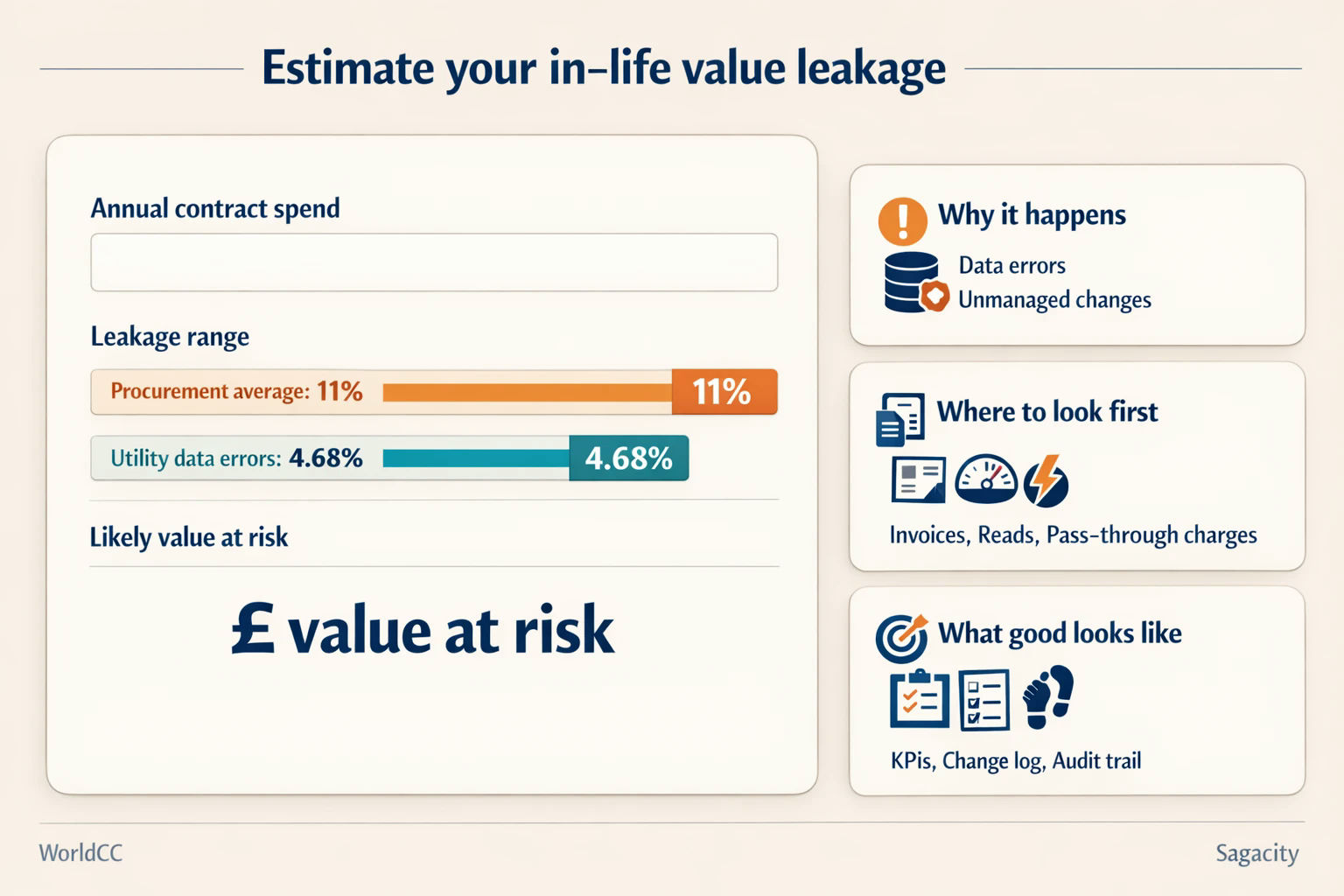
Research from WorldCC has repeatedly highlighted value erosion during the post-award phase of contracts. In utility agreements, that leakage can appear through billing errors, untracked changes, incorrect tariff application, missed service failures and weak supplier governance.
This is what procurement experts call "residual risk" the operational gap between the agreement you signed and the value you actually receive. For UK businesses, this problem is particularly acute in the utilities sector, where billing complexities and frequent supplier changes create constant opportunities for error.
Effective utility contract management closes that gap. It creates a structured process for validating invoices, monitoring supplier performance, controlling contract changes and preparing for renewal before value is lost.
This guide moves beyond high-level theory to give you a practical framework for active contract governance. We'll show you how to compare management models, identify hidden costs, and implement the controls needed to protect your bottom line throughout the entire contract lifecycle.
What is utility contract management?
Utility contract management is the post-award process of monitoring and controlling an active electricity, gas, telecoms or other utility agreement throughout its lifecycle.
It begins once the contract is signed and continues until renewal, termination or transition to a new supplier. The purpose is to ensure the commercial terms agreed at procurement are reflected in actual invoices, supplier behaviour, service performance and operational outcomes.
In practical terms, utility contract management covers invoice validation, supplier performance monitoring, change control, dispute management, service-level tracking, data quality, contract obligations and renewal readiness.
The objective is simple: make sure the organisation receives the value it contracted for rather than assuming that value will be delivered automatically.
Utility procurement vs utility contract management
Utility procurement and utility contract management sit at different points in the same commercial lifecycle.
Utility procurement focuses on what happens before contract award: analysing requirements, researching the market, tendering suppliers, evaluating bids and negotiating terms. Utility contract management begins after signature and focuses on making sure those terms are delivered in practice.
Procurement may secure a competitive rate, but contract management determines whether that saving survives billing errors, supplier underperformance, operational changes and poor administration.
A mature utility strategy therefore links the two disciplines. Procurement creates the commercial value; contract management protects it.
Choosing your management approach: an in-life audit
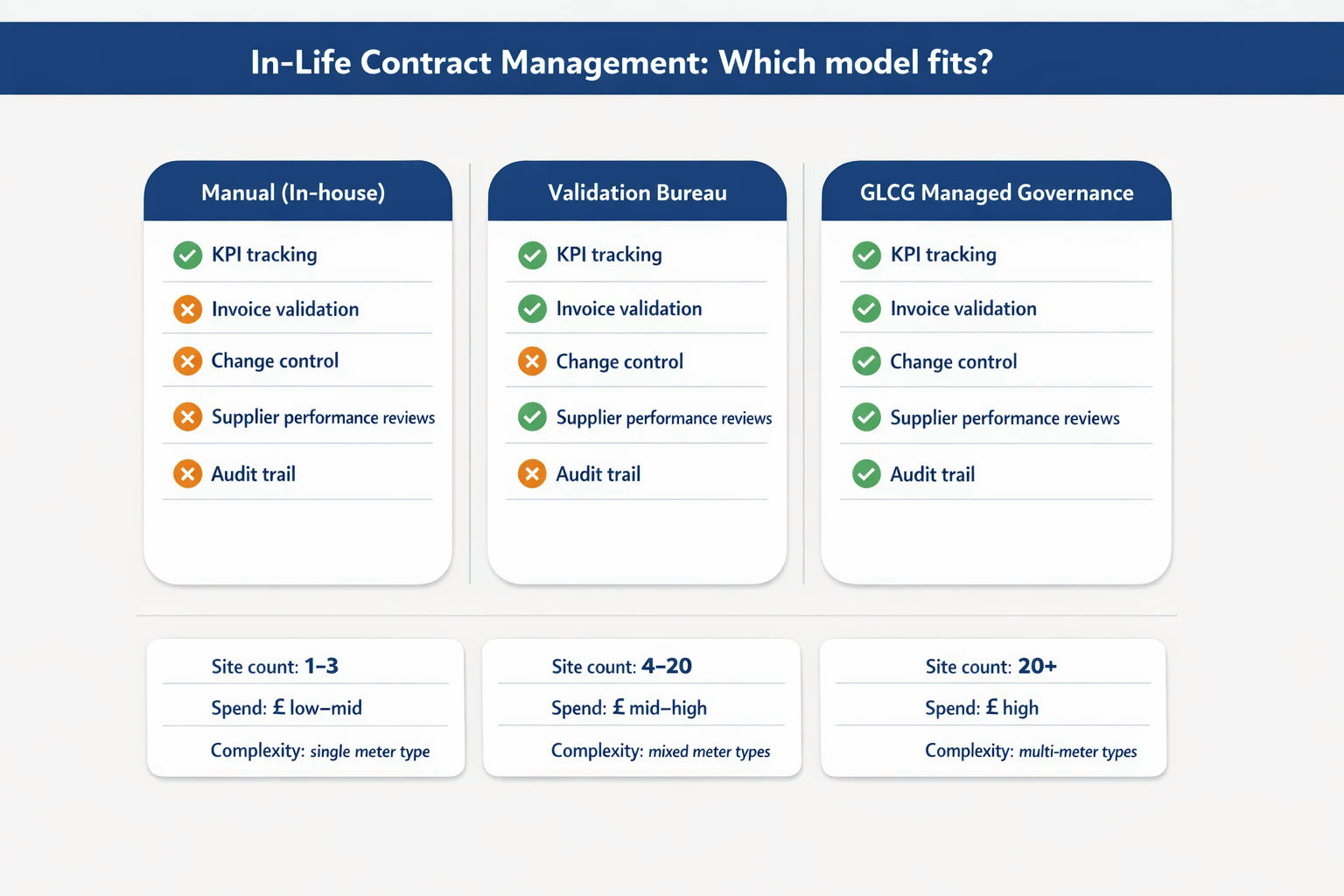
The first step is matching your management strategy to your portfolio's complexity. A single-site business has vastly different needs than a multi-site enterprise with complex metering. Most businesses fall into one of three models: manual in-house validation, transactional bureau services, or a fully managed governance partnership.
Manual in-house management
Best for: Small businesses with one or two sites and simple, fixed-rate contracts.
Process: The accounts team manually checks invoices against the contract.
Strengths: No additional cost.
Limitations: Lacks specialist knowledge of pass-through charges, tax exemptions like CCL, and complex meter data. Highly prone to human error and can't scale with the business.
Transactional bureau services
Best for: Businesses with moderate complexity (5-20 sites) that need a dedicated check on invoice accuracy.
Process: A third-party service validates bills against meter reads and agreed rates, flagging discrepancies for a fee.
Strengths: Catches common billing errors effectively.
Limitations: This approach is purely reactive. It validates what has already happened but doesn't manage the supplier relationship, handle contract amendments, or track broader performance KPIs. It’s a safety net, not a strategy.
Managed operational governance
Best for: Multi-site businesses or those with high energy spend, complex contracts, or a need for proactive supplier management.
Process: A dedicated partner like Green Light Consultancy Group acts as an extension of your team. This includes invoice validation, but also covers performance monitoring, change request management, and ongoing supplier relationship development.
Strengths: Shifts from reactive error-catching to proactive value protection. It addresses the entire 11% leakage risk, not just billing mistakes.
Limitations: Requires a partnership approach where your consultant has a clear view of your operational goals.
The real cost of inaction: calculating your contract leakage
Abstract percentages don't always resonate, but the financial impact is undeniable. Research from Sagacity confirms that UK businesses lose 4.68% of their total utility spend amounting to £3.3 billion annually to data errors and billing inaccuracies alone.
This figure represents the most visible part of the problem. When you add unmanaged contract changes and missed performance targets, the true cost gets closer to the 11% benchmark. Before you can fix the leaks, you need to understand their potential size.
Use this table to estimate your own "at-risk" revenue based on the documented 4.68% utility leakage rate.
Annual Utility Spend
Illustrative 4.68% Leakage
£50,000
£2,340
£100,000
£4,680
£250,000
£11,700
£500,000
£23,400
£1,000,000
£46,800
This is the money you can reclaim with a robust in-life management system. It's the budget to hire a new employee, invest in new equipment, or simply improve profitability.
The invoice validation blueprint
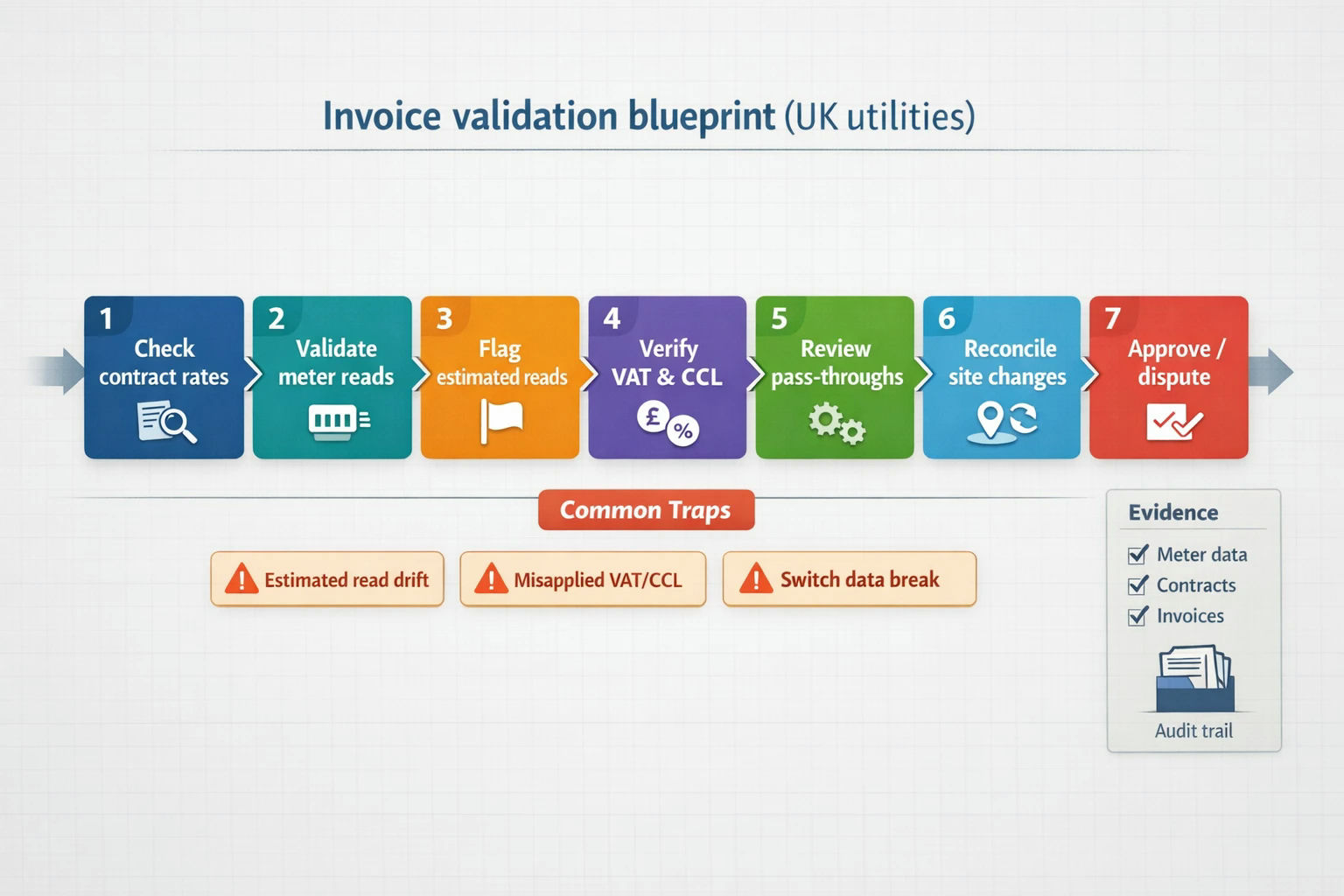
Effective invoice validation goes far beyond checking the final amount. A comprehensive process is your first line of defence against value leakage in your business electricity and gas contracts.
A UK-specific validation checklist:
Contract Alignment: Does the tariff structure on the bill (unit rates, standing charges) match the signed agreement exactly?
Consumption Sanity Check: Are you being billed on actual meter reads or estimates? Accumulated estimates are a common source of large, unexpected "catch-up" bills.
Pass-Through Charge Verification: Are charges like FiT, RO, and CfD applied correctly? These non-commodity costs change frequently and are a common area for supplier error.
Tax and Levy Accuracy: Is VAT applied at the correct rate? Have you been correctly assessed for the Climate Change Levy (CCL), and are your CCL exemptions (if any) reflected?
Post-Switch Data Integrity: This is a critical but often-overlooked step. When you switch suppliers for your business gas, opening and closing meter reads can be disputed or recorded incorrectly, leading to double-billing or inaccurate first invoices. Proactive validation here is essential.
Which utility contract KPIs should you monitor?
Invoice accuracy is only one measure of whether a utility contract is performing properly. A mature utility contract management process should monitor a small set of KPIs that show whether the supplier is delivering the commercial and operational outcomes agreed.
Billing accuracy is an obvious starting point. Organisations can track the proportion of invoices that pass validation first time, the value of billing corrections and the average time taken to resolve a disputed charge.
Estimated billing is another useful indicator because repeated estimates can signal problems with meter data or supplier processes. A rising proportion of estimated bills can create both financial uncertainty and future reconciliation risk.
Change-request completion should also be monitored. If new sites, closures, tariff changes or account updates repeatedly miss agreed implementation dates, the issue is not simply administrative; it can create recurring billing problems.
Other useful measures include supplier response times, open dispute age, data accuracy, SLA performance and the number of unresolved issues carried from one reporting period to the next.
The goal is not to create a dashboard with dozens of metrics. It is to monitor the few indicators that show whether the contract is delivering what was promised.
Stop Utility Contract Value Leakage Before It Costs More
Get a no-obligation review of your utility contracts to uncover billing errors, supplier issues, and hidden value leakage and protect your savings throughout the contract lifecycle.