Oops! Something went wrong while submitting the form.
Nearly a third of UK businesses are dissatisfied with their energy suppliers, with billing and issue resolution among the recurring sources of frustration. This highlights a critical gap in the market: the real work doesn't end when you sign a contract; it begins. For too long, the focus has been on the transactional "switch-and-save" moment rather than what happens throughout the supplier relationship.
Utility supplier relationship management (SRM) addresses this gap. Instead of measuring supplier value only at procurement, it creates a structured process for monitoring performance, improving service, resolving problems and identifying opportunities throughout the contract lifecycle.
The new benchmark for success is a strategic, service-led partnership that delivers value throughout the entire contract lifecycle. This requires a shift in mindset from procurement to governance. It’s about building a relationship that not only ensures accurate bills and reliable service but also actively supports your long-term operational and sustainability goals.
For UK businesses, that means treating strategically important energy and utility suppliers as relationships that need to be measured, governed and improved rather than contracts that can simply be filed away after signature.
What is utility supplier relationship management?
Utility supplier relationship management is the structured process of managing the performance, communication, risk, commercial value and improvement opportunities associated with an electricity, gas, telecoms or other utility supplier after contract award.
It provides a framework for answering questions that the original procurement exercise cannot answer on its own. Is the supplier delivering the promised service? Are problems being resolved quickly enough? Is billing performance improving? Is the supplier providing reliable data? Are agreed improvements actually being implemented? And is the relationship creating additional value as the organisation's requirements change?
Supplier relationship management vs utility contract management
Utility contract management and utility supplier relationship management are closely connected, but their emphasis is different.
Utility contract management focuses primarily on controlling the agreement itself: billing against contracted rates, contractual obligations, changes, renewals, compliance and other in-life requirements. Supplier relationship management focuses on the performance and development of the organisation that sits on the other side of that agreement.
Contract management asks, “Are the agreed terms being delivered?” Supplier relationship management goes further and asks, “How can this supplier perform better and create more value?”
The two disciplines should therefore work together. Contract data and performance issues provide evidence for supplier reviews, while SRM provides the governance mechanism for turning that evidence into corrective action and improvement.
A competitive energy price can create value at procurement, but the supplier influences outcomes long after the price has been agreed. Billing accuracy, issue resolution, data provision, account management, operational changes and sustainability reporting can all affect the real value received during the contract term.
The importance of those factors increases with the complexity of the relationship. A strategic supplier supporting a large multi-site portfolio may interact with finance, procurement, sustainability, operations and senior management. Poor performance can therefore create costs far beyond the original energy rate.
SRM creates accountability by defining what good performance looks like, measuring it consistently and providing a formal mechanism for addressing problems and identifying improvements.
Why standard supplier management falls short in energy
Applying a generic procurement framework to your utility contracts is like using a city map to navigate the ocean. It misses the industry-specific complexities that cause the most friction, such as volatile pass-through costs, Renewable Energy Guarantees of Origin (REGOs), and the intricate compliance demands of a market moving toward Net Zero.
Effective governance in the utilities sector demands a tailored approach. It requires a framework that holds suppliers accountable for more than just price, transforming a transactional arrangement into a strategic alliance.
Step 1: Segment your suppliers for targeted governance
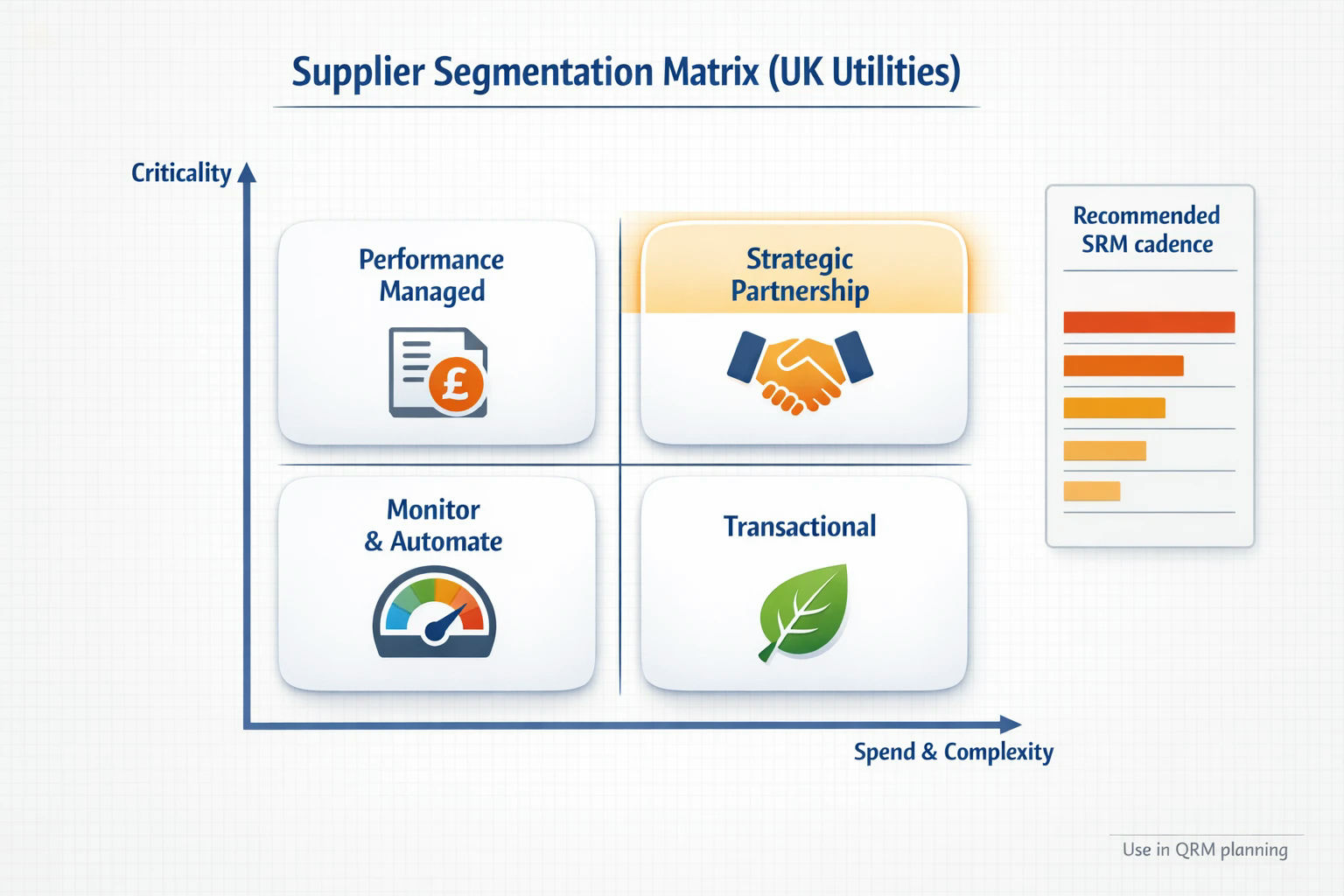
Not all supplier relationships require the same level of intensive management. The first step is to categorize your utility providers based on their strategic importance and the complexity of your contract. A supplier for a small, low-consumption site is tactical, whereas the partner managing your multi-site portfolio and Power Purchase Agreements (PPAs) is strategic.
This segmentation allows you to focus your governance efforts where they will have the most impact.
Segment suppliers by criticality and complexity so you apply the right governance effort deep QRM focus for strategic partners, lighter-touch automation for transactional accounts.
For strategic partners, you'll need regular, in-depth reviews. For transactional accounts, a more automated, light-touch approach is sufficient. This ensures your resources are invested in managing the relationships that drive the most value and pose the most risk.
How often should you review utility suppliers?
Supplier review frequency should follow the segmentation model rather than applying the same meeting calendar to every provider.
Strategic suppliers will often justify a quarterly review, with more frequent operational meetings where active issues or significant change programmes require them. Bottleneck and leverage suppliers may be reviewed quarterly or biannually depending on risk, spend and performance. Transactional suppliers can often be managed annually or through exception-based monitoring.
Frequency should also change when performance deteriorates. A supplier that normally requires a six-monthly review may temporarily need monthly oversight if billing errors, service failures or unresolved disputes begin to accumulate.
The objective is therefore not to hold more meetings. It is to create the right governance intensity for the value and risk associated with each relationship.
Step 2: Implement a utility-specific balanced scorecard
Moving your supplier conversations from subjective complaints to objective analysis requires a clear framework for measuring performance. A balanced scorecard, tailored to the utility sector, is the most effective tool for this. It provides a structured agenda for every quarterly review meeting (QRM), ensuring you cover the metrics that truly matter.
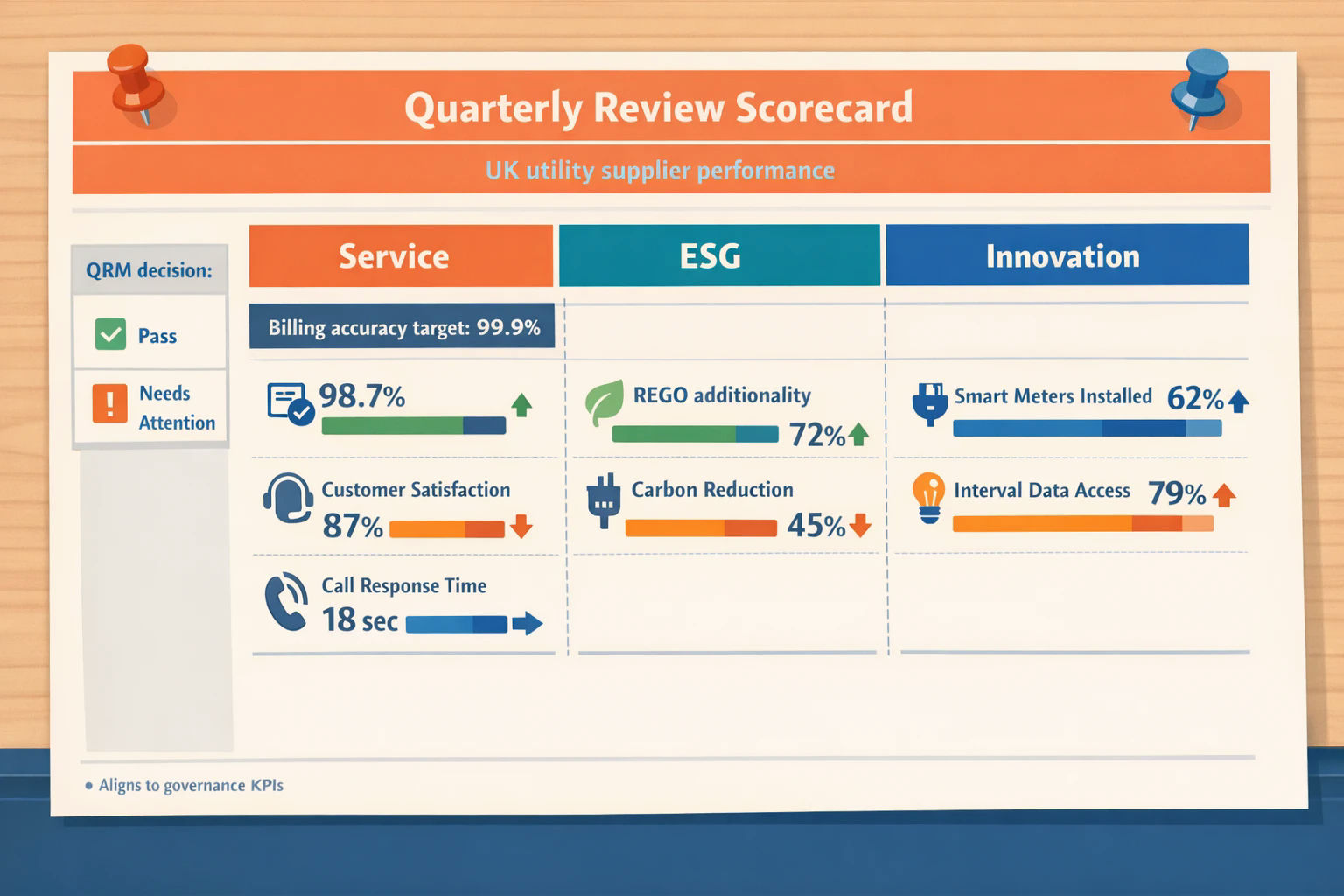
Use a balanced scorecard in every QRM to move from subjective feedback to measurable outcomes service reliability, ESG traceability, and innovation enablement in one view.
Your scorecard should track performance across three core areas, using specific, measurable KPIs.
Key performance indicators for your quarterly review
Service & Operations: This is about getting the fundamentals right. Track metrics like billing accuracy (with a target of over 99%), first-call resolution rates for queries, and the timeliness of data provision. These KPIs directly address the most common sources of friction.
ESG & Sustainability: Your supplier relationship is a key part of your environmental reporting. Monitor KPIs such as the traceability and additionality of REGO certificates, the availability of hourly time-matched renewable energy data, and the supplier's own progress on reducing carbon intensity.
Innovation & Collaboration: A true partner should help you future-proof your operations. Measure their willingness to provide access to interval data via APIs, offer flexibility incentives for demand-side response, and proactively suggest innovative solutions that align with your business goals.
How to run a utility supplier quarterly review meeting
A quarterly review meeting should be a decision-making forum, not a presentation exercise. The purpose is to use evidence from the previous period to identify problems, agree corrective actions and determine where the supplier can create additional value.
Start with the previous meeting's actions. Any overdue commitment should have an owner, explanation and revised completion date before new issues are added. This creates continuity between meetings and prevents recurring problems from disappearing between reporting periods.
The performance scorecard should then provide the factual basis for the discussion. Review billing and operational performance, unresolved disputes, SLA failures, data quality and material contract changes. Significant deviations should be discussed in terms of cause and corrective action rather than simply reported as red or amber metrics.
Strategic reviews should also look forward. Upcoming site changes, changes in consumption, sustainability requirements, technology projects and procurement milestones can all affect what the business needs from the supplier during the next quarter.
Every QRM should finish with a documented action log. Each action needs a named owner, deadline and expected outcome. Material contractual changes should follow the formal contract change-control process rather than being treated as informal meeting commitments.
Step 3: Shift from dispute resolution to dispute prevention
The most efficient way to handle billing disputes is to prevent them from happening in the first place. The frustration felt by the 32% of dissatisfied businesses often stems from a lack of clear, proactive protocols for identifying and rectifying errors before they escalate.
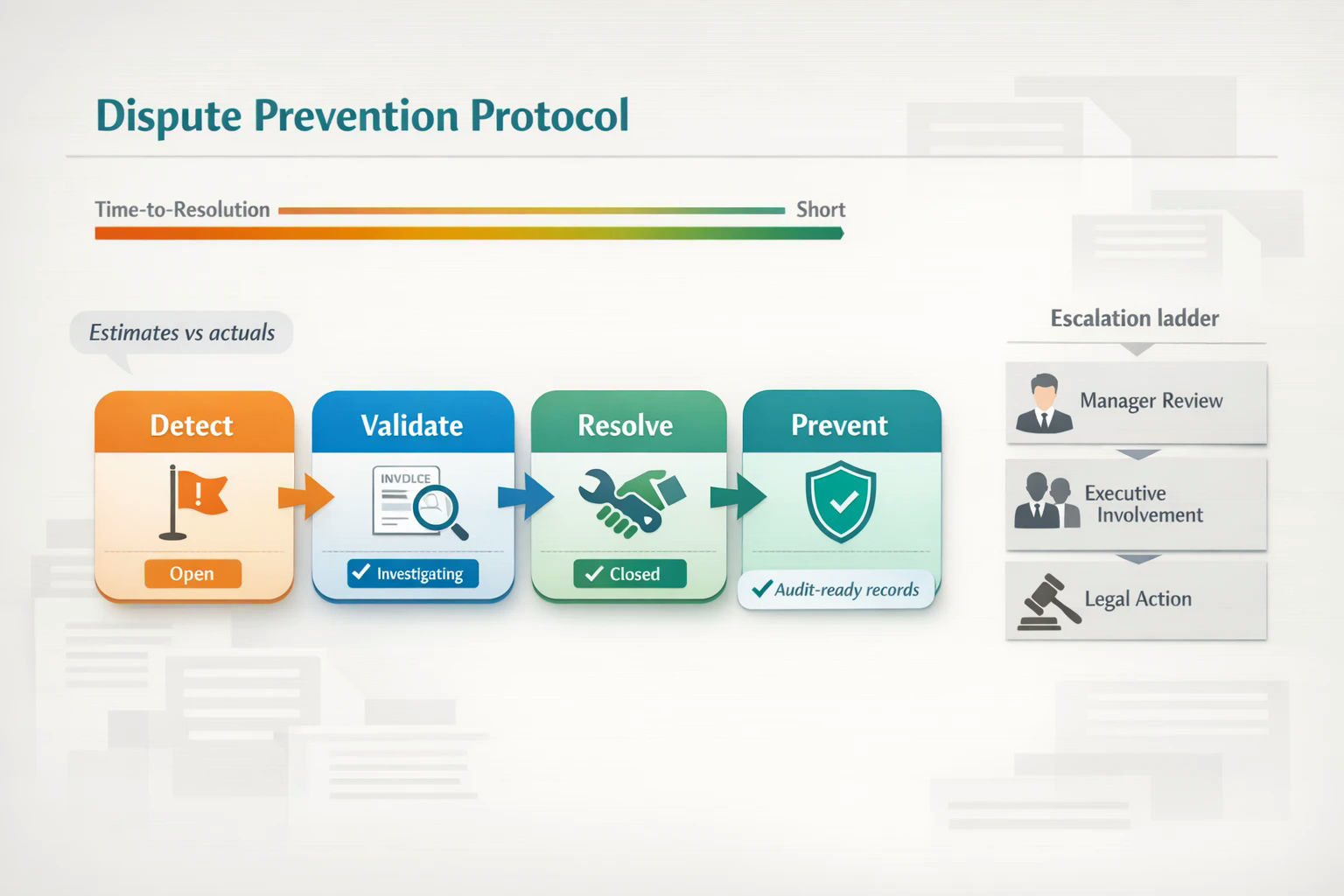
By establishing a clear, agreed-upon process for managing common friction points, you can maintain control and keep the relationship collaborative. This involves standardising how you detect anomalies, validate charges, and resolve discrepancies.
Prevent billing disputes before they become escalations: standardise detection, validation, and resolution steps, then lock in controls that keep invoices and data audit-ready.
A robust communication protocol is central to this. Your QRM agenda should include a review of billing performance, and you should have a pre-defined "escalation ladder" that clarifies who to contact and within what timeframe if an issue isn't resolved by your day-to-day contact.
Use root cause analysis to stop recurring supplier problems
Resolving a dispute should not automatically close the issue. If the underlying cause remains in place, the same error may return on the next invoice or affect another account.
For significant or recurring failures, supplier relationship management should include a simple root cause analysis. Establish why the issue occurred, whether the cause exists elsewhere, which process or control failed and what action will prevent recurrence.
For example, correcting an inaccurate invoice resolves the immediate financial problem. Identifying that an incorrect tariff was loaded across multiple accounts addresses the underlying cause. The second outcome is where SRM begins to create lasting value.
Root causes and corrective actions should feed back into the supplier scorecard. Repeated failures can then be measured as a performance trend rather than managed as disconnected support tickets.
When to create a supplier improvement plan
A supplier improvement plan becomes appropriate when underperformance is persistent, material or unlikely to be corrected through normal account management.
The plan should define the current problem and establish a measurable baseline. It should then state the required improvement, corrective actions, responsible supplier and customer owners, deadlines and the evidence needed to demonstrate completion.
For example, if invoice correction routinely takes several weeks, the improvement plan should not simply state that billing needs to improve. It should establish the current resolution time, the target, the operational changes required and the date on which performance will be reviewed.
Progress should become a standing item in subsequent governance meetings until the required improvement is sustained. If performance does not improve, the organisation then has documented evidence to support escalation, commercial remedies where applicable or future sourcing decisions.
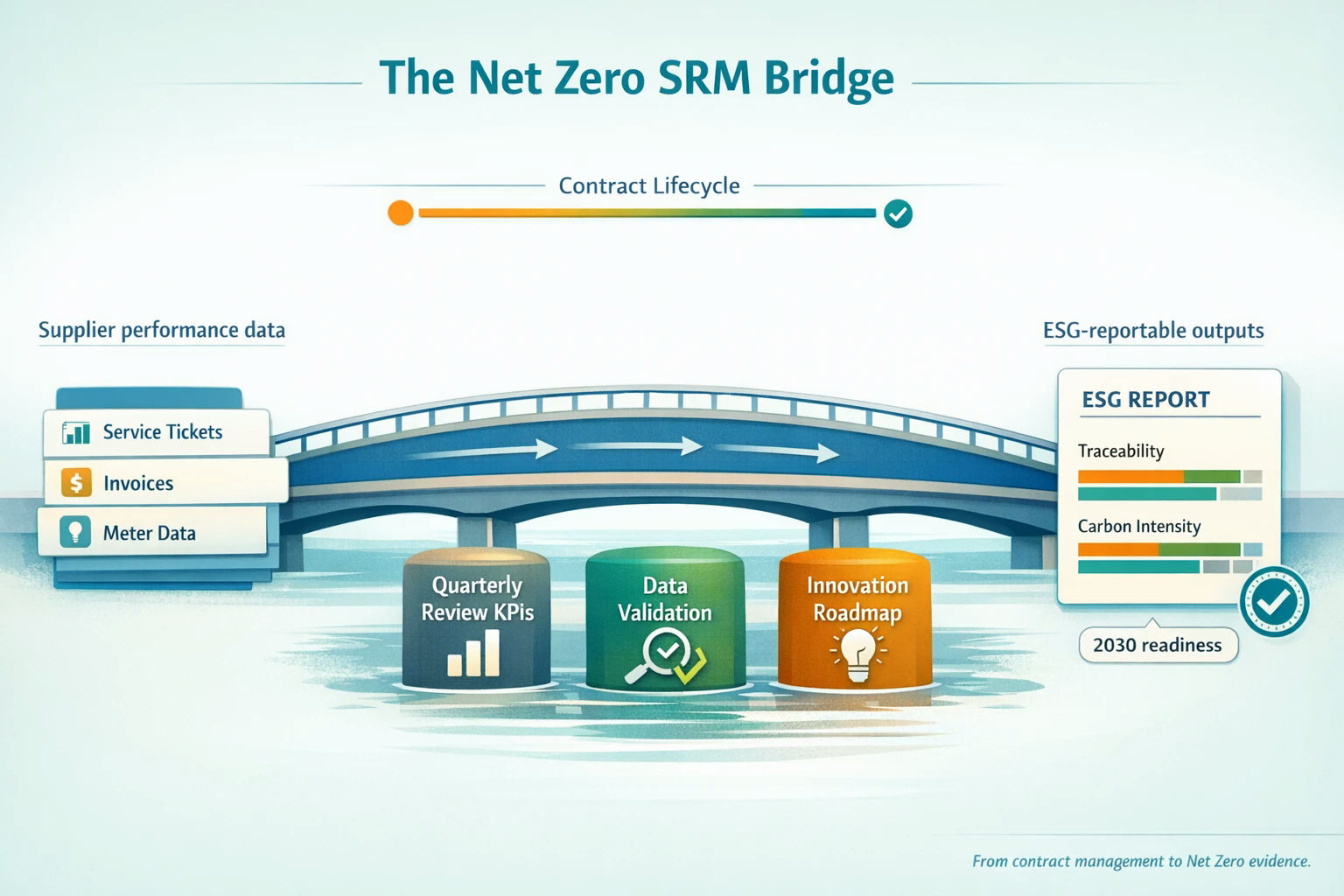
Step 4: Turn your supplier relationship into a Net Zero asset
As Power Purchase Agreements (PPAs) grow at 21% annually, the nature of energy procurement is becoming more collaborative. Your supplier relationship is no longer just a cost centre; it's a critical component of your sustainability strategy. An effective SRM framework provides the governance needed to convert supplier performance into tangible, reportable ESG data.
Strong supplier management ensures the data you receive is accurate, timely, and fit for purpose, whether for mandatory carbon reporting or for sharing progress with stakeholders.
Make SRM measurable beyond service: translate supplier KPIs, validated data, and innovation commitments into ESG evidence your stakeholders can use for Net Zero planning.
This "Net Zero bridge" turns your supplier management from an operational task into a strategic function. It proves that you are not just buying green energy but actively managing your contracts to achieve measurable environmental outcomes.
How utility suppliers can create additional value
The strongest supplier relationships do more than prevent problems. Once core service performance is stable, SRM can be used to identify additional commercial, operational and strategic value.
Data is one opportunity. Better access to interval consumption data, automated reporting or system integrations can reduce administrative effort and improve decision-making. Where appropriate, suppliers may also be able to support demand flexibility, portfolio optimisation or new tariff structures.
Market intelligence can be valuable as well. Strategic suppliers should understand the customer's portfolio sufficiently well to identify relevant market, regulatory or product developments rather than waiting for the customer to ask about them.
Innovation should still be governed. An idea is not valuable simply because it is new. Proposed initiatives should have a defined business case, owner, expected outcome and method for measuring whether the promised benefit was delivered.
This is one of the clearest differences between transactional supplier management and strategic SRM: the relationship progresses from correcting failures to jointly identifying improvements.
Where supplier relationship management fits in the contract lifecycle
Utility supplier relationship management is one stage in a broader commercial lifecycle, and understanding that relationship helps prevent overlap between procurement, negotiation and post-award management.
Procurement identifies the organisation's requirements, approaches the market and selects the supplier. Business energy contract negotiation then determines the detailed commercial terms, risk allocation and obligations that will govern the agreement.
Utility contract management begins after award and makes sure the signed terms are implemented, billed and administered correctly. Supplier relationship management uses that contractual foundation to manage performance, communication, improvement and strategic value throughout the relationship.
As renewal approaches, evidence generated through contract management and SRM should feed back into procurement. Supplier scorecards, billing performance, dispute history, improvement plans and innovation outcomes provide objective evidence about whether the incumbent should be retained, challenged or replaced.
Navigating the complexities of the UK utility market requires more than just a good price; it demands a great partnership. At Green Light Consultancy Group, we build our service around this principle. Our approach is founded on providing human support and clear solutions that extend far beyond the initial procurement.
We help you implement the governance frameworks needed to manage your suppliers effectively, ensuring the value promised in a contract is delivered every day. If you're ready to move beyond the endless cycle of switching and firefighting, let's talk about building a utility management strategy that lasts.
Turn Your Utility Suppliers into Strategic Partners
Move beyond switching and firefighting. Build a smarter supplier management strategy that improves performance, reduces risk, and delivers lasting value across your utility contracts.