Oops! Something went wrong while submitting the form.
Business electricity is expensive in the UK because gas sets the price of power, and everything stacked on top of the energy itself keeps rising. Most small and medium firms pay 22p to 30p per kWh in 2026, against a typical 12p to 18p before 2021. The energy itself is now the minority of the bill: non-commodity costs account for around 64% of what a UK business pays for electricity.
Prices have not returned to where they were. Electricity is still around 75% higher than pre-2021 levels, and network charges rose by roughly 60% from April 2026. This article explains exactly where the money on your bill goes, why UK businesses pay more than households and more than most of Europe, and which parts of the cost you can actually control.
Ready to act rather than read? If you already suspect you are overpaying, compare business electricity rates with our team and we will benchmark your current contract against the whole market. Prefer to understand the numbers first? Keep reading.
Why is business electricity so expensive?
Business electricity is expensive for three reasons. Gas-fired power stations set the wholesale price of all UK electricity, and gas has stayed costly since 2022. Network and policy charges now make up most of the bill, and they rose sharply again in April 2026. And businesses have no price cap, so a company that lets its contract lapse can pay 40p per kWh or more when the going market rate is 22p to 30p.
How much are businesses paying for electricity in 2026?
The table below shows where the market sits this year. Full size-by-size figures are in our guide to current rates.
Measure
Typical figure (2026)
Average unit rate for SMEs on fixed contracts
22p to 30p per kWh
The cheapest fixed deals on the market
~18p to 22p per kWh
Out-of-contract and deemed rates
40p+ per kWh
Daily standing charge
45p to 65p
Typical unit rate before 2021
12p to 18p per kWh
The number to notice is not in the table. On the same meter, the gap between the cheapest and most expensive quote is commonly 30% to 50%. Two identical shop units on the same street can pay very different rates purely because of when each owner signed and with whom. See what businesses are paying by size in 2026 for the full breakdown.
What makes up a business electricity bill?
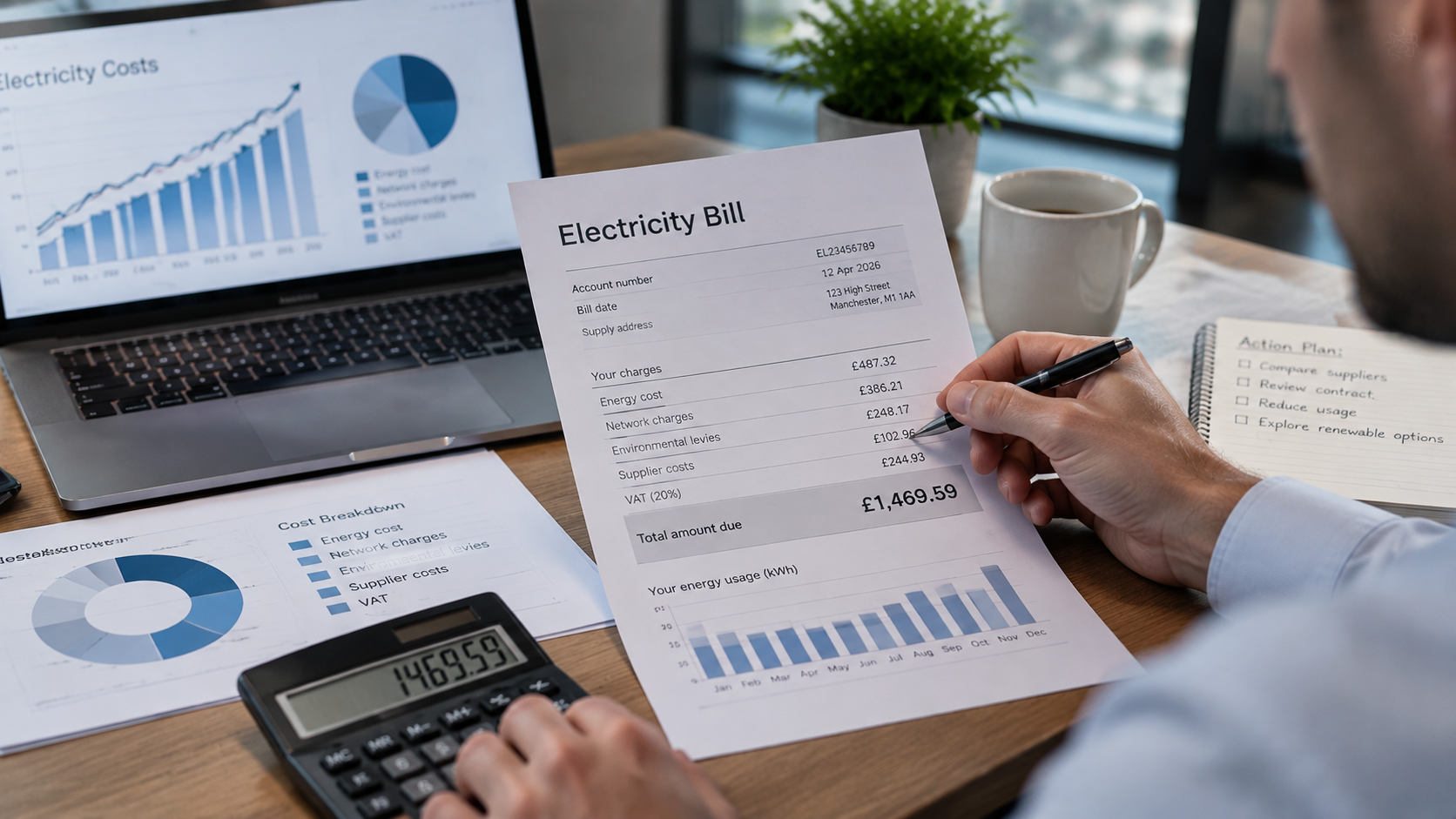
Most of your bill is not the electricity. Wholesale power currently trades around £99 to £102 per MWh, roughly 10p per unit and far below the 2022 peaks above £400. Yet businesses are quoted 22p to 30p. The difference is everything stacked on top.
Part of the bill
What it pays for
Rough share
Wholesale energy
The electricity itself
~36%
Network charges (TNUoS and DUoS)
Moving power across the grid and keeping it balanced
25% to 30%
Policy and environmental levies
Renewables schemes, the Climate Change Levy, new nuclear
15% to 20%
Supplier costs and margin
Billing, service, risk, profit
5% to 10%
VAT
20% for most businesses, 5% for low-usage sites
Added on top
The practical takeaway: a falling wholesale price does not always show up as a lower bill, because the charges around the energy keep rising. That is exactly what happened to many businesses in 2026.
Why does gas set the price if half our power is renewable?
This is the question we get asked most, and it comes down to how the wholesale market prices power. The UK uses marginal cost pricing. In every half-hour period, the price for all electricity is set by the most expensive power station needed to meet demand at that moment. Not the average. The most expensive.
Wind and solar are cheap to run but depend on the weather. When they fall short, gas-fired stations switch on to fill the gap, and because they are usually that last resort, the price of gas sets the price of everything. Including the wind power. A business on a 100% renewable tariff still pays prices driven by the gas market.
The UK feels this harder than most neighbours because we import a large share of our gas and store very little of it. Disruption to supply, including the fallout from the war in Ukraine, feeds straight into British bills. Countries that lean less on gas for generation tend to pay less.
Why did business electricity bills rise again in 2026?
A standing charge is a fixed daily cost. You pay it whether you use one unit or a thousand. This is why so many businesses saw bills climb in 2026 while their usage stayed flat, and why the unit rate alone no longer tells you the full story of any quote.
Why do businesses pay more than households for electricity?
Because the rules are different, and mostly not in your favour.
No price cap. The Ofgem cap protects households only. Businesses have had no equivalent since the Energy Bill Relief Scheme ended in March 2023, which leaves them fully exposed to the market.
The Climate Change Levy. Most businesses pay 0.775p per kWh on electricity, a charge households never see. Energy-intensive firms can cut it by up to 90% through a Climate Change Agreement, though many that qualify have never applied.
VAT at 20%. Households pay 5%. Businesses using under 33 kWh a day can qualify for the reduced rate too, and plenty sit on the wrong rate simply because nobody checked.
Nothing catches you when a contract ends. Let a fixed deal lapse and you drop onto out-of-contract rates, often 40p per kWh or higher, with no cap and no warning beyond a line in a letter.
Why do different businesses pay different electricity rates?
There is no standard business electricity price. Suppliers quote each business individually based on annual usage, region, operating hours, meter type, credit profile and the state of the market on the day you sign. Bigger users get keener unit rates. Each distribution region carries its own network charges. Half-hourly meters are priced on your exact usage pattern.
The pattern to notice: a restaurant with kitchens and refrigeration running long hours, an office dominated by lighting and IT, and a manufacturer running heavy machinery are three different risks to a supplier, and they get three different prices. For energy-intensive manufacturers, a Climate Change Agreement is usually the first thing worth investigating.
Why are some businesses paying too much for electricity?
Market factors hit everyone. The overpaying usually comes from four habits.
Rolling onto out-of-contract rates. A fixed deal ends, nobody renews it, and the supplier quietly moves the business onto default rates that can top 40p per kWh. We have reviewed bills where a company sat on those rates for over a year. If you do not know your contract end date, find it today.
Signing the renewal letter. A renewal offer is rarely your supplier's best price and almost never the best in the market. Suppliers count on inertia, and every year thousands of businesses oblige.
Picking the wrong contract type. A cafe that needs predictable costs has no business on a flexible contract. A large user with someone watching the market might do well on one. The wrong structure costs money in either direction.
Leaving it too late. The best fixed deals are usually locked in several months before the current contract ends. Suppliers let you agree future prices well in advance. Leave it to the final week and you take whatever the market offers that day.
Should you choose a fixed or flexible energy contract?
A fixed-rate contract locks your unit price and standing charge for one to three years. It gives you a stable rate to budget around and protects you if the market climbs during your term. It is the right choice for most small and medium businesses.
A flexible contract moves with the wholesale market. It lets you benefit when prices fall, but it needs someone actively managing purchases, which is why it mainly suits large, high-consumption users. For most SMEs, the real decisions are the length of the fix and the timing of the signature.
How can you reduce your business electricity costs?
You have four practical levers, and most businesses should pull more than one.
First, benchmark your current contract. Dig out your unit rate, standing charge and end date. If you are paying much above 30p per kWh in 2026, or you cannot find your end date, that is your starting point. It takes ten minutes.
Second, compare the whole market rather than one supplier. With quotes on the same meter varying by 30% to 50%, a proper comparison across the full supplier panel is usually the largest single saving available. This is where a broker earns its place, by benchmarking your usage against multiple suppliers at once.
Third, cut the waste. LED lighting pays for itself quickly in most premises. Timers and smart controls stop equipment running out of hours, and half-hourly monitoring shows you what runs at 3am. Tired refrigeration and old motors are quiet money pits.
Fourth, cut your reliance on the grid where it pays off. Because the sharpest 2026 increases hit grid charges rather than the energy itself, on-site generation has become more attractive, not less. Solar and switching to a renewable energy tariff can lower your exposure to wholesale swings. Whether it makes financial sense depends on your site and usage.
Compare business electricity rates with Green Light
At Green Light Consultancy Group, we help UK businesses work out why their electricity costs what it does, and then bring the number down. We benchmark your current contract against the whole market, flag where standing charge increases are hitting you, and structure a deal around your usage, contract terms and sustainability goals. Where renewable energy fits your budget and aims, we build that in. Where another option is better value, we tell you plainly.
Why is business electricity so expensive in the UK?
Because gas-fired stations set the wholesale price of all UK electricity, and non-commodity costs such as network charges and policy levies now make up around 64% of the bill. Businesses also have no price cap, so lapsed contracts can reach 40p per kWh or more.
Why is business electricity more expensive than domestic?
Businesses have no Ofgem price cap, pay VAT at 20% rather than 5% in most cases, and pay the Climate Change Levy at 0.775p per kWh. A business on a well-negotiated fixed deal can still beat household unit rates. A business on lapsed contract rates will pay far more.
What is a good business electricity rate in 2026?
A competitive fixed rate for most SMEs sits between roughly 20p and 25p per kWh, against a market average of 22p to 30p. Larger users can go lower. Anything near 40p almost always means you are out of contract.
Why did my bill go up in 2026 when my usage stayed the same?
TNUoS network charges rose by roughly 60% from April 2026, and most of that increase went onto standing charges. Standing charges are fixed daily costs, so they push bills up regardless of consumption.
Will business electricity prices come down?
Wholesale prices have settled well below crisis levels, but rates are expected to stay high compared with the pre-2021 era while the UK depends on imported gas and pays for major grid upgrades. Securing a competitive contract beats waiting for the market.
Can a broker get me a cheaper business electricity rate?
Switch Business Electricity To learn more about why your business is paying what it pays, and how to bring the number down, get in touch with the team today.
Ready to Take Control of Your Contract Renewal?
Avoid costly auto-renewals and poor supplier terms. Get expert support from GLCG to review, renegotiate and secure better energy, water and telecom contracts for your business.