Oops! Something went wrong while submitting the form.
Unlike your straightforward domestic energy bill, a business energy contract is a complex agreement filled with critical choices that can significantly impact your bottom line. Choosing the wrong one can mean overpaying by thousands, while the right one offers budget certainty and supports growth. Yet many businesses fall into expensive default rates simply because the options feel overwhelming.
This guide breaks down the jargon and clarifies the choices. We’ll walk through the main contract types, expose common myths, and give you a clear framework for deciding which path is right for your business.
What Is a Business Energy Contract?
Business energy contracts are generally less regulated than domestic tariffs, meaning suppliers have greater flexibility when setting prices and contract terms. This creates opportunities to secure competitive rates, but it also makes it more important to understand exactly what you're agreeing to before signing.
Most suppliers offer multiple business energy contract types to accommodate different levels of energy consumption, budget certainty, and risk tolerance. Selecting the right contract depends on your operational needs, financial objectives, and how actively you want to manage energy purchasing throughout the contract period.
The core components of any business energy contract
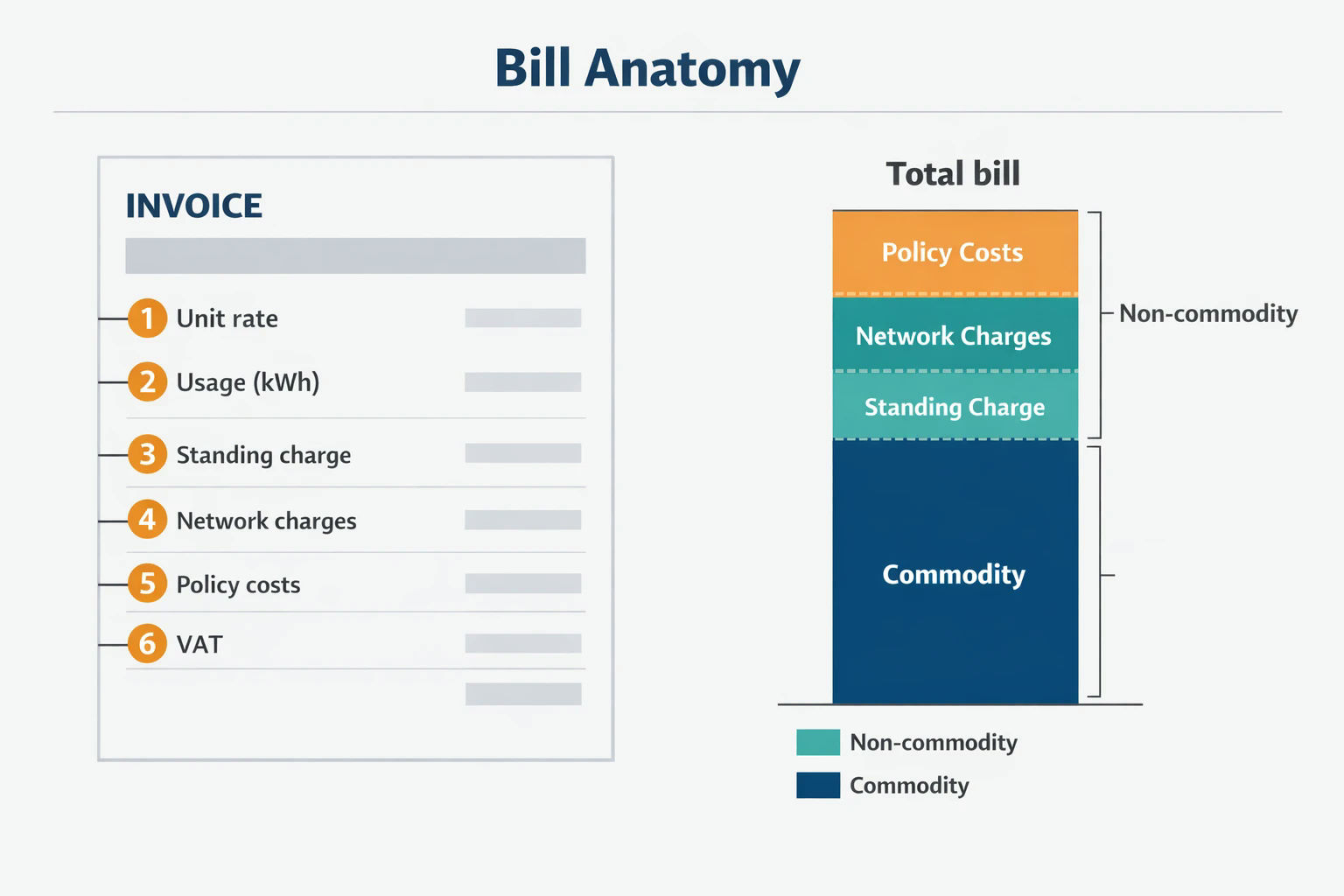
Before diving into contract types, it’s essential to understand what you’re actually paying for. Every bill is split into two main parts:
Commodity Costs: This is the price of the energy (gas or electricity) itself. It’s the part of your bill that fluctuates with the wholesale market.
Non-Commodity Costs: These are all the other charges required to get the energy from the power station to your premises. They include network maintenance fees, government levies for green initiatives, and supplier operating costs. These charges can make up over half of your total bill and are a common source of confusion.
Understanding this split is crucial because different contracts handle these costs in different ways.
A deep dive into business energy contract types
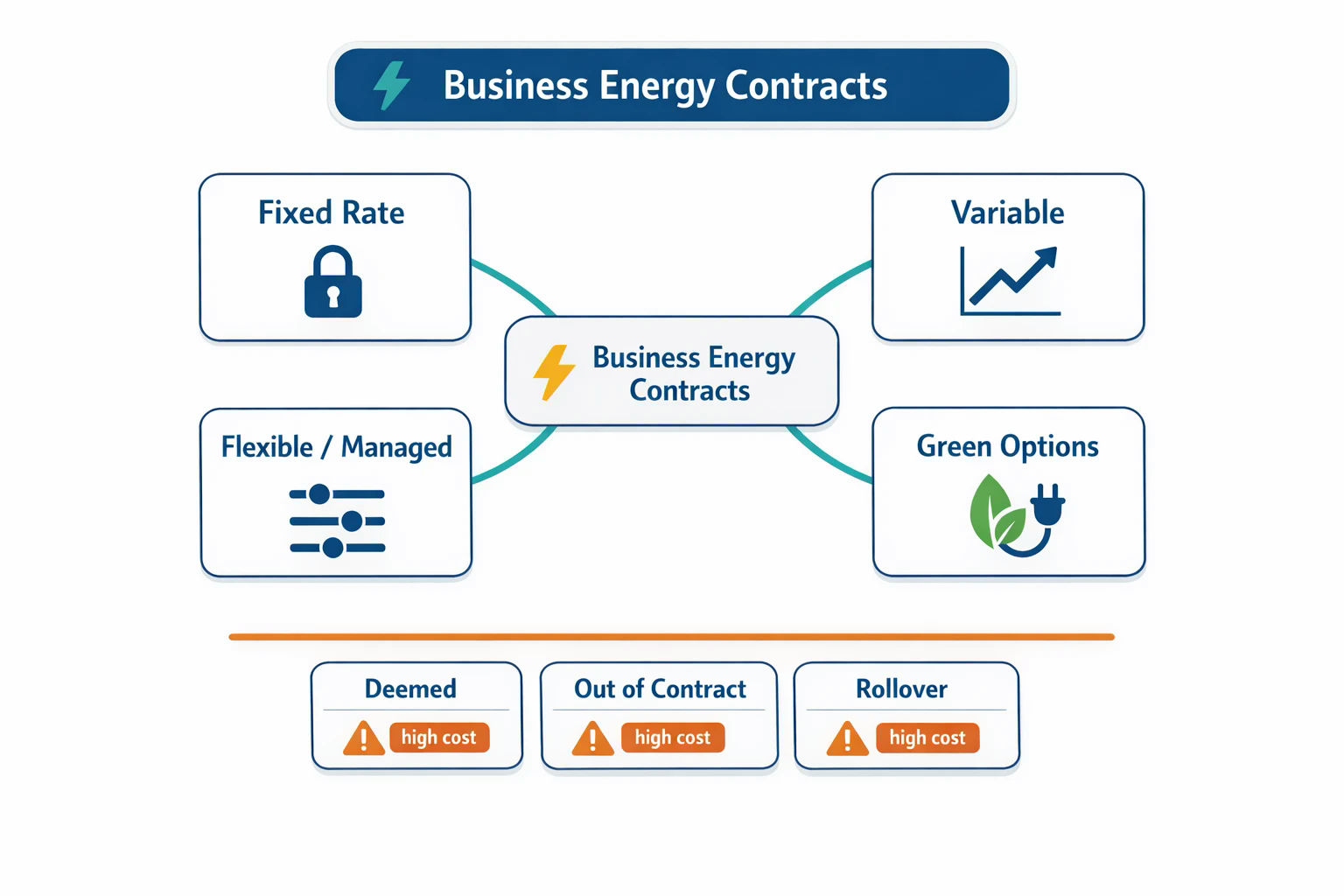
Most business energy contracts fall into one of three main categories: Fixed, Variable, or Flexible. There are also a couple of default states you should actively avoid.
Fixed-rate contracts
This is the most common type of contract, especially for small to medium-sized enterprises (SMEs). You agree to a set price per unit (kWh) of energy for a defined period, typically one to three years.
Pros: Offers budget certainty and protects you from sudden wholesale market price spikes. It simplifies financial planning.
Cons: You won't benefit if market prices fall. You are locked in for the duration, and exit fees can be substantial.
Best for: Businesses that need predictable costs and value stability over potential market savings. Think cafes, retail shops, and small offices.
A common myth busted: "Fixed" doesn't always mean 100% of your bill is fixed. Many fixed-rate contracts allow suppliers to pass on unexpected increases in non-commodity costs. It's vital to check the contract terms for clauses about "change events" or "pass-through charges."
Variable-rate contracts
With a variable-rate contract, the unit price of your energy changes based on fluctuations in the wholesale market. The supplier adjusts your rate periodically, often monthly.
Pros: You can benefit from falling market prices without being locked into a high rate. They often offer more flexibility with shorter or no fixed terms.
Cons: You are exposed to market volatility. A sudden price surge can dramatically increase your bills, making budgeting difficult.
Best for: Businesses with a higher risk appetite or those who believe the market is likely to fall. It can also be a short-term solution while waiting for better fixed-rate deals.
Flexible purchasing (or pass-through) contracts
These are more advanced contracts designed for large, energy-intensive businesses. Instead of buying all your energy in one go, you purchase it in smaller blocks throughout the contract period. This allows you to take advantage of market lows and manage risk more actively.
Pros: Offers the potential for significant savings by buying energy strategically when prices are low. Provides greater transparency as commodity and non-commodity costs are often separated.
Cons: Requires active management and a deep understanding of the energy market. It carries higher risk and is not suitable for most SMEs.
The expensive defaults: deemed and out-of-contract rates
These aren't contracts you choose; they are states your business can fall into, and they are always costly.
Deemed Contracts: If you move into a new business premises without arranging a contract beforehand, you’ll be placed on a "deemed" contract with the existing supplier. Ofgem confirms these rates are typically much higher than negotiated ones.
Out-of-Contract/Rollover Contracts: This happens when your fixed-term contract ends, and you haven't agreed to a new one or switched suppliers. Your current supplier will often move you onto a very expensive variable rate. Some contracts include an auto-renewal clause, locking you into another term at uncompetitive rates if you don't provide notice to terminate.
The key to avoiding these is proactive management: know your contract end date and start looking for a new deal at least three to six months in advance.
How to choose the right contract for your business
Selecting the optimal contract isn't about finding the absolute cheapest unit rate. It’s about finding the best value and the right fit for your business's operational needs and goals.
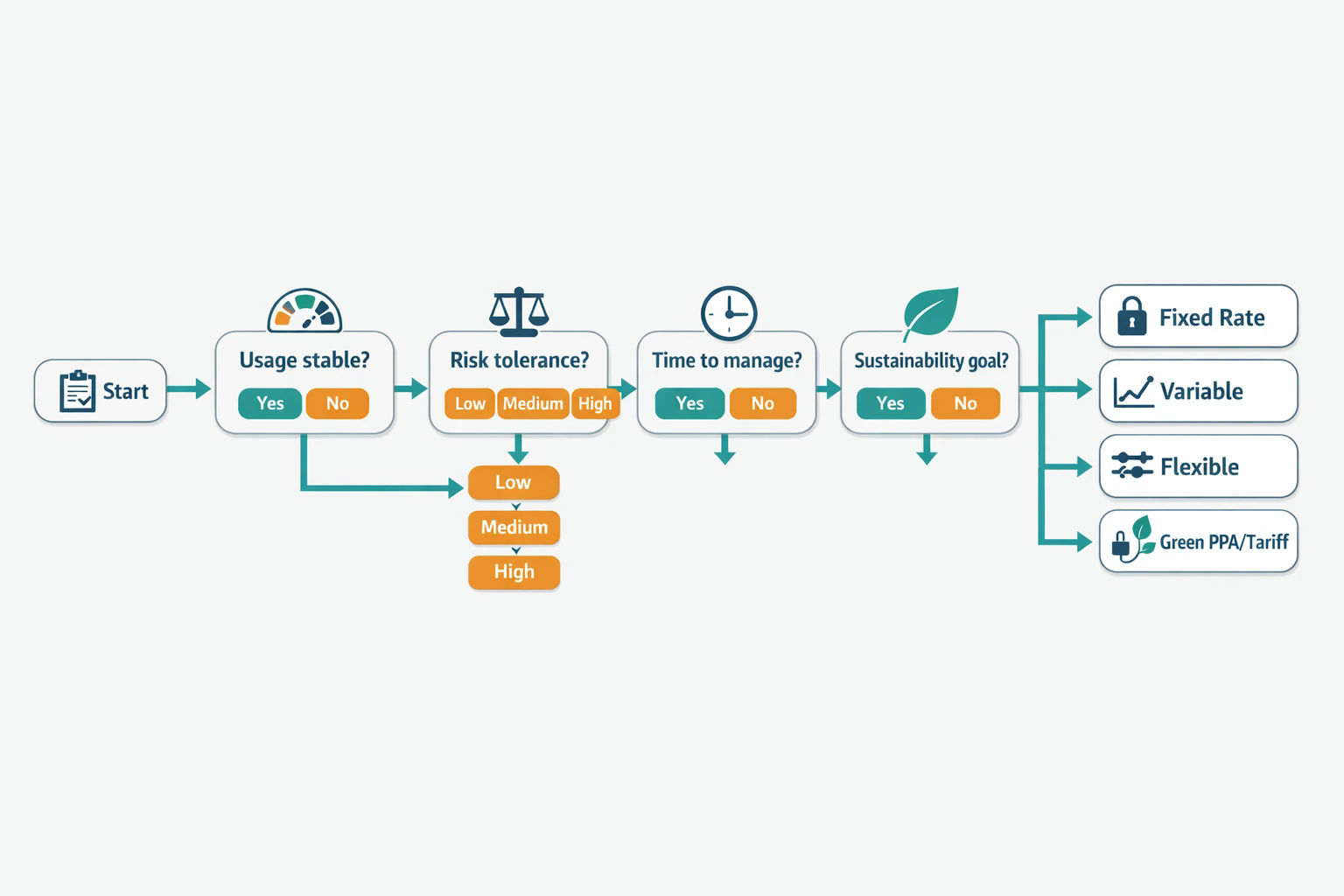
Assess your energy usage: Do you operate at consistent times, or does your consumption fluctuate wildly? Smart meter data can provide powerful insights here. A business with predictable usage (like a 9-to-5 office) is a great candidate for a fixed rate. A business with seasonal peaks might explore different options.
Define your risk appetite: How important is budget certainty? If an unexpected 30% jump in your energy bill would be a serious problem, the safety of a fixed-rate contract is likely your best choice. If you have the cash flow to handle volatility and want to chase market lows, a variable rate could be considered.
Consider your business goals: Are sustainability and reducing your carbon footprint a priority? If so, you might look specifically for green tariffs that guarantee your energy comes from renewable sources or even explore a Power Purchase Agreement (PPA) if your consumption is large enough.
How Long Should a Business Energy Contract Be?
Contract length is another important consideration when comparing business energy contract types. Although one-, two-, and three-year agreements remain the most common, the ideal term depends on market conditions, business stability, and future plans.
One-Year Contracts
Shorter agreements provide greater flexibility and allow businesses to renegotiate sooner if market prices fall. However, they also expose organisations to more frequent renewals and potential price volatility.
Two-Year Contracts
Two-year contracts often strike a balance between pricing certainty and flexibility. Many businesses choose this option because it provides longer-term budget stability without committing to an extended agreement.
Three-Year Contracts and Longer
Longer contracts may offer attractive pricing during favourable market conditions while reducing the administrative burden of regular renewals. However, businesses should carefully consider future expansion, relocation, or operational changes before committing to longer terms, as early termination charges may apply.
Regardless of contract length, businesses should begin reviewing renewal options several months before expiry. Allowing sufficient time to compare suppliers and negotiate pricing significantly reduces the likelihood of being transferred onto expensive out-of-contract rates.
Understanding your bill: where the costs really are
A common point of frustration for business owners is an energy bill that seems disconnected from the rate they signed up for. This is almost always due to the impact of non-commodity costs.
Your bill will show the unit rate (commodity) you agreed to, but it will also include separate line items for:
Transmission and Distribution Charges (TNUoS & DUoS): The cost of using the national and local energy networks.
Balancing Services (BSUoS): Costs for keeping the national grid stable.
Climate Change Levy (CCL): A government tax on energy usage.
Renewables Obligation (RO) & Feed-in Tariff (FiT): Levies that support large-scale and small-scale renewable energy generation.
In a fully fixed contract, the supplier estimates these costs and bundles them into your rate. In a pass-through contract, these are charged at their actual cost, which provides transparency but reduces budget certainty.
Watch out for red flags before you sign
The complexity of energy contracts can unfortunately be used to hide unfavourable terms. Before signing any new agreement, look carefully for these common pitfalls. A trusted independent consultant can be invaluable in spotting these clauses.
Should You Use an Energy Broker?
Many businesses choose to work with an independent business energy broker or consultant when comparing business energy contract types. While this is not essential for every organisation, professional advice can simplify the procurement process and provide access to a broader range of supplier options.
An experienced broker can help analyse historical energy consumption, explain contract structures, identify hidden charges, and negotiate pricing with multiple suppliers. This can be particularly valuable for businesses without dedicated procurement teams or those managing several commercial properties.
However, not all brokers operate in the same way. Some receive commission from suppliers, while others work on transparent consultancy fees. Before engaging a broker, ask how they are compensated and whether they compare the entire market or only selected suppliers.
Businesses should also remember that the final responsibility for reviewing and approving the contract remains with the customer. Whether purchasing directly from an energy supplier or through a broker, understanding the terms of the agreement remains essential.
Moving forward with clarity
Understanding your business energy contract is the first step toward taking control of one of your most significant operational costs. By moving beyond just the headline unit price and considering your usage patterns, risk tolerance, and the details in the fine print, you can make a strategic decision that benefits your business for years to come.
The next practical step is to identify your current contract's end date and notice period. Put it in your calendar. This simple action is the key to avoiding expensive rollover rates and gives you the time you need to explore the market and find the contract that truly fits your business.
Find the Right Energy Contract for Your Business
Avoid costly rollover rates, confusing terms, and contracts that do not match your needs. Speak with our business energy specialists to compare available options and secure a contract that supports your budget, energy usage, and long-term goals.