Oops! Something went wrong while submitting the form.
In 2026, business energy procurement is no longer simply about securing the lowest unit rate. Non-commodity costs such as network charges and policy-related costs can account for a significant proportion of the total electricity bill, meaning an effective procurement strategy must evaluate total contract cost, supplier risk and long-term exposure rather than headline price alone.
For UK businesses, this changes the role of energy tendering. Comparing supplier quotes is only one part of the procurement process. Strategic sourcing now requires organisations to understand their consumption requirements, assess market conditions, structure an effective tender, evaluate supplier stability, scrutinise contract terms and establish effective governance after the contract is awarded.
The old model of simply comparing quotes is no longer enough. Today, strategic sourcing is about building resilience. It requires a modern framework that accounts for regulatory changes like the Procurement Act 2023, assesses supplier stability, and ensures billing accuracy from day one.
The objective is not simply to buy energy at an attractive price. It is to secure an energy contract that balances cost, risk, operational requirements, transparency and long-term value throughout the contract term.
What is business energy procurement?
Business energy procurement is the process of determining an organisation's energy requirements, analysing the market, developing a sourcing strategy, tendering suitable suppliers, evaluating offers, negotiating contract terms and managing the resulting supplier relationship.
Although purchasing is part of the process, procurement has a much broader scope. Buying energy describes the transaction itself. Business energy procurement considers the decisions that surround that transaction: what the organisation needs, when it should approach the market, which contract structure is appropriate, which suppliers are suitable, how competing bids should be compared and how commercial and operational risks will be controlled.
A complete energy procurement process therefore connects several activities: consumption and contract data analysis, energy market research, strategic sourcing, RFP or tender development, supplier due diligence, bid evaluation, negotiation, contract award and ongoing supplier governance.
For organisations with significant energy consumption, these decisions can affect budgeting, cash flow, operational resilience and carbon reporting for years after the initial tender has been completed.
Business energy procurement vs energy purchasing
Energy purchasing is usually concerned with the point at which energy is bought and the commercial price agreed. Energy procurement begins earlier and continues after the purchase.
For example, a purchasing decision might compare two suppliers offering different electricity rates. A procurement decision asks additional questions: Are the bids genuinely comparable? Which costs are fixed and which can be passed through? Does the contract match the organisation's consumption profile? How financially resilient is the supplier? Can it provide accurate billing and carbon data? What happens if market conditions or regulation change?
This wider perspective is why strategic sourcing and tendering are central to effective business energy procurement.
Why business energy procurement has changed in 2026
Energy contracts increasingly need to be assessed as a combination of commodity cost, non-commodity cost, contractual risk and supplier capability. A low headline unit rate can be misleading if the contract allows additional charges to be passed through or contains terms that create greater financial exposure later.
Network charges, policy-related costs and other non-commodity elements can represent a substantial share of the final electricity bill. The exact proportion varies by customer, consumption profile, contract structure and market conditions, so businesses should assess their own cost stack rather than relying on a headline industry percentage.
This means procurement teams need to understand both the quoted energy price and how the supplier proposes to treat costs that sit around it.
At the same time, supplier resilience, billing capability, data quality and contract transparency have become more important. An apparently competitive energy contract can create significant administrative or financial problems if invoices are inaccurate, contractual responsibilities are unclear or the supplier cannot deliver the required level of service.
The result is a shift from price-led energy purchasing towards risk-aware strategic procurement.
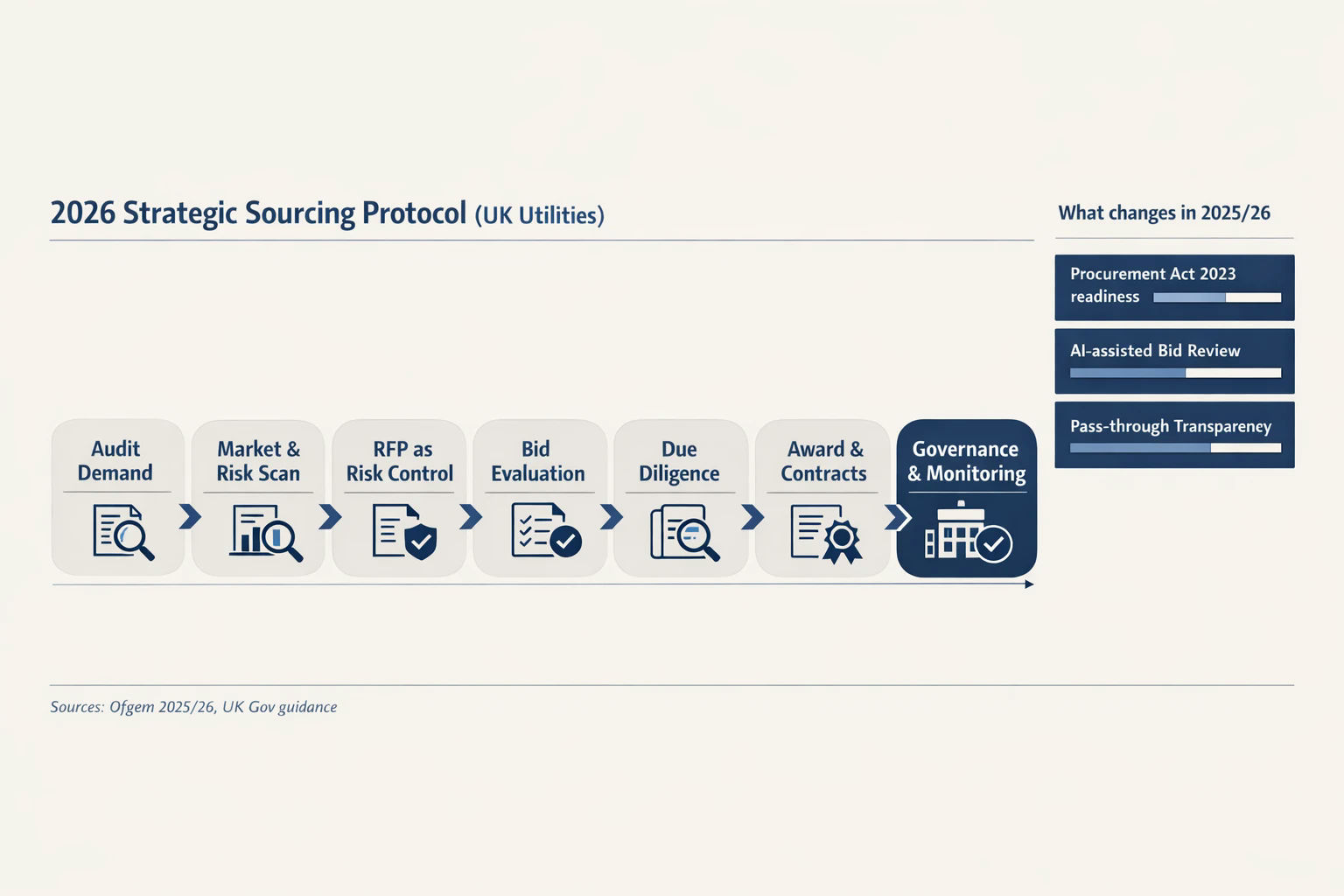
The 7-step strategic sourcing protocol for 2026
Standard sourcing processes are common, but most are outdated. They fail to prepare businesses for the complexities of today's utility market, particularly the need for regulatory alignment and deeper transparency. Our protocol modernizes the classic approach, integrating the critical checkpoints needed for a resilient 2026 strategy.
A modern seven-step business energy procurement process should connect internal requirements with market intelligence, competitive tendering, structured supplier evaluation and post-award governance.
A modern 7-step sourcing protocol tailored to UK utilities- adding Procurement Act 2023 readiness, AI-assisted evaluation, and transparency checks to the classic tender process.
This framework moves beyond a simple reactive comparison. It transforms your Request for Proposal (RFP) from a price request into a risk control document, ensuring you partner with suppliers who offer stability and transparency, not just a low initial quote. For a closer look at market dynamics, you can explore our full guide to \[Market Research for UK Utility Contracts 2026]\().
1. Audit energy consumption and contract data
Effective procurement starts with reliable data. Before approaching suppliers, establish what is being procured and verify the information that bidders will use to price the requirement.
This should include historical consumption, meter and site information, existing contract details, renewal and termination dates, billing records and any expected operational changes that could materially affect future demand. For electricity portfolios, this may also involve checking MPAN information and understanding whether sites are half-hourly or non-half-hourly metered.
Poor input data can result in inaccurate pricing assumptions and bids that cannot be compared on a genuine like-for-like basis. A data audit therefore reduces uncertainty before the tender reaches the market.
2. Analyse the energy market and potential suppliers
The next stage is to understand the market in which the contract will be placed. Energy procurement decisions should not be made solely from historical prices; businesses should consider current market conditions, contract availability, supplier appetite and the organisation's tolerance for price volatility.
Supplier intelligence is equally important. The objective is to develop a credible shortlist of suppliers capable of servicing the organisation's consumption profile, operational requirements, reporting needs and preferred contract structure.
For a deeper assessment of these factors, see our guide to conducting energy market research before tendering a utility contract.
3. Establish governance and regulatory requirements
Before issuing the tender, establish who will make the decision, how bids will be scored, which requirements are mandatory and what evidence suppliers must provide. This makes the procurement process easier to defend internally and reduces the risk of changing evaluation criteria after bids have been received.
Public-sector and other covered procurements also need to consider the applicable requirements of the Procurement Act 2023 and associated procurement rules. Private-sector businesses are generally not governed by the Act in the same way when conducting ordinary commercial energy procurement, although principles such as transparency, clear award criteria and documented decision-making can still provide useful governance benchmarks.
4. Develop a strategic energy RFP or tender
The RFP should convert business requirements into clear commercial, operational and contractual questions. Instead of simply asking suppliers for a price, it should establish exactly what is included in that price and what could change during the contract.
The tender should also request evidence relating to billing performance, account management, data provision, carbon reporting, financial resilience, dispute handling and operational continuity where these factors are relevant to the organisation.
A well-structured RFP makes competing offers easier to normalise and reduces ambiguity during later negotiations. This is a core part of developing robust RFPs for business energy.
5. Evaluate and normalise supplier bids
Supplier offers frequently use different assumptions, terminology and pricing structures. Before scoring them, procurement teams should normalise the bids so that equivalent costs, contract terms and service requirements are being compared.
Price remains important, but it should sit alongside contractual risk, supplier capability, billing performance, data quality and financial resilience. Weightings should ideally be determined before bids are opened so that the evaluation reflects the organisation's priorities rather than the attractiveness of a particular proposal.
6. Negotiate price, risk and contract terms
Negotiation should focus on the complete commercial position rather than headline price alone. Areas requiring particular attention can include pass-through provisions, change-of-law clauses, volume tolerance, payment terms, termination rights, contract extensions, data responsibilities and the treatment of additional charges.
The objective is to identify where financial or operational risk sits and determine whether the proposed contract allocates that risk appropriately. Any negotiated changes should be documented clearly before award.
7. Establish contract governance and supplier performance management
Procurement does not finish when the contract is signed. The final stage is establishing how supplier performance, billing accuracy, contractual commitments, data provision and service issues will be monitored throughout the term.
Clear responsibilities, escalation routes and review points make it easier to identify problems early. They also create a stronger evidence base when the organisation next returns to market.
What should a business energy tender evaluate beyond unit price?
The headline unit rate is only one component of an energy contract. To understand the real commercial position, businesses need to examine the total cost structure and the contractual mechanisms that can change what they ultimately pay.
Commodity and wholesale energy costs
Commodity cost reflects the energy itself and is influenced by wholesale market conditions and the way the contract is structured. Depending on the procurement approach, businesses may secure pricing at one point or manage purchasing across multiple periods.
The appropriate approach depends on factors such as consumption, budget certainty, internal resources and appetite for market risk.
Non-commodity costs
Business electricity bills also include costs associated with networks, system operation, policy mechanisms and other regulated or industry charges. How these costs are treated within a contract matters.
Procurement teams should establish which charges are included in the quoted price, which are fixed for the contract term and which can be passed through or adjusted. Two contracts with similar headline rates can therefore produce different final costs.
Fixed versus pass-through charges
A key tender question is whether individual cost components are genuinely fixed or remain subject to adjustment. Greater price certainty may be valuable for budgeting, but businesses need to understand exactly what the supplier means by “fixed”.
Tender documentation should therefore require suppliers to identify exclusions, pass-through mechanisms and circumstances in which charges can change.
Volume tolerance and consumption risk
Some contracts contain provisions relating to expected consumption. Significant differences between forecast and actual demand may have commercial consequences depending on the agreement.
Businesses expecting site openings, closures, production changes, electrification projects or other material changes in demand should make these factors visible during procurement rather than treating historical consumption as a perfect forecast.
Contract duration and flexibility
A longer contract can provide greater certainty but can also reduce the ability to respond to changing market or operational conditions. A shorter contract may provide more flexibility while increasing exposure to the timing of the next procurement event.
The decision should therefore be based on the organisation's objectives rather than an assumption that one contract length is universally preferable.
Billing, payment and data requirements
Invoice accuracy affects cash flow and administrative workload. Tender evaluation should consider billing formats, consolidated billing requirements, payment terms, access to consumption data, query resolution and the process for correcting billing errors.
Organisations with ESG or carbon reporting requirements should also establish what energy and emissions-related data the supplier can provide, at what level of granularity and how frequently.
Termination and change provisions
Contractual provisions dealing with termination, site changes, regulatory developments and changes in law can materially alter the risk profile of an agreement. These clauses deserve the same attention as the initial price because they determine what happens when circumstances change.
Evaluating supplier bids: moving beyond the price tag
With nearly a third of UK businesses returning to fixed-term contracts to manage budget uncertainty, the temptation is to focus solely on the fixed rate. But the real value and risk are hidden in the contract's fine print and the supplier's operational capabilities.
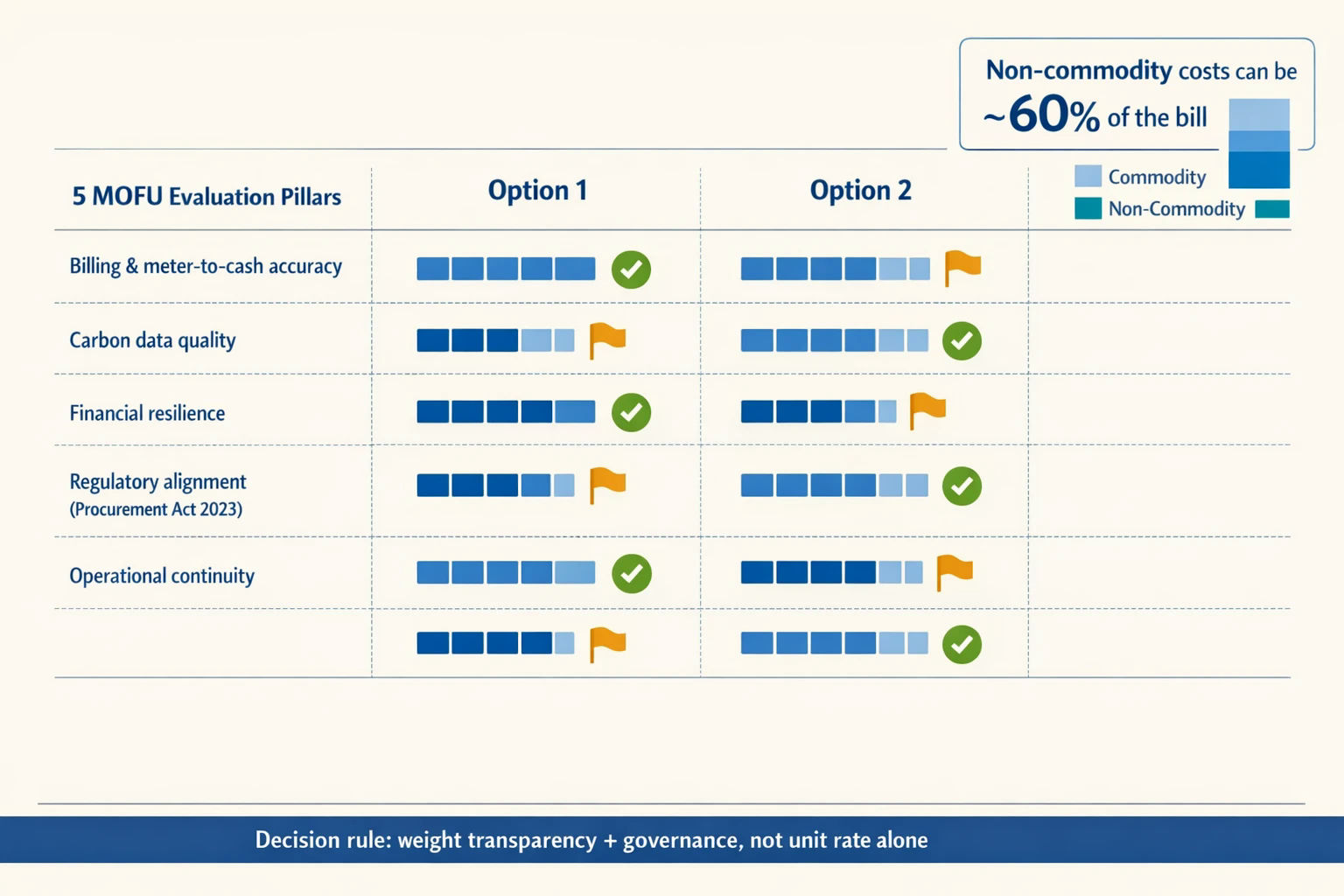
To make a truly informed decision, your evaluation must weigh five critical pillars that determine long-term contract success.
Use this beyond-price scorecard to compare bids on what actually drives outcomes: billing accuracy, transparency, resilience, Act alignment, and continuity - not just the headline unit rate.
The 5 pillars of modern supplier evaluation
Billing & Meter-to-Cash Accuracy: How reliable is the supplier's billing engine? Inaccurate invoices create huge administrative burdens and cash flow problems. Your RFP should demand evidence of their billing accuracy rates and dispute resolution processes.
Carbon Data Quality: ESG reporting is no longer optional. A supplier must be able to provide accurate, timely, and verifiable carbon data for your energy consumption. Vague commitments are a red flag.
Financial Resilience: How stable is the supplier? The new 'Economic and Financial Standing' guidance from the UK government provides a framework for assessing this. You need a partner who can weather market volatility without passing unexpected costs on to you.
Regulatory Alignment: Is the supplier fully prepared for the Procurement Act 2023? Their processes should reflect the new requirements for transparency, fair dealing, and open contracting.
Operational Continuity: What is their plan for managing debt risk and ensuring supply is never compromised? This is especially crucial for businesses where energy is a mission-critical resource.
By scoring potential partners against these pillars, you can confidently \[evaluate supplier bids beyond just price]\().
Preparing for the Procurement Act 2023
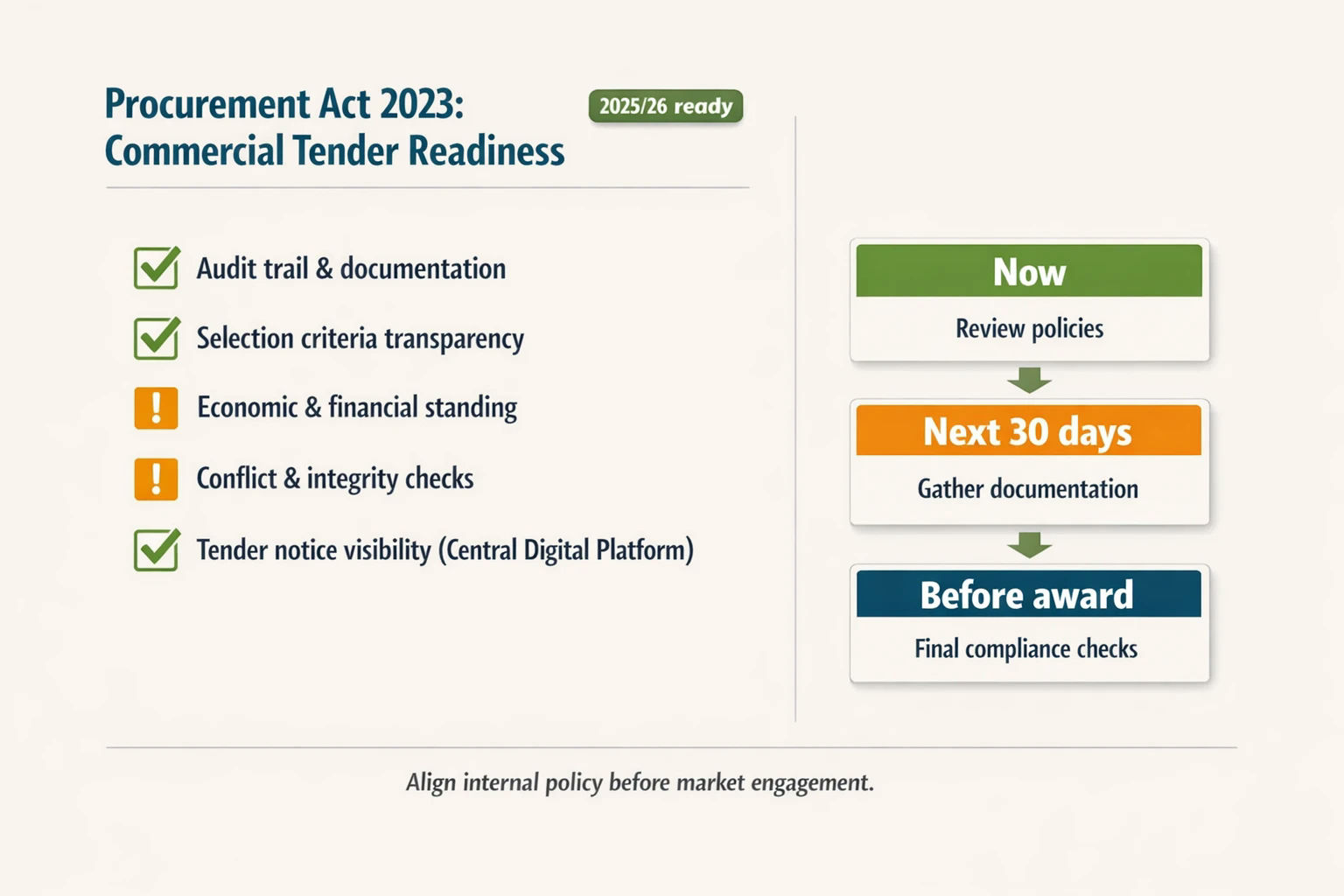
While aimed at the public sector, the Procurement Act 2023 sets a new standard for transparency that is influencing commercial contracts. Key provisions, like the new central digital platform for tender notices, are increasing expectations for openness across the board.
Businesses that align their private tendering processes with the principles of the Act are better protected and more likely to attract high-quality, stable suppliers. This isn't just about compliance; it's about adopting best practices that reduce risk.
A practical Act-readiness checklist that turns regulatory anxiety into a clear set of steps - so your tender is defensible, transparent, and easier to govern after award.
Adopting these standards now helps you build a future-proof procurement function. It demonstrates to the market that you are a serious, well-governed organisation, making you a more attractive client for top-tier suppliers.
What the Procurement Act 2023 means for energy tendering
The Procurement Act 2023 is principally relevant to covered public procurement rather than ordinary private-sector commercial purchasing. Organisations subject to the regime should therefore assess their energy tendering requirements against the legislation and current official guidance rather than treating general commercial procurement practice as a substitute for compliance.
For private-sector organisations, the Act can still provide a useful reference point for procurement governance, particularly around clearly defined criteria, transparency and documented decision-making, but this should not be confused with a general legal requirement for private businesses to follow the Act.
For organisations to which the legislation applies, procurement teams should confirm requirements using current GOV.UK and Cabinet Office guidance and maintain appropriate records throughout the tender and award process.
For other businesses, adopting selected governance disciplines can still make energy procurement easier to audit internally and can improve consistency between successive tender exercises.
The AI advantage in bid evaluation
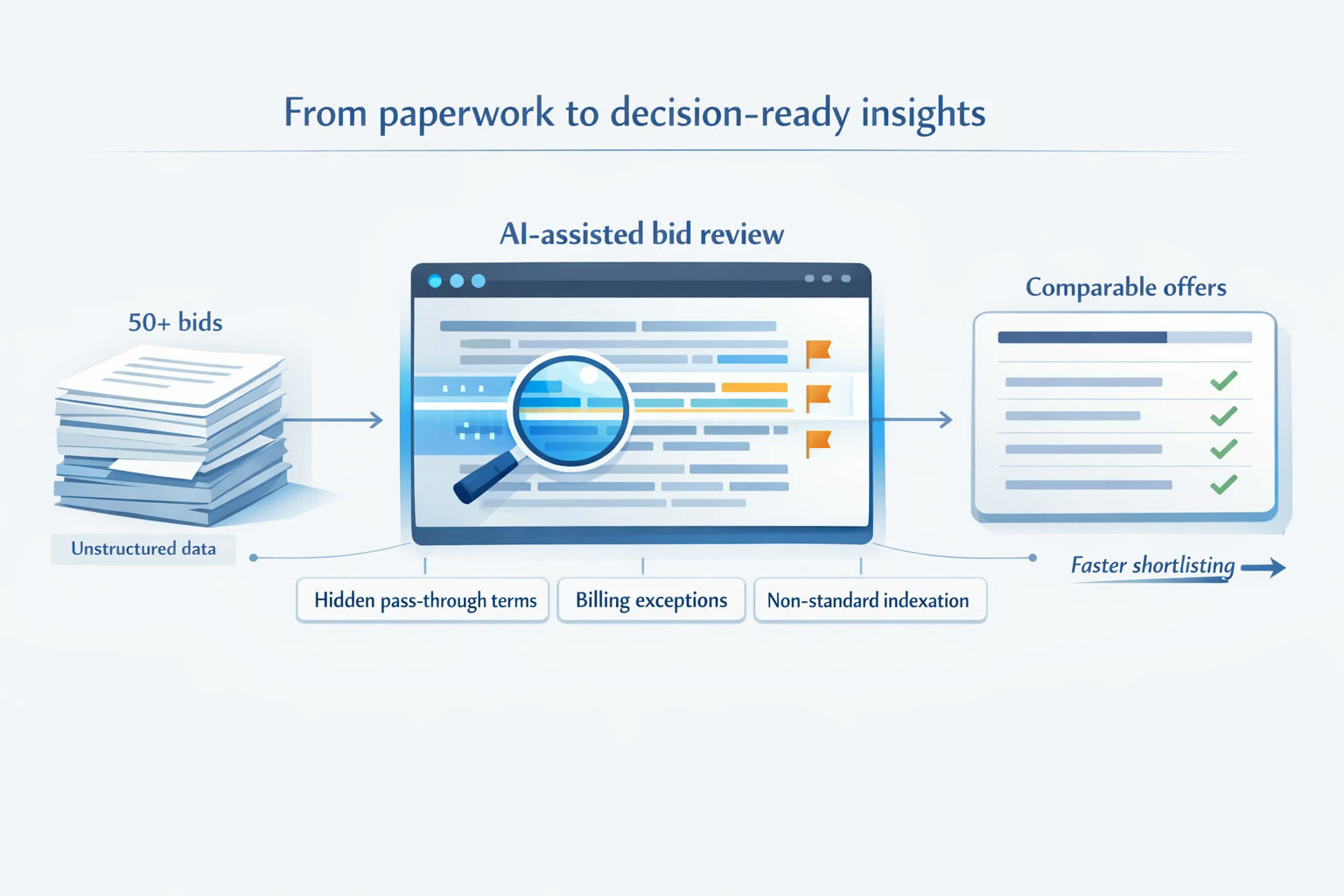
How do you efficiently compare dozens of complex supplier bids, each with unique terminology and structure? The traditional method involves days of manual spreadsheet work, which is prone to human error and often misses subtle but significant risks hidden in the details.
This is where AI-assisted evaluation provides a decisive advantage. Instead of just comparing headline numbers, AI tools can scan unstructured bid documents to identify anomalies, non-standard clauses, and pass-through costs that aren't immediately obvious.
AI-supported evaluation doesn’t replace governance - it strengthens it by turning messy bid documents into comparable offers and surfacing risk markers before you commit.
This data-driven approach allows you to:
Normalize Bids: Compare different supplier proposals on a true like-for-like basis.
Identify Hidden Costs: Flag potential pass-through charges that could inflate a seemingly "fixed" price.
Assess Risk: Pinpoint clauses that deviate from industry standards or introduce unacceptable levels of risk.
By leveraging this technology, you can move faster and with greater confidence, ensuring the contract you sign is the one you actually want. This level of detail is a core part of \[developing robust RFPs for business energy]\() that attract the right partners.
Fixed vs flexible business energy procurement
One of the strategic decisions businesses may need to make is how much price certainty they require and how much market exposure they are prepared to accept. Fixed and flexible procurement approaches address these priorities differently.
What is fixed energy procurement?
A fixed-price approach generally seeks to establish agreed pricing for defined components of the energy contract for a specified period. The principal advantage is greater budget predictability, although the precise degree of certainty depends on which contract components are fixed and which remain variable or pass-through.
Businesses considering a fixed contract should therefore look beyond the product name and identify exactly what the supplier has agreed to fix.
What is flexible energy procurement?
Flexible procurement can allow energy purchasing decisions to be made in stages rather than fixing the relevant commodity exposure at a single point. This may provide greater ability to respond to market conditions, but it can also require stronger governance, purchasing rules and internal tolerance for changing prices.
Neither approach is inherently superior. The appropriate strategy depends on consumption volume, budget requirements, risk appetite, internal expertise and the organisation's wider financial objectives.
For some organisations, the relevant question is therefore not “Which contract is cheapest today?” but “Which procurement structure best reflects how our organisation manages energy price risk?”
When should a business start an energy procurement exercise?
Businesses should avoid treating the contract expiry date as the starting point for procurement. Leaving the process too late can reduce the time available for data validation, market analysis, supplier engagement, bid clarification and contract negotiation.
The appropriate lead time varies according to portfolio complexity, contract structure, number of sites, governance requirements & market conditions. A relatively straightforward single-site procurement may require less preparation than a complex multi-site or public-sector tender.
A useful first step is therefore to work backwards from the existing contract end date and identify the time required for data collection, strategy development, tendering, evaluation, approval and contract execution.
Starting earlier does not necessarily mean purchasing earlier. It gives the organisation more time to make a deliberate decision about when and how to approach the market.
Common business energy procurement mistakes
Many procurement problems begin before suppliers submit their bids. Incomplete consumption data, unclear tender requirements or inconsistent evaluation criteria can make even a competitive market exercise difficult to interpret.
Another common mistake is treating all “fixed” offers as directly comparable without checking what is included. Differences in pass-through treatment, volume provisions, payment terms & other contractual conditions can materially change the commercial outcome.
Businesses can also focus heavily on the initial tender while giving too little attention to implementation and contract management. Supplier onboarding, meter information, billing arrangements, data access & escalation procedures should be established early so that the value expected at award is actually delivered during the contract.
Finally, procurement decisions should be documented. Recording the assumptions, criteria, scores and commercial reasoning behind an award creates accountability and provides useful information for the next procurement cycle.
From sourcing to partnership
Strategic sourcing in 2026 is no longer a simple procurement task. It's a core business function that directly impacts your financial stability, operational resilience, and ESG credentials.
By adopting a modern framework that prioritizes transparency, regulatory alignment, and deep evaluation, you can move beyond reactive price-chasing. You can forge partnerships with suppliers who deliver long-term value and help secure your organisation's future.
If you're ready to implement a sourcing strategy built for the challenges of today's market, our team at Green Light Consultancy Group can help. We provide the expertise and tools to navigate the entire process, from data-driven market analysis to AI-assisted bid evaluation, ensuring you make the most informed decision possible.
Make Energy Procurement Smarter
Build a stronger energy procurement strategy with better sourcing, supplier evaluation and contract risk control. Speak to Green Light Consultancy Group today.