Oops! Something went wrong while submitting the form.
Managing energy for a single business location is straightforward. Managing it for five, ten, or fifty locations is a different challenge entirely. The administrative methods that work for one site quickly break down under the weight of multiple contracts, suppliers, and renewal dates, leading to hidden costs and missed opportunities for savings.
What Is Multi-Site Energy Management?
Multi-site energy management is the coordinated procurement and monitoring of energy across all of a company's locations. Instead of treating each site as an isolated unit, this approach consolidates them into a single portfolio. The goal is to create a unified view of consumption, costs, and contracts, enabling strategic decision-making and control over your total multi site energy spend. This shifts your business from a reactive state of just paying bills to a proactive one of actively managing a significant operational cost.
Effective multi site energy management goes beyond purchasing electricity and gas. It involves centralising contracts, monitoring consumption trends, tracking supplier performance, analysing energy data, and aligning procurement strategies across an entire business estate. Whether a company operates three locations or hundreds, managing energy through a unified portfolio provides greater transparency and operational control.
Businesses that successfully implement multi site energy management are often better positioned to identify inefficient sites, negotiate improved commercial energy contracts, forecast future expenditure, and support wider sustainability initiatives through consistent reporting and monitoring.
What Are Multi Site Energy Contracts?
Multi site energy contracts are commercial agreements that combine multiple business locations under a single procurement strategy. Rather than negotiating separate contracts for each premises, businesses purchase energy collectively, allowing suppliers to assess the organisation's total consumption when preparing quotations.
Depending on the supplier and procurement approach, businesses may operate under a single consolidated agreement or a portfolio of aligned contracts with common renewal dates. Both approaches simplify administration while improving visibility across every location.
For organisations with multiple offices, retail stores, warehouses, hospitality venues, manufacturing facilities, or franchise operations, multi site energy contracts often create stronger buying power than negotiating each site independently. Suppliers may offer more competitive pricing when evaluating the total portfolio rather than individual premises in isolation.
Selecting the right contract structure depends on factors such as the number of locations, annual energy consumption, operational flexibility, and long-term business objectives.
The Challenges of Managing Energy Across Multiple Sites
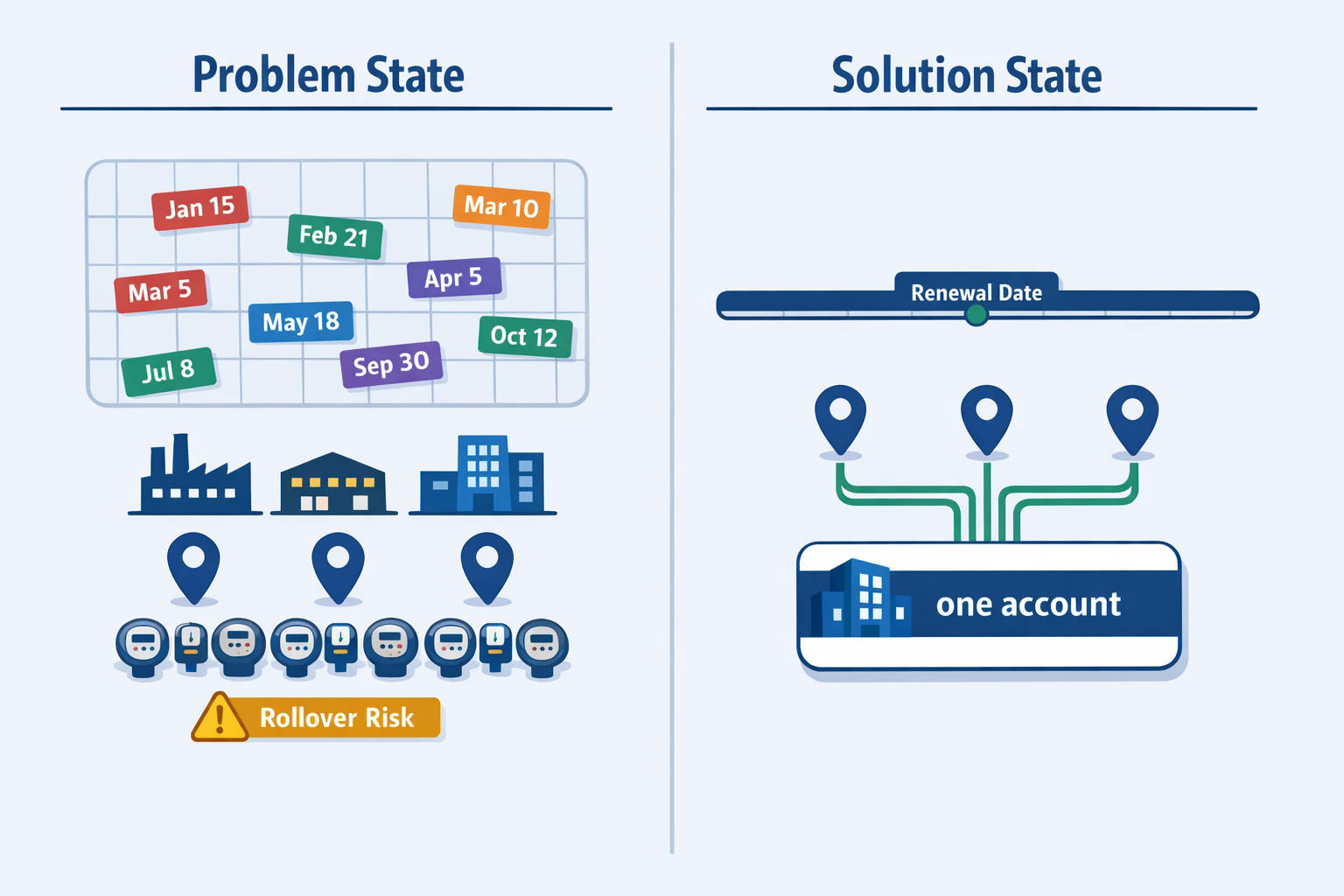
The main challenges are staggered contract end dates, managing multiple suppliers, inconsistent pricing, and a significant administrative load. When each site’s energy is managed independently, inefficiencies multiply, creating complexity that directly impacts your bottom line.
Key difficulties for any business with multiple sites include:
Staggered Contract End Dates: With contracts ending at different times throughout the year, your team is in a constant cycle of procurement. This increases the risk of a site accidentally rolling onto expensive out-of-contract rates if a renewal is missed.
Multiple Suppliers and Meters: Each supplier has a unique billing format, contact process, and data structure. This lack of standardisation makes it nearly impossible to get a clear, comparative view of energy performance across your estate.
Inconsistent Rates: When each site negotiates its own contract, you lose the bulk purchasing power of your entire portfolio. This often results in different sites paying vastly different rates for the same energy.
Heavy Administrative Load: The time your staff spends processing dozens of separate invoices, resolving billing errors with multiple suppliers, and tracking renewal dates is a hidden operational cost. This is time that could be spent on core business functions.
Benefits of Multi Site Energy Management
Although managing multiple business locations introduces additional complexity, adopting a structured multi site energy management strategy offers significant operational and financial advantages.
One of the biggest benefits is improved purchasing power. By combining the energy demand of multiple locations, businesses often strengthen their negotiating position during supplier tenders, creating opportunities to secure more competitive commercial energy pricing.
Administrative efficiency is another major advantage. Consolidated reporting, aligned contract renewals, and standardised supplier communication reduce manual workloads while improving visibility across the entire portfolio. This enables finance and procurement teams to spend less time processing invoices and more time analysing energy performance.
Multi site energy management also supports better decision-making. Centralised consumption data allows businesses to benchmark locations against one another, identify unusually high energy usage, and investigate opportunities for operational improvements or efficiency projects.
For organisations pursuing environmental objectives, portfolio-wide reporting simplifies carbon tracking, sustainability reporting, and renewable energy procurement. Rather than evaluating each location individually, businesses gain a comprehensive view of energy performance across the entire estate, supporting both cost reduction and ESG initiatives.
Single vs Consolidated Multi-Site Energy Contracts
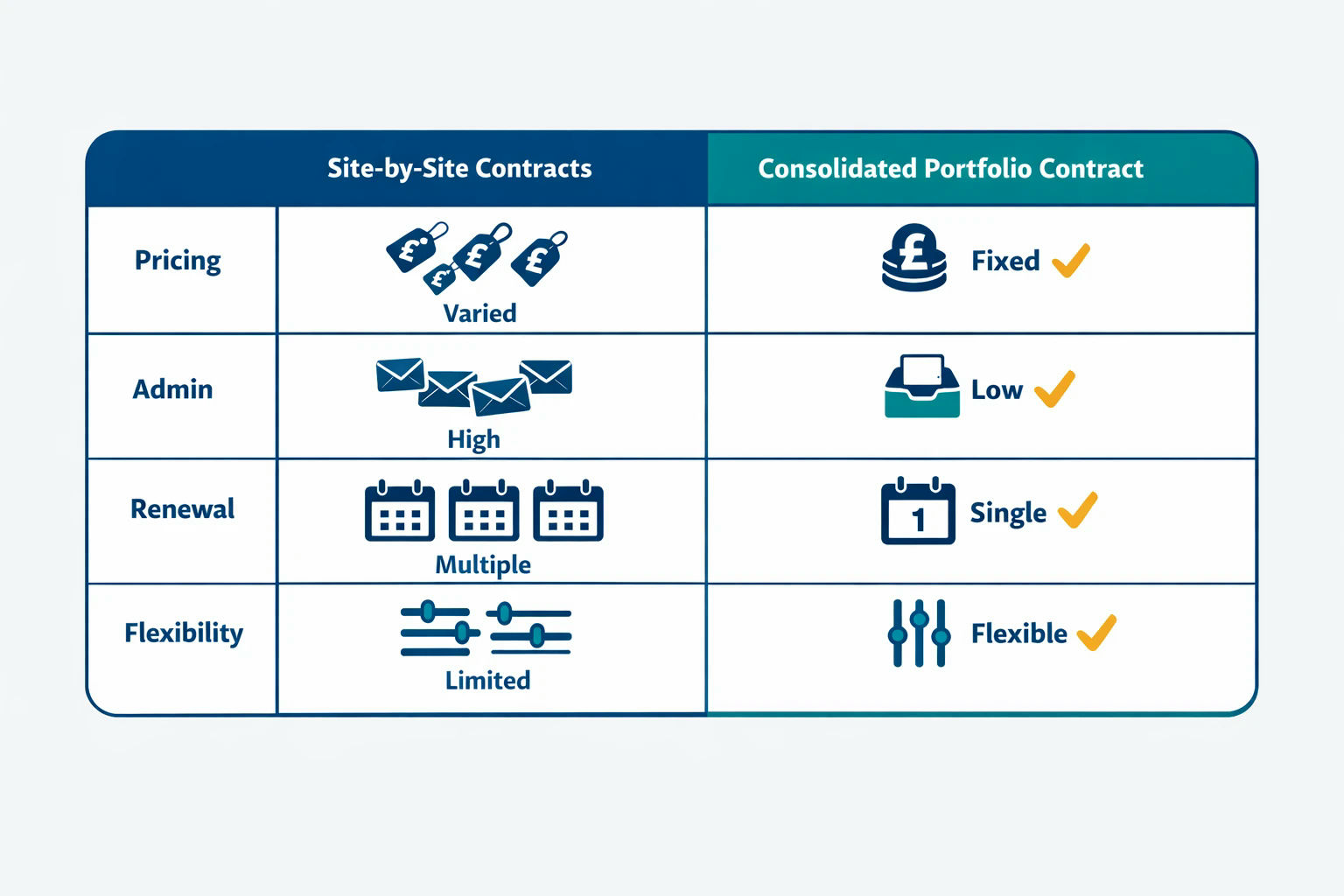
Choosing how to structure yur energy contracts is a critical decision that impacts cost, efficiency, and risk. Most businesses operate with separate, site-by-site contracts simply by default. A consolidated approach, however, offers a strategic alternative built around effective energy portfolio management.
1. Pricing
Separate Site-by-Site Contracts: Negotiated individually for each site; misses out on bulk purchasing power.
Consolidated Portfolio Contract: Leverages the collective volume of all sites to negotiate more competitive rates.
2. Administration
Separate Site-by-Site Contracts: Multiple invoices in different formats from various suppliers; higher administrative burden.
Separate Site-by-Site Contracts: Staggered renewal dates throughout the year create ongoing management requirements.
Consolidated Portfolio Contract: One coordinated renewal strategy reduces procurement complexity.
4. Supplier Management
Separate Site-by-Site Contracts: Multiple supplier relationships require additional communication and reporting.
Consolidated Portfolio Contract: Centralised supplier relationship with a single procurement strategy.
5. Flexibility
Separate Site-by-Site Contracts: Individual sites can select different suppliers or products.
Consolidated Portfolio Contract: Portfolio decisions are made collectively across multiple locations.
Neither approach is universally better. Businesses with only a handful of independent locations may benefit from retaining separate agreements, particularly if sites have very different operational requirements. However, organisations managing larger estates often find that consolidated contracts improve purchasing power, reduce administration, and strengthen long-term energy portfolio management.
When Should a Business Consolidate Multiple Sites?
Not every organisation needs a consolidated energy portfolio immediately. However, as businesses expand, the advantages of multi site energy management become increasingly significant.
Consolidation is often worth considering when a business operates three or more commercial locations, particularly if contracts have been negotiated independently over several years. At this stage, duplicated administration, inconsistent pricing, and staggered renewals frequently begin outweighing the flexibility of separate agreements.
Businesses experiencing rapid growth through acquisitions, franchising, or opening new branches also benefit from reviewing their procurement strategy. Bringing new locations into a coordinated energy portfolio helps establish consistent supplier relationships while improving visibility across the organisation.
Retail chains, hospitality groups, healthcare providers, manufacturers, logistics companies, and organisations with regional office networks are among the businesses most likely to benefit from consolidated multi site energy contracts because of their larger purchasing volumes and ongoing procurement requirements.
Building a Corporate Energy Management Strategy
Building a corporate energy management strategy involves shifting from reactive bill payment to a proactive system of data collection, analysis, and strategic procurement. It transforms energy from an uncontrollable expense into a managed asset. A successful strategy is built on visibility and control.
The first step is centralising your data. This means gathering every contract, bill, and meter number for all locations into a single system. With this complete view, you can benchmark sites against one another to identify high-consumption outliers or operational inefficiencies. From there, you can set clear, measurable goals, whether it's reducing overall spend by 10% or sourcing a higher percentage of renewable energy. This data-driven foundation is essential for making informed purchasing decisions for your entire portfolio.
Technology That Supports Multi Site Energy Management
Modern technology plays an increasingly important role in successful multi site energy management. Digital monitoring tools provide businesses with real-time visibility into energy consumption, allowing procurement teams to make faster, more informed decisions.
Smart meters automatically collect accurate consumption data while reducing reliance on estimated billing. For larger commercial premises, half-hourly meters provide even greater detail by recording electricity usage throughout the day, making it easier to identify unusual consumption patterns and operational inefficiencies.
Energy management software brings information from multiple suppliers and locations into a single dashboard. Instead of manually reviewing dozens of invoices, businesses can monitor portfolio performance, generate automated reports, compare locations, and identify opportunities for cost reduction from one central platform.
Many organisations also integrate automated alerts into their reporting systems. These notifications highlight unusual consumption, approaching contract renewal dates, or billing anomalies before they develop into larger financial issues. Combined with regular portfolio reviews, technology provides the visibility needed to support long-term commercial energy management.
How to Consolidate and Manage Multi-Site Energy
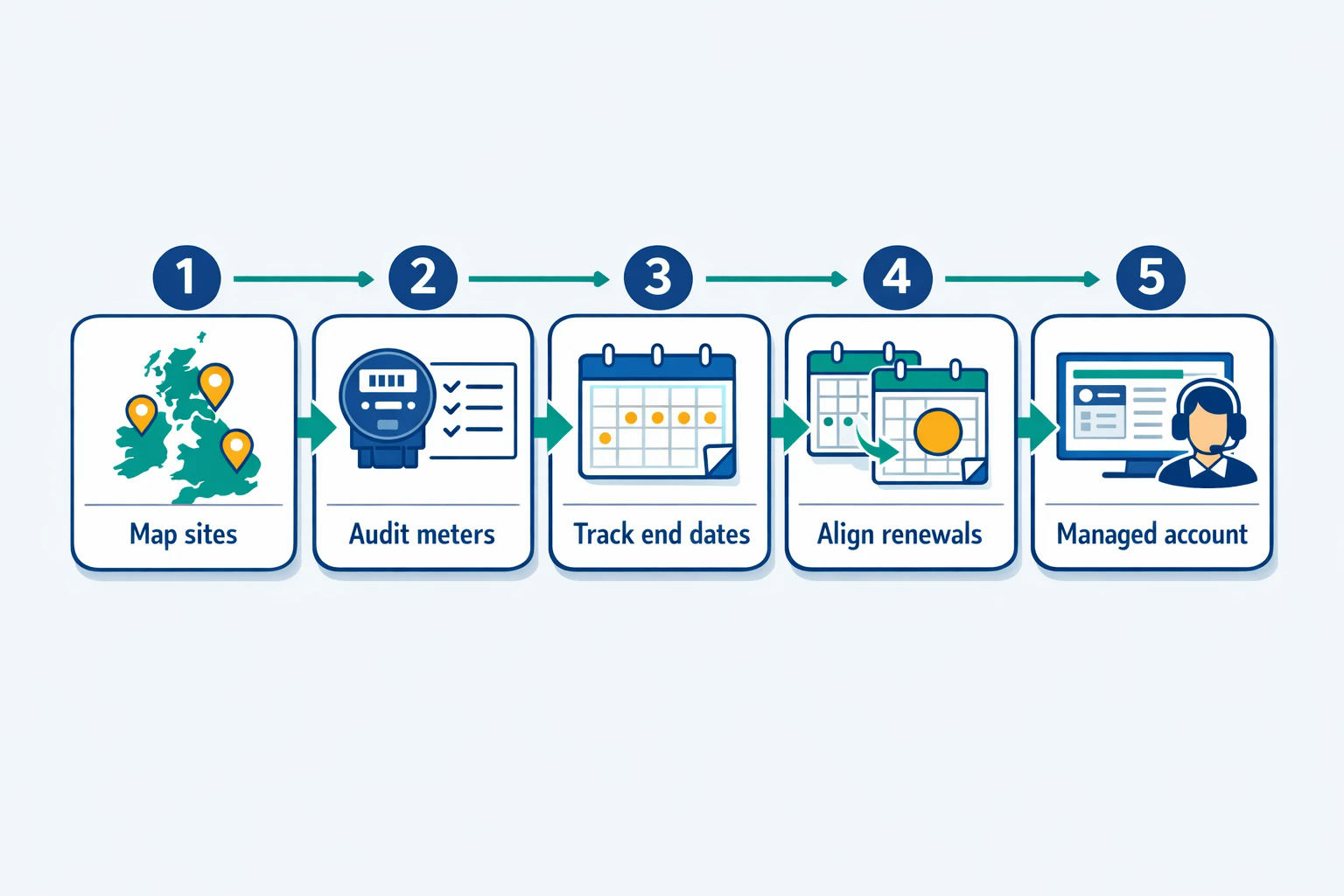
Consolidating multi-site energy follows a structured process of auditing current contracts, aligning them to a single end date, and managing them as a unified portfolio. This systematic approach eliminates the chaos of staggered renewals and creates a clear path to lower costs and reduced administrative work.
Follow these steps to bring all your business locations under one manageable plan:
Map Every Site and Contract: Begin by creating a complete inventory. List every business location and its associated meter point administration numbers (MPANs for electricity, MPRNs for gas). Alongside each meter, document the current supplier and, most importantly, the exact contract end date. This audit creates the "single source of truth" for your entire energy portfolio.
Align Renewal Dates: The core of consolidation is creating a Common End Date (CED) for all your contracts. This often requires short-term contract extensions for some sites to bring them all into the same renewal window. An energy consultant can manage this process to ensure no site is left vulnerable.
Procure as a Single Portfolio: Once all sites are aligned, you can take the entire portfolio to the market at once. Tendering your collective energy volume gives you significant purchasing power, attracting more competitive bids from suppliers than any single site could achieve on its own.
Consolidate Under a Managed Account: After selecting a supplier, all sites are grouped under one managed account. This provides a single point of contact for all billing queries and operational issues, drastically cutting down on administrative time.
Secure Ongoing Support: A dedicated account manager should provide continuous support throughout the life of the contract. They will monitor the market for you, handle supplier relationships, and proactively manage the next renewal cycle well in advance, ensuring you never miss a deadline.
By transforming a collection of separate contracts into a single, managed portfolio, you gain the clarity and control needed to make strategic energy decisions.
Common Mistakes in Multi Site Energy Management
Even businesses with experienced procurement or facilities teams can lose money when multi site energy management is handled reactively instead of strategically. As organisations expand, small administrative oversights often become significant financial risks across an entire portfolio.
Missing Contract Renewal Dates
One of the most common mistakes is allowing individual contracts to expire without arranging a replacement. This can result in sites being placed onto expensive out-of-contract or deemed rates, increasing costs until a new agreement is secured. Maintaining a central contract register with automated renewal reminders helps minimise this risk.
Maintaining Incomplete Meter Records
Businesses operating multiple sites often inherit additional MPANs and MPRNs through acquisitions, relocations, or new developments. If these records are incomplete or inaccurate, supplier quotations, billing validation, and portfolio reporting become much more difficult.
Using Multiple Suppliers Without a Procurement Strategy
While different suppliers may occasionally suit different operational requirements, allowing each location to negotiate independently often reduces purchasing power and creates inconsistent pricing across the organisation. A coordinated procurement strategy provides greater visibility and stronger negotiating leverage.
Focusing Only on Unit Rates
The cheapest unit price does not always represent the lowest overall energy cost. Contract length, pass-through charges, renewal clauses, supplier service levels, billing accuracy, and administrative efficiency all contribute to the total cost of ownership.
Ignoring Energy Performance Data
Collecting energy data without analysing it limits the value of multi site energy management. Regularly reviewing consumption trends, benchmarking locations, and investigating unusual usage patterns allows businesses to identify operational improvements and reduce unnecessary energy spend.
If your business is ready to move beyond the complexity of managing multiple sites individually, exploring professional business energy services is a logical next step. An independent consultancy like Green Light Consultancy Group can provide the expertise to map your portfolio, align your contracts, and unlock the savings that come with a unified strategy.
Take Control of Your Multi-Site Energy Costs
Simplify your energy management with expert support. We can help align contracts, reduce administration, and identify savings across your business locations.