Oops! Something went wrong while submitting the form.
UK manufacturers have lived with some of the highest commercial electricity prices in Europe for years. For energy-intensive sites, energy costs can be the difference between a successful business and a loss-making one, and that pressure has been a major driver behind government plans to reindustrialise British manufacturing.
The government's response is theBritish Industrial Competitiveness Scheme (BICS), a new electricity cost relief scheme for manufacturers, with a tight application window opening this autumn. If your business runs energy-intensive manufacturing operations, this is a scheme worth understanding now as applications open on the 1st of October 2026 and close on the 30th of November 2026.
What is the British Industrial Competitiveness Scheme (BICS)?
The British Industrial Competitiveness Scheme (BICS)is a scheme run by the Department for Business, Innovation, Science and Trade (formerly BEIS/DBT) designed to reduce electricity costs for eligible manufacturers from 2027 onwards. It targets manufacturing "frontier industries" within the government's Industrial Strategy growth sectors, together with the foundational manufacturing industries that supply important inputs into those frontier sectors.
In practical terms, BICS works by exempting eligible businesses from paying the indirect costs of three existing electricity policy schemes:
These are costs that currently sit on every industrial electricity bill to fund renewable generation and grid capacity. For a high-usage manufacturing site, removing them can add up to a meaningful saving.
How much could your business save?
Government guidance estimates BICS could reduce electricity costs by up to £40 per megawatt hour for the most energy-intensive, eligible manufacturing sites. This is described in official guidance as an indicative figure, the real number depends on how much of your site's electricity use is tied to eligible manufacturing activity.
Here's more information on what your business could save as it isn't a flat discount for every applicant:
Sites that manufacture only eligible products can qualify for a full exemption from the RO, FiT and CM costs, subject to verification.
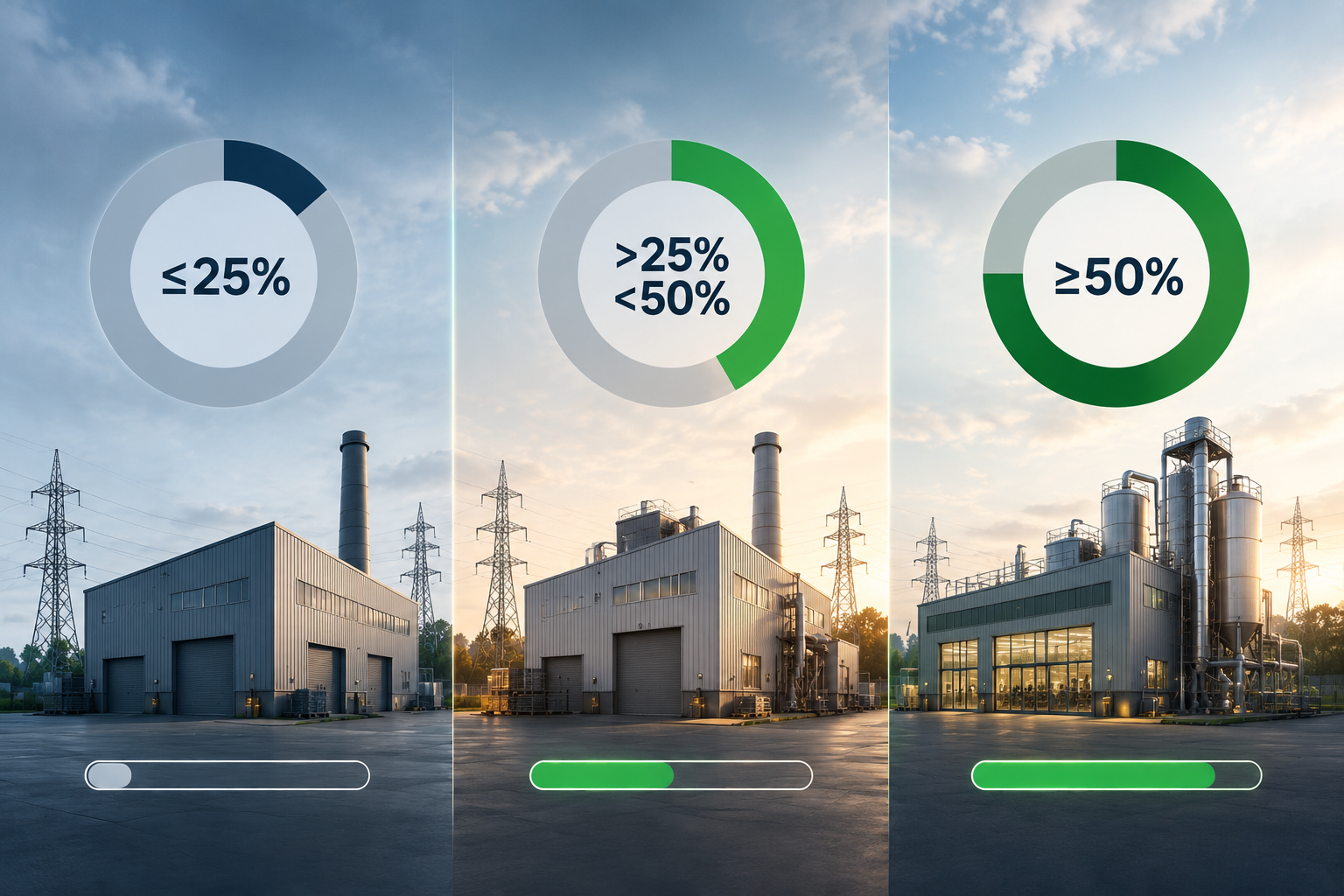
Sites that manufacture a mix of eligible and ineligible products receive a pro-rated exemption based on the proportion of grid electricity used for eligible activity:
Proportion of electricity used for eligible manufacturing
Exemption level
25% or less
0%
More than 25% but less than 50%
50%
50% or more
100%
So, a site where eligible production accounts for, say, 60% of electricity use would receive a full exemption on that site's RO/FiT/CM costs, while a site sitting just under the 25% threshold would receive none. Getting this calculation right, with proper supporting evidence, is crucial to maximising what you can claim.
It's also worth noting that businesses already receiving support under the British Industry Supercharger scheme can apply for BICS too, but cannot claim relief for the same electricity twice.
Does your business qualify?
BICS eligibility is not just a SIC-code lookup. There are four criteria, and your business must meet all of them.
1. Be registered on Companies House Straightforward for most limited companies, but if your registration is less than six months old, expect additional enquiry.
2. Operate in an eligible sector Eligible sectors are defined by 4-digit SIC 2007 codes, covering manufacturing frontier industries within the IS-8 and qualifying foundational manufacturing industries that pass a sectoral electricity-intensity threshold. Your business needs at least one eligible SIC code registered with Companies House, and it must genuinely reflect what you do on site.
3. Manufacture an eligible product This is assessed separately, using 6-digit Harmonised System (HS) codes. You don't need to import or export anything, you simply need to demonstrate that eligible products are manufactured at the site claiming support.
4. Meet the electricity usage threshold Each manufacturing site must use at least 33 MWh of grid-supplied electricity per year (evidenced as more than 16.5 MWh across a six-month period). Only grid electricity counts, power from on-site solar, CHP or wind generation is excluded from the calculation.
The reason we stress "not SIC-code-only" is that criteria 2 and 3 are assessed
independently. A business can have the right SIC code and still fail if its actual products don't match an eligible HS code, or vice versa. Sites with shared meters, landlord billing arrangements, or private wire supply face additional evidence requirements too.
Key dates and the application window
The application window is tight, and there's no room for error in your application.
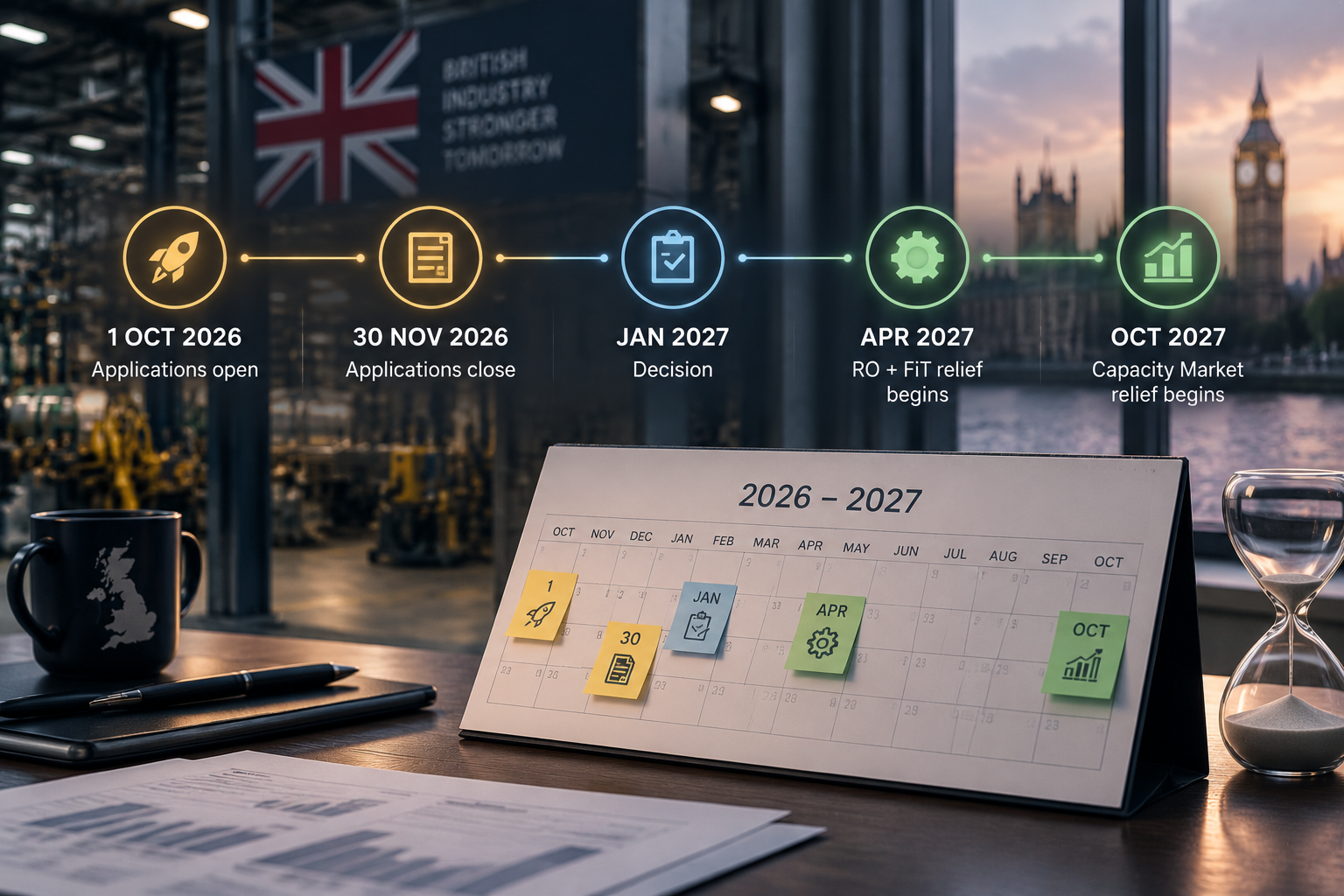
Applications open on the 1st of October 2026
Application window closes on the 30th of November 2026
Business will be notified of eligibility decisions in January 2027
Exemptions from RO and FiT costs begin in April 2027
Exemption from Capacity Market costs begin in October 2027
Applications only have an eight-week application window, and government guidance makes it clear that applications cannot be amended once submitted. There's also only one application per legal entity per year, though a single application can cover multiple manufacturing sites.
What you need to do now
With roughly a month before applications open, we recommend the following process:
Check your likely eligibility using the government's online eligibility checker, it gives an initial indication, though final eligibility is only confirmed after a full application.
Gather your evidence early. You'll need six consecutive months of electricity bills (from within the last 12 months) for each site, Meter Point Administration Numbers (MPANs), and details of what's manufactured at each location.
Work out your pro-rating position. If a site produces both eligible and ineligible products, you'll need a defensible method for splitting electricity use between them, sub-metering data where available, or a clearly reasoned estimate where it isn't.
Decide who's submitting the application. The scheme explicitly allows a third party, such as a consultant, to complete and submit the application on a business's behalf, provided a Companies House-registered officer confirms authorisation.
Given the workload, multiple sites, shared meters, pro-rating calculations, evidence packs, many manufacturers, particularly those with several sites, will want a second pair of hands well before the October deadline.
How Green Light Consultancy Group can help
This is exactly what Green Light Consultancy Group can assist with. The evidence BICS requires, historic electricity bills, MPAN records, site-level consumption data, is the same information we already work with every day for our clients' energy contracts and cost management.
We can support you with:
An eligibility review across all your SIC codes, product lines and manufacturing sites, checking whether you meet all four criteria before you commit time to a full application.
Evidence gathering and pro-rating calculations, pulling together six months of bills, MPAN data and a defensible methodology for splitting eligible and ineligible electricity use.
End-to-end application management, submitting on your behalf as an authorised third party, so nothing is missed before the application window closes.
With an eight-week window and no ability to amend a submitted application, the businesses that benefit most from BICS will be the ones who start preparing now.
Book a BICS eligibility reviewwith Green Light Consultancy Group today and make sure you're ready to apply the moment the window opens on 1 October 2026.
Check Your BICS Eligibility Before Applications Close
Discover if your manufacturing business qualifies for the British Industrial Competitiveness Scheme (BICS). Get expert support with eligibility checks, evidence preparation and your application before the deadline.