Oops! Something went wrong while submitting the form.
Business utility budgeting has become significantly more complex in 2026. Rising network charges, new regulatory levies, and increasing operational costs mean businesses can no longer rely on supplier switching alone to control expenditure. A strategic utility budget must account for energy, water, telecommunications, and payment processing costs while forecasting future market changes.
UK businesses can no longer control utility costs by chasing the lowest unit rate. More than 60% of a typical electricity bill now comes from network charges and government levies, not energy itself. This guide explains how to budget accurately and avoid cost shocks.
For years, the standard advice for managing business utility costs has been simple: shop around for the lowest unit rate. In 2026, that strategy is not just outdated; it actively increases budget risk. Industry forecasts show that non-commodity charges now account for over 60% of an average UK business electricity bill, up from around 45% in 2021.
This guide provides a defensible budgeting framework that separates commodity and non-commodity costs and supports board-level financial planning for the 2026 to 2027 period.
Why is the traditional utility budget model no longer reliable?
Because energy prices are no longer the main driver of total utility spend. Structural charges, regulatory costs, and levies now introduce more volatility than wholesale energy markets.
The UK energy market has fundamentally changed. The price paid for the actual electricity or gas, known as the commodity cost, is no longer the primary driver of the final bill. The majority of volatility now sits in regulated and semi-regulated charges that sit outside supplier control.
These non-commodity charges now require explicit forecasting:
Transmission Network Use of System (TNUoS): Charges for transporting electricity across the national transmission network.
Distribution Use of System (DUoS): Charges for delivering electricity from regional networks to business premises.
Balancing Services Use of System (BSUoS): Charges applied by National Grid Electricity System Operator, the organisation responsible for balancing supply and demand in real time.
Nuclear Regulated Asset Base (RAB) Levy: A government levy introduced in late 2025 to fund the construction of Sizewell C nuclear power station, often omitted from early supplier quotes.
Ignoring these charges is equivalent to building a logistics budget that includes packaging costs but excludes freight, fuel surcharges, and customs fees. The result is predictable budget failure.
What is integrated utility planning?
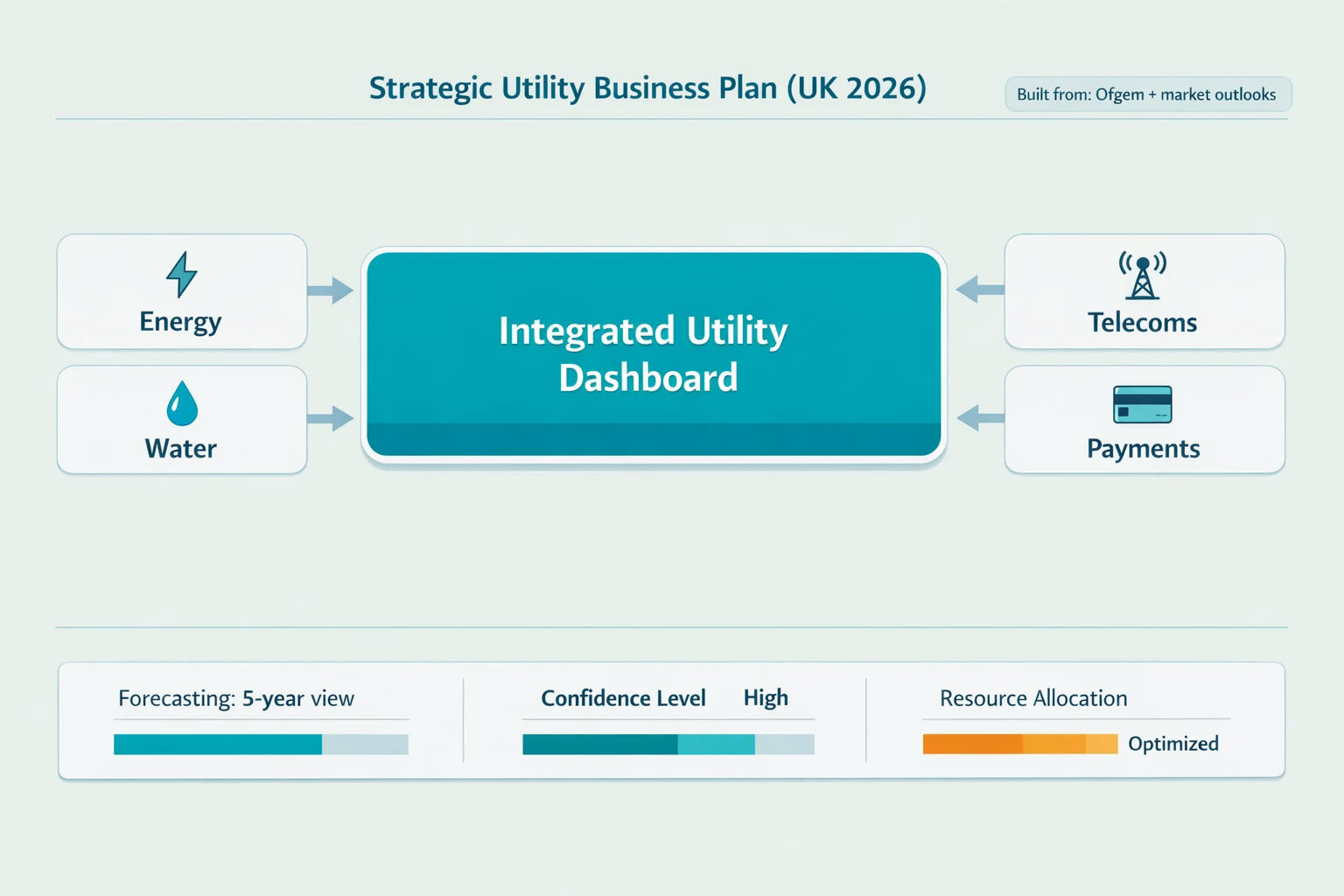
Integrated utility planning is the process of managing energy, water, telecoms, and payment services as a single financial system rather than separate operational expenses. Instead of budgeting for each utility independently, businesses create a unified framework that improves forecasting accuracy, identifies cost interactions, and supports long-term financial planning.
For UK businesses in 2026, integrated utility planning has become increasingly important as non-commodity energy charges, water market changes, telecoms infrastructure investments, and payment processing costs all contribute to overall operating expenditure. A consolidated approach provides greater visibility over total utility spend and reduces the risk of unexpected budget increases.
The most effective integrated utility planning strategies combine procurement, forecasting, cost allocation, and performance monitoring into a single budgeting process, creating a more resilient financial model.
What is the 4-pillar framework for integrated utility planning?
The 4-pillar framework combines energy, water, telecoms, and payment services into a single financial model, enabling accurate forecasting and consistent cost control across all utilities.
To gain control through integrated utility planning, utilities must be treated as a unified cost system rather than isolated contracts.
Pillar 1: Energy (electricity and gas)
The objective is to model non-commodity exposure explicitly. This requires invoice-level visibility that separates unit rates from regulated charges. Understanding how and when charges such as TNUoS apply enables strategies like load shifting, which reduces costs without switching suppliers.
A resilient energy budget also includes forward planning forbusiness gas contracts, which remain exposed to wholesale volatility but still interact with network costs.
Pillar 2: Water
The English non-household water market is deregulated, allowing supplier choice but introducing regional wholesale price variation. A robust budget accounts for wholesale charge changes and includes regular billing audits, as water invoices remain one of the most error-prone utilities.
Telecoms are a core operational utility, not a discretionary service. Full-fibre broadband and 5G connectivity directly affect productivity, downtime, and system resilience.
A modern telecoms budget models return on investment, not just monthly line rental. Reliable connectivity reduces outages, supports cloud infrastructure, and enables scalable growth.
Pillar 4: Payment services
Payment processing introduces incremental margin erosion through interchange fees, a phenomenon often referred to as interchange fee creep. These fees are set by card schemes and adjusted periodically, increasing costs without visible contract changes.
A strategic utility plan includes regular audits of payment service providers to maintain transparency and ensure rates remain competitive.
What is the 4-pillar framework for integrated utility planning?
The 4-pillar framework combines energy, water, telecoms, and payment services into a single financial model, enabling accurate forecasting and consistent cost control across all utilities.
To gain control through integrated utility planning, utilities must be treated as a unified cost system rather than isolated contracts.
Pillar 1: Energy (electricity and gas)
The objective is to model non-commodity exposure explicitly. This requires invoice-level visibility that separates unit rates from regulated charges. Understanding how and when charges such as TNUoS apply enables strategies like load shifting, which reduces costs without switching suppliers.
A resilient energy budget also includes forward planning for business gas contracts, which remain exposed to wholesale volatility but still interact with network costs.
Pillar 2: Water
The English non-household water market is deregulated, allowing supplier choice but introducing regional wholesale price variation. A robust budget accounts for wholesale charge changes and includes regular billing audits, as water invoices remain one of the most error-prone utilities.
Telecoms are a core operational utility, not a discretionary service. Full-fibre broadband and 5G connectivity directly affect productivity, downtime, and system resilience.
A modern telecoms budget models return on investment, not just monthly line rental. Reliable connectivity reduces outages, supports cloud infrastructure, and enables scalable growth.
Pillar 4: Payment services
Payment processing introduces incremental margin erosion through interchange fees, a phenomenon often referred to as interchange fee creep. These fees are set by card schemes and adjusted periodically, increasing costs without visible contract changes.
A strategic utility plan includes regular audits of payment service providers to maintain transparency and ensure rates remain competitive.
How can Activity-Based Costing improve utility budgeting?
Activity-Based Costing assigns utility costs to the departments, products, or locations that consume them, turning utilities from a vague overhead into an auditable financial model.
When utilities are treated as a single overhead, cost increases are difficult to explain or justify. Activity-Based Costing (ABC) solves this by allocating costs based on actual consumption drivers.
Examples include:
Manufacturing:Electricity costs allocated directly to individual production lines and reflected in cost of goods sold.
Retail: Total utility cost per square foot compared across locations for performance benchmarking.
Office environments: Energy, telecoms, and payment costs allocated by department using headcount and usage metrics.
This approach transforms utility budgeting into a transparent financial control system, making it easier to justify increases, identify inefficiencies, and support investment decisions.
What risks should businesses check before finalising a 2026 utility budget?
Before renewal, businesses should validate that all major non-commodity charges, levies, and contract risks are explicitly modelled and documented.
2026 Utility Risk Registry
Non-Commodity Cost Separation Have commodity and non-commodity costs been forecast as separate line items? Mitigation: Use suppliers or advisors that provide fully itemised cost breakdowns.
Nuclear RAB Levy Inclusion Is the Nuclear RAB Levy included in 2026/27 electricity forecasts? Mitigation: Require written confirmation that all current and upcoming levies are included in quotes.
Deemed Rate Exposure What is the cost impact if contracts expire without renewal? Mitigation: Implement a renewal calendar with alerts set 9 to 12 months in advance.
TNUoS Peak Demand Risk (Large Users) Has exposure to peak transmission charges been modelled? Mitigation: Analyse half-hourly data and implement load-shifting strategies.
Multi-Utility Fragmentation Are energy, water, and telecoms budgets managed separately? Mitigation: Consolidate utilities under a single strategic framework to align renewals and improve negotiating leverage.
How should businesses approach utility strategy in 2026?
UK businesses must move from price comparison to integrated utility planning and structured financial forecasting.Separating cost types, integrating utilities, and allocating spend accurately are now essential for budget stability.
The UK utility landscape in 2026 rewards forecasting discipline, transparency, and integration. Businesses that continue to chase unit rates will face recurring budget shocks, while those that adopt structured planning gain predictability and control.
At Green Light Consultancy Group, we help businesses build auditable, forward-looking utility strategies that stand up to scrutiny. Our approach focuses on clarity, accuracy, and human support in an increasingly complex market.
Plan ahead with a clear utility budgeting framework that forecasts energy, water, telecoms, and payment costs while helping you manage non-commodity charges and avoid unexpected budget shocks.