Oops! Something went wrong while submitting the form.
A business electricity meter is the device that records how much power your premises use, measured in kilowatt hours (kWh), and it is the basis for every electricity bill your supplier sends you. It matters more than most owners realise. Your meter type decides which tariffs you can access, whether your bills are accurate or estimated, and how much leverage you have when your contract comes up for renewal.
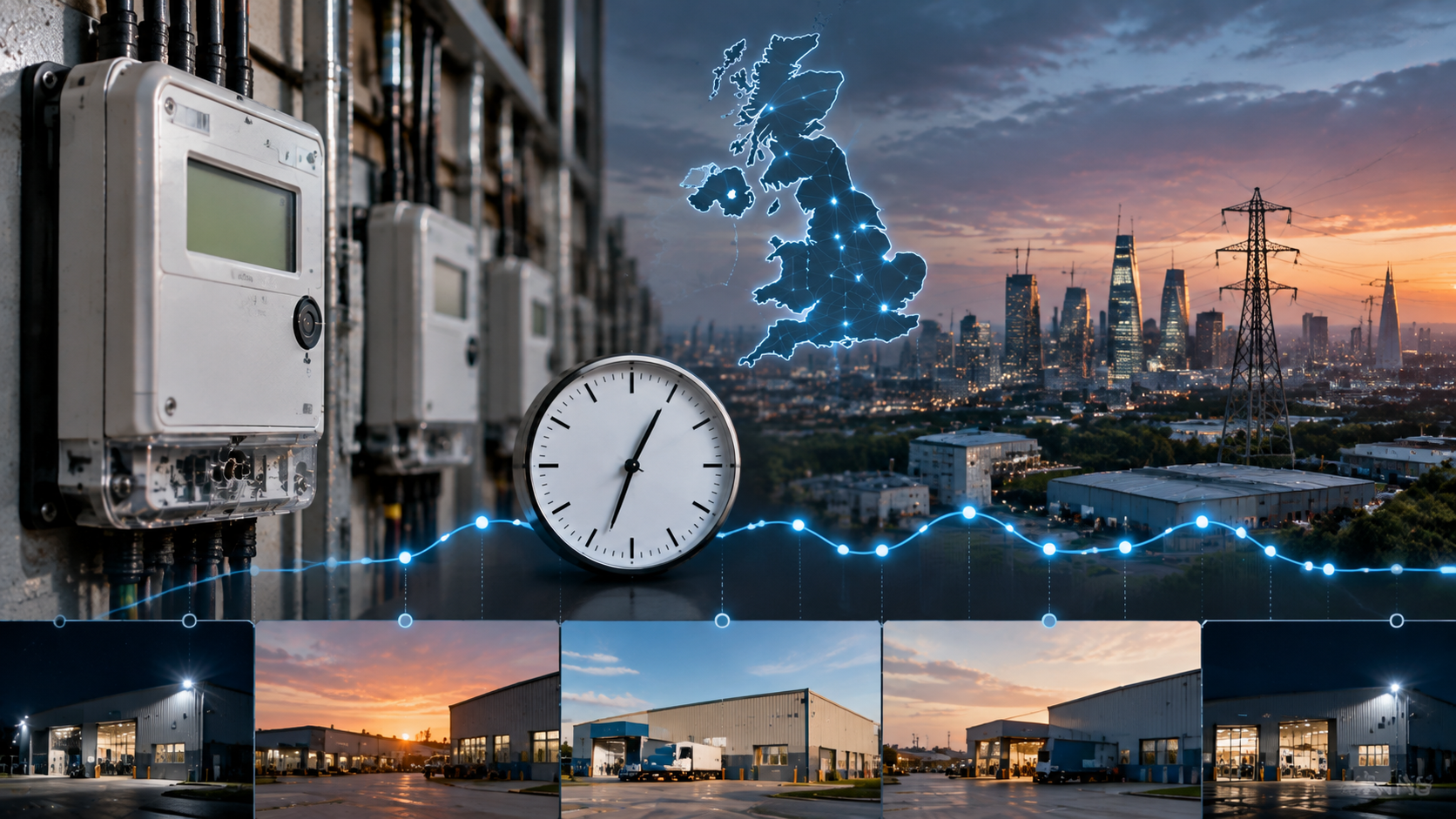
It matters even more in 2026, because Britain is partway through the biggest metering change since the 1990s. Under Market-wide Half-Hourly Settlement, every electricity meter in the country will record usage in 30 minute intervals by May 2027. This article explains the meter types, what installation actually costs, and how your meter shapes what you pay.
Ready to act rather than read? If your bills are estimated, your meter is decades old, or your contract is up for renewal, compare business electricity rates with our team and we will review your metering alongside your contract.
What is a business electricity meter?
A business electricity meter, sometimes called a commercial electricity meter, measures the electricity your premises draw from the grid. Your supplier uses its readings to calculate your bill, and the industry uses the same data to settle what your supplier owes for the power you consumed.
You can tell which category your meter falls into from your MPAN, the supply number printed on your bill. The first two digits are your profile class, and that classification shapes the business electricity rates you are quoted.
Commercial meters differ from domestic ones in a few practical ways. Larger premises often run three-phase supplies rather than the single-phase found in homes. High-consumption sites may need current transformer metering and can be charged for reactive power, which is drawn by equipment like motors and compressors but does no useful work. None of this applies to a house, which is why a business meter is not just a household meter on bigger premises.
Why does your electricity meter matter?
Because everything downstream of it depends on its data. Four things in particular:
Accurate billing. A working, properly read meter means you pay for what you used. An old meter with no communications means estimated bills, and estimates drift. We have seen businesses build up large credits and equally large surprise debts purely from years of estimated reads.
Usage visibility. You cannot cut consumption you cannot see. Interval data shows you the equipment running out of hours and the baseload that never switches off.
Contract decisions. Suppliers price risk. A business that can show its real usage pattern gets sharper quotes than one asking for a price against guesswork.
Tariff access. Off-peak and time-of-use tariffs only exist for meters that can record when power was used.
The pattern to notice: a restaurant with kitchens and refrigeration running into the night, a warehouse with charging equipment, a nine-to-five office and a small retail shop all use electricity in completely different shapes. The right meter, on the right tariff, prices each shape properly. The wrong one flattens them all into a single average rate that suits nobody.
What types of business electricity meters are there?
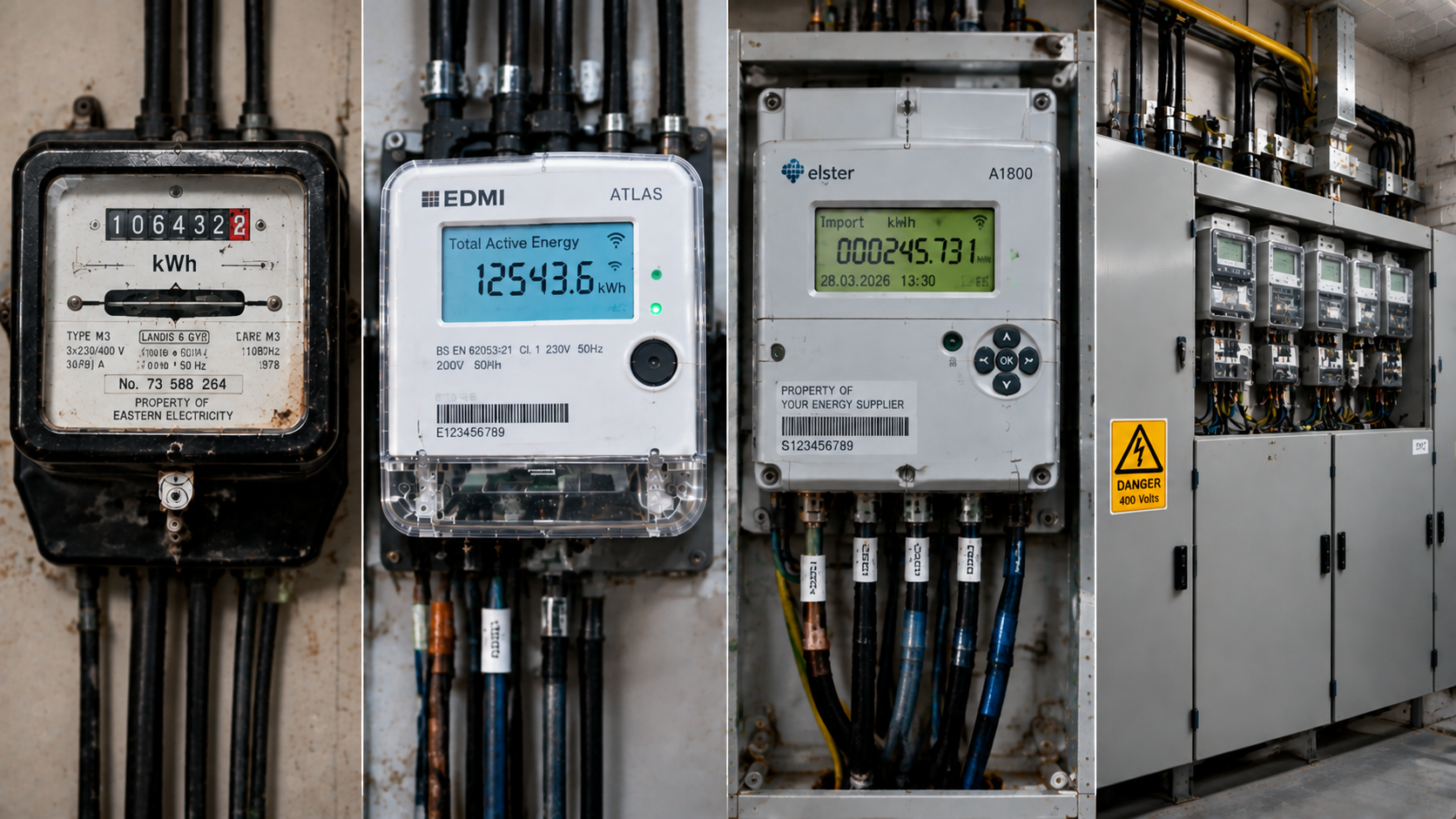
Four main types cover almost every commercial premises in Britain.
Meter type
MPAN profile class
Best suited to
Single rate
03
Businesses with steady daytime usage
Multi rate (Economy 7, Economy 10, evening and weekend)
04
Businesses using significant power off-peak
Half hourly
00, 05 to 08
Larger sites; mandatory above 100 kW demand
Smart meter
Replacing 03 and 04
Small and medium businesses
Single rate meters
The simplest type. One reading, one unit rate, whatever the time of day. Fine for a business with ordinary daytime usage, but it cannot access off-peak pricing, so a business running equipment overnight on a single rate meter is leaving money on the table.
Multi rate meters
These record consumption in two or three time bands, which unlocks cheaper off-peak rates. Economy 7 gives seven off-peak hours, Economy 10 gives ten, and evening and weekend variants suit businesses that trade outside office hours. The trade-off is a higher peak rate, so they only pay off if enough of your usage genuinely sits in the cheap windows.
Half hourly electricity meters
A half hourly electricity meter records usage every 30 minutes and sends the data straight to your supplier automatically. Any site with a maximum demand above 100 kW must have one, and many businesses between 70 kW and 100 kW choose one voluntarily. Half hourly sites are priced individually on their actual usage shape, and they need a meter operator contract to maintain the equipment. For larger businesses, this data is the raw material for serious contract negotiation.
Smart meters for business
Smart meters are the modern replacement for single and multi rate meters in smaller premises. They send readings to your supplier automatically, which ends estimated billing, and they give you near real time visibility of consumption. Suppliers are rolling them out to profile class 03 and 04 businesses, normally at no upfront cost. If your supplier has offered one, there is rarely a good reason to refuse.
A fifth type worth knowing exists: prepayment meters, where credit is loaded before power is drawn. They are mostly found in short-term tenancies or after account debt, and their unit rates are typically higher, so businesses should move off them where possible.
What is Market-wide Half-Hourly Settlement and why does it matter now?
The practical takeaway for businesses is twofold. First, if you still have an old non-communicating meter, your supplier will be contacting you about an upgrade, because the new system needs interval data. Second, once every meter records usage in 30 minute blocks, time-of-use tariffs stop being a big-business product and become available to everyone. Businesses that understand their usage shape will be positioned to benefit. Businesses that ignore their metering will simply be settled on it anyway.
Does installing a new electricity meter reduce your energy costs?
Not by itself, and any article telling you otherwise is selling something. A new meter records your usage. It does not change your unit rate, and the meter is not why business electricity is expensive in the first place.
What better metering gives you is better data, and the savings come from what you do with it. Accurate reads replace estimated bills. Interval data shows where consumption can be cut, and out-of-hours waste is usually the first find. A clear usage profile lets you pick the tariff structure that matches how you actually operate, and it strengthens your hand when negotiating a renewal. The meter is the measuring tool. The savings come from the decisions it makes possible.
When does a business need a new electricity meter?
The common triggers, roughly in order of frequency:
Upgrading to a smart meter as part of the national rollout, or ahead of MHHS migration
Moving into new premises where the existing meter is old, faulty or wrong for your usage
A meter reaching the end of its certified lifespan, typically 10 to 20 years
Rising demand from new equipment, an extension or electric vehicle charging, which can push a site over the 100 kW half hourly threshold
Wanting proper consumption monitoring that an old analogue meter cannot provide
A brand new connection to the grid is a separate process involving your local network operator, and it takes longer than a straight meter swap.
How much does business electricity meter installation cost?
For most small and medium businesses, nothing. Smart meter upgrades are supplier funded as part of the national rollout, replacements for faulty or end-of-life meters are the supplier's responsibility, and suppliers will often install a new meter free when you sign a new fixed contract with them.
Costs appear in two situations. Larger half hourly sites need an appointed meter operator, which can mean an installation charge of a few hundred pounds plus ongoing annual charges for maintenance and communications. And physical work beyond a straight swap, such as relocating a meter or upgrading the supply itself, is chargeable.
On timing: a standard installation is usually booked one to two weeks ahead and takes one to two hours on the day, with power off for around 30 minutes. Plan it for a quiet trading period and the disruption is minimal.
How does your meter affect your business electricity rates?
Three ways, and they compound.
It sets which tariffs you can be quoted. Single rate meters get single rate quotes. Multi rate and smart meters open up off-peak and time-of-use pricing. Half hourly sites are priced individually on their profile.
It shapes your standing charges. Meter type feeds into the fixed daily charges on your bill, and half hourly sites carry additional charges such as meter operator fees and capacity charges based on their agreed supply capacity.
It determines your negotiating position. A supplier quoting against twelve months of half hourly data prices your actual risk. A supplier quoting against an estimated annual figure prices in a margin for uncertainty, and you pay it. This is why we treat metering and contract strategy as one conversation, not two.
What mistakes do businesses make with their meters?
Ignoring an outdated meter. If your meter has no communications, every bill is an estimate and every estimate is a small gamble.
Accepting estimated bills for years. Reconciliation eventually arrives, and it is rarely in your favour. Submit reads or upgrade the meter.
Never looking at the data. Businesses with smart or half hourly meters often have exactly the information needed to cut waste, sitting unopened in a supplier portal.
Signing a contract that ignores the usage shape. An off-peak-heavy business on a flat rate, or a daytime business paying multi rate peak prices, is on the wrong structure regardless of how good the headline rate looked.
Treating energy as a once-every-three-years task. Meters, usage and the market all change. A yearly review takes an hour and routinely pays for itself.
Compare business electricity rates with Green Light
At Green Light Consultancy Group, metering is where our contract reviews start, because the meter tells us how your business actually uses power. We read your consumption data, check whether your meter type and tariff structure match your usage shape, and then benchmark your contract across the whole market. Where a meter upgrade would put you in a stronger position ahead of the MHHS changes, we tell you, and where your current setup is right, we tell you that too.
What type of electricity meter does my business need?
Check the first two digits of your MPAN. Profile class 03 or 04 businesses suit a smart meter, and any site with maximum demand above 100 kW must have a half hourly meter. Between those, the right choice depends on when you use power, which is exactly what a usage review establishes.
Can businesses get free electricity meter installation?
Often, yes. Smart meter upgrades are supplier funded, faulty and end-of-life replacements are the supplier's responsibility, and many suppliers install free as part of a new fixed contract. Half hourly sites pay meter operator charges, and physical supply work is chargeable.
How long does business electricity meter installation take?
Typically one to two weeks to book and one to two hours on site, with power off for around 30 minutes. Half hourly and three-phase installations can take longer to arrange.
Do smart meters save businesses money?
Not automatically. A smart meter ends estimated billing and shows you where power is being used, and the savings come from acting on that: cutting waste, fixing the tariff structure and negotiating renewals with real data.
What is a half hourly electricity meter?
A meter that records consumption every 30 minutes and sends the readings to your supplier automatically. It is mandatory for sites with maximum demand above 100 kW and is priced individually on the site's actual usage profile.
Can changing my electricity meter reduce my bill?
The meter itself does not change your unit rate. What it changes is your access to better-suited tariffs and the quality of data behind your next negotiation, which is where the reduction actually comes from. Green Light reviews both together.